Where to stay in Namibia: distinct territories for luxury travelers
The Namib Desert and Sossusvlei
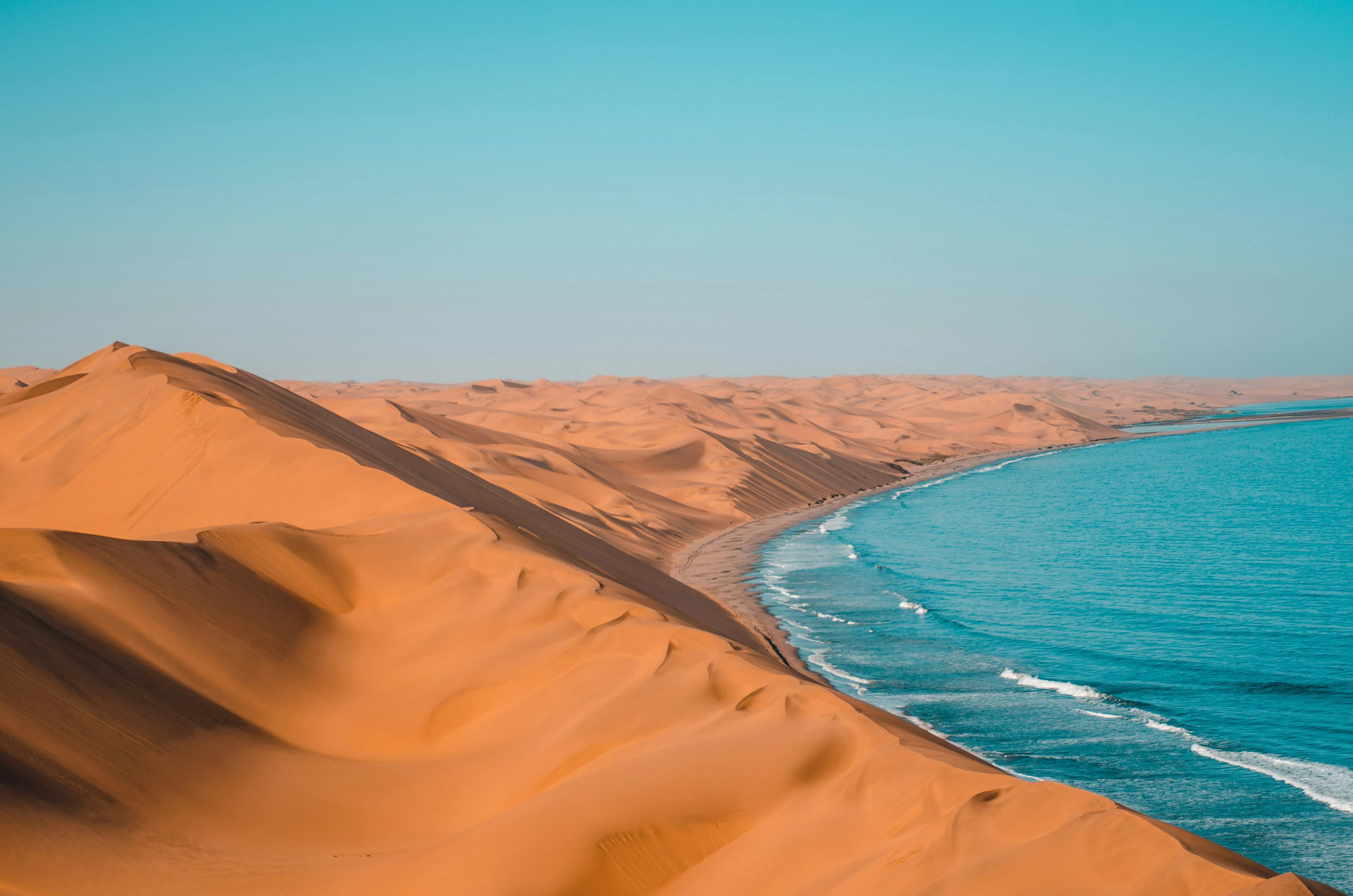
The central desert corridor, anchored by the Sossusvlei dune field in the Namib-Naukluft National Park, is the image most travelers carry into Namibia. Dunes here reach 300 metres in height and shift colour across the day from deep apricot at dawn to near-crimson at midday. Properties in this zone sit either within private concessions bordering the park or on the park's edge, offering exclusive access to the dune system before the general visitor gates open. Suite design in this area tends to reflect the terrain: low profiles, natural materials, and large apertures oriented toward the dune horizon. Privacy is structural, not performative.
Etosha and the northern savanna
Etosha National Park, organised around a vast calcite pan visible from space, is Namibia's primary wildlife destination. The pan itself is largely lifeless, but its perimeter draws extraordinary concentrations of elephant, lion, black rhinoceros, and giraffe, particularly at the floodlit waterholes that remain active through the night. Luxury lodges in this zone position guests within private game concessions adjacent to the park, offering game drives without the density of vehicles found in East African circuits. The northern savanna also extends into the Kunene Region and Damaraland, where desert-adapted elephant and ancient rock engravings at Twyfelfontein (a UNESCO World Heritage Site) add a further layer of interest.
The Skeleton Coast and the Atlantic littoral
Few coastlines on the planet carry the same weight as the Skeleton Coast. Named for the whale and seal bones that once lined its beaches, and for the ships wrecked by unpredictable surf and fog, it remains one of the least-visited stretches of coastline in Africa. Access to the northern sector requires a fly-in permit. The cold Benguela Current drives a marine ecosystem of unusual richness: large Cape fur seal colonies, brown hyena, and desert lion have all been recorded within sight of the ocean. Suite properties here are sparse by design, and their scarcity is part of their value.
The Caprivi Strip and the northeast
The Caprivi Strip (now formally the Zambezi Region) extends east like a narrow corridor, reaching toward Botswana, Zimbabwe, and Zambia. The landscape shifts entirely: tropical floodplains replace desert, and the Okavango and Zambezi river systems support hippo, crocodile, and large elephant herds. For travelers combining Namibia with a broader southern Africa itinerary, this zone offers natural continuity. Suite lodges here typically feature elevated river decks and plunge pools oriented toward water channels, a deliberate inversion of the desert-facing geometry found elsewhere in the country.
When to visit Namibia for a luxury suite experience
Namibia's climate is one of the most consistent on the continent, which simplifies planning considerably. The country receives fewer than 300 millimetres of rainfall annually across most of its territory, and sunshine is near-constant. That said, seasonality still shapes the experience in meaningful ways.
The dry season, running from May through October, is the standard recommendation for wildlife observation. As surface water recedes, animals concentrate around permanent sources, making sightings more predictable and more dramatic. Temperatures are cooler in the early morning and evening, and the desert air is clear. This is also peak season for suite availability, and properties at Sossusvlei and within private Etosha concessions book several months in advance for the July to September window.
The green season, from November through April, transforms the landscape. The Namib's sparse vegetation briefly greens, migratory birds arrive in large numbers, and the dunes take on a different quality of light under cloud cover. Rates at most properties are lower, and the sense of isolation is more complete. The Caprivi Strip, however, can experience flooding that closes certain access routes, so advance planning for that region is essential during this period.
There are no major international luxury events on the scale of Monaco or Cannes that structure the Namibian calendar, which is precisely the point. The luxury here is temporal: the absence of crowds, the predictability of silence, and the ability to have a wilderness area effectively to oneself.
Local luxury standards: what defines a premier suite in Namibia
Namibia does not use the French Palace designation or an equivalent state-endorsed tier. The country's luxury accommodation sector is regulated through the Namibia Tourism Board's grading system, but the most meaningful signal of quality is the private concession model. The finest properties operate on land they lease directly from the Namibian government or from communal conservancies, giving them exclusive access to specific wilderness areas. This exclusivity is the primary luxury differentiator in the Namibian market.
Top-tier suites in Namibia share several characteristics. First, physical separation: villas or tented suites are positioned so that no adjacent unit is visible, preserving the illusion of total solitude. Second, indoor-outdoor continuity: the boundary between suite interior and surrounding landscape is deliberately porous, through sliding walls, open-air bathing areas, and private viewing decks. Third, low environmental footprint by design: solar power, rainwater harvesting, and locally sourced materials are standard at the highest-end properties, and these are not marketed as eco-credentials but as logical responses to operating in a fragile desert ecosystem.
The guided safari model is also central to the experience. Most luxury suite properties include game drives or guided walks led by professional guides who are, in many cases, born and raised in the surrounding region. This local knowledge is not interchangeable with a generic safari operation, and it constitutes a meaningful part of what the suite rate covers. If you are exploring Africa more broadly, understanding this concession-based model is essential to comparing properties across different countries.
How to choose the best suite in Namibia
The primary axis of decision for a Namibia suite is landscape preference. Desert and dune-focused properties are architecturally and experientially distinct from savanna wildlife lodges, which are again distinct from coastal or river-based properties. Very few travelers have enough time to experience all three zones in a single trip, so the first question is whether the priority is geology (dunes, canyon, desert light), wildlife (Etosha, Damaraland), or remoteness (Skeleton Coast, Caprivi).
The second consideration is access. Namibia is large. Driving between zones can require eight or more hours on good roads. Most high-end itineraries rely on light aircraft transfers between regions, and some properties (particularly on the Skeleton Coast) are accessible only by air. Suite rates at fly-in properties do not always include charter flights, which are a significant additional cost and should be factored into the total budget before comparing properties on room rate alone.
Third, consider the level of programming versus solitude. Some luxury properties offer a full daily structure of guided activities, meals, and interpretive experiences. Others are explicitly designed for guests who wish to be left entirely undisturbed, with suite infrastructure scaled for independent use. Namibia's scale and silence make it one of the few destinations where complete, unscheduled solitude is genuinely available.
Why a curated selection matters in Namibia
With only eight properties listed on La Suite for Namibia, the curation here is intentional and tight. The country has dozens of lodges that market themselves as luxury, but the gap between the top tier and the rest is wide in practice: it shows up in guide quality, in the condition of suite infrastructure, in the calibre of the food program, and above all in the integrity of the wilderness access. The La Suite curated selection by La Suite identifies only those properties where the suite experience is genuinely commensurate with the landscape it occupies. In a country where the landscape is the entire reason for the journey, that alignment is the only standard that matters.