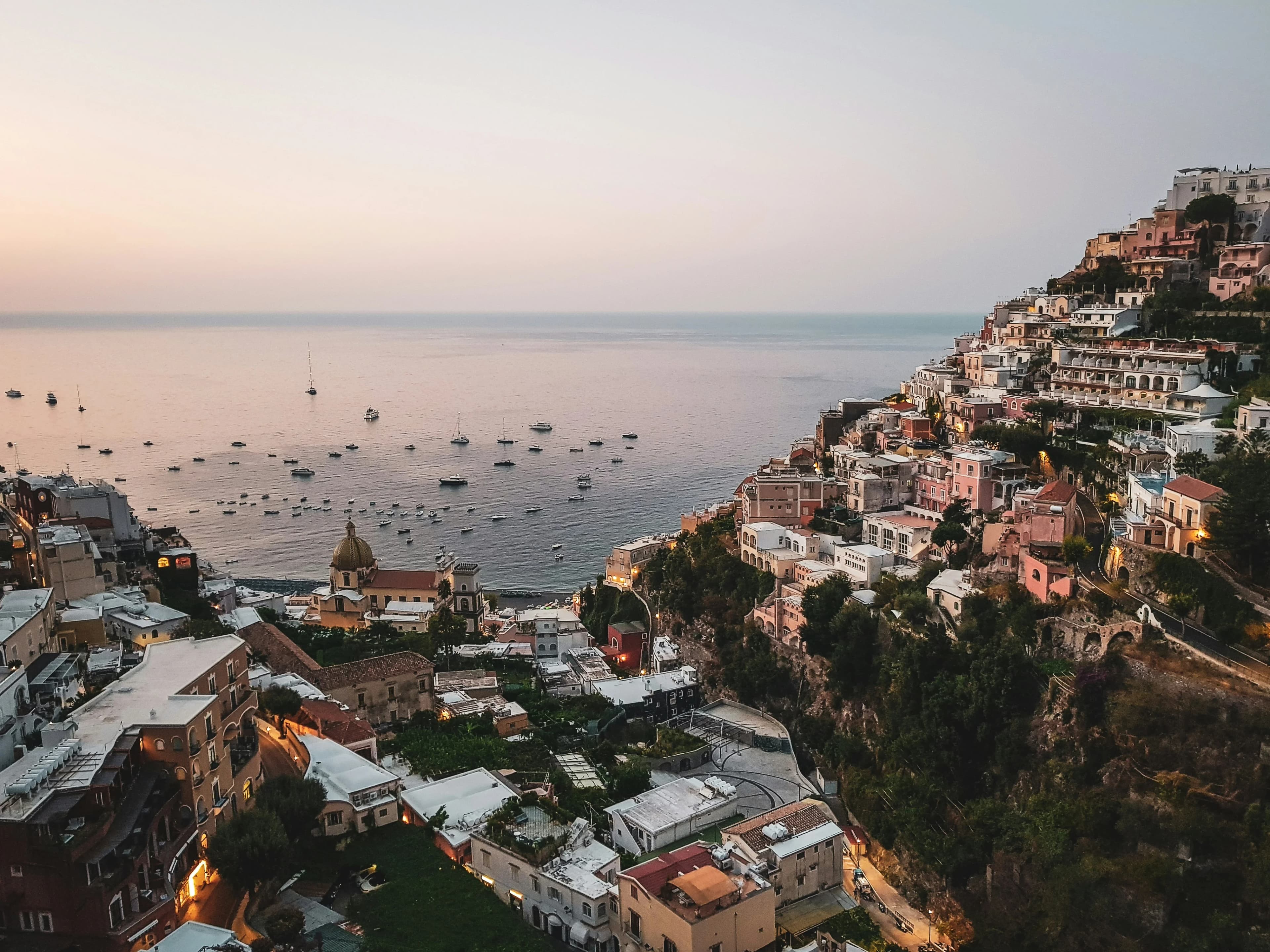
Where to stay in Santorini: distinct territories for luxury suite travelers
Oia
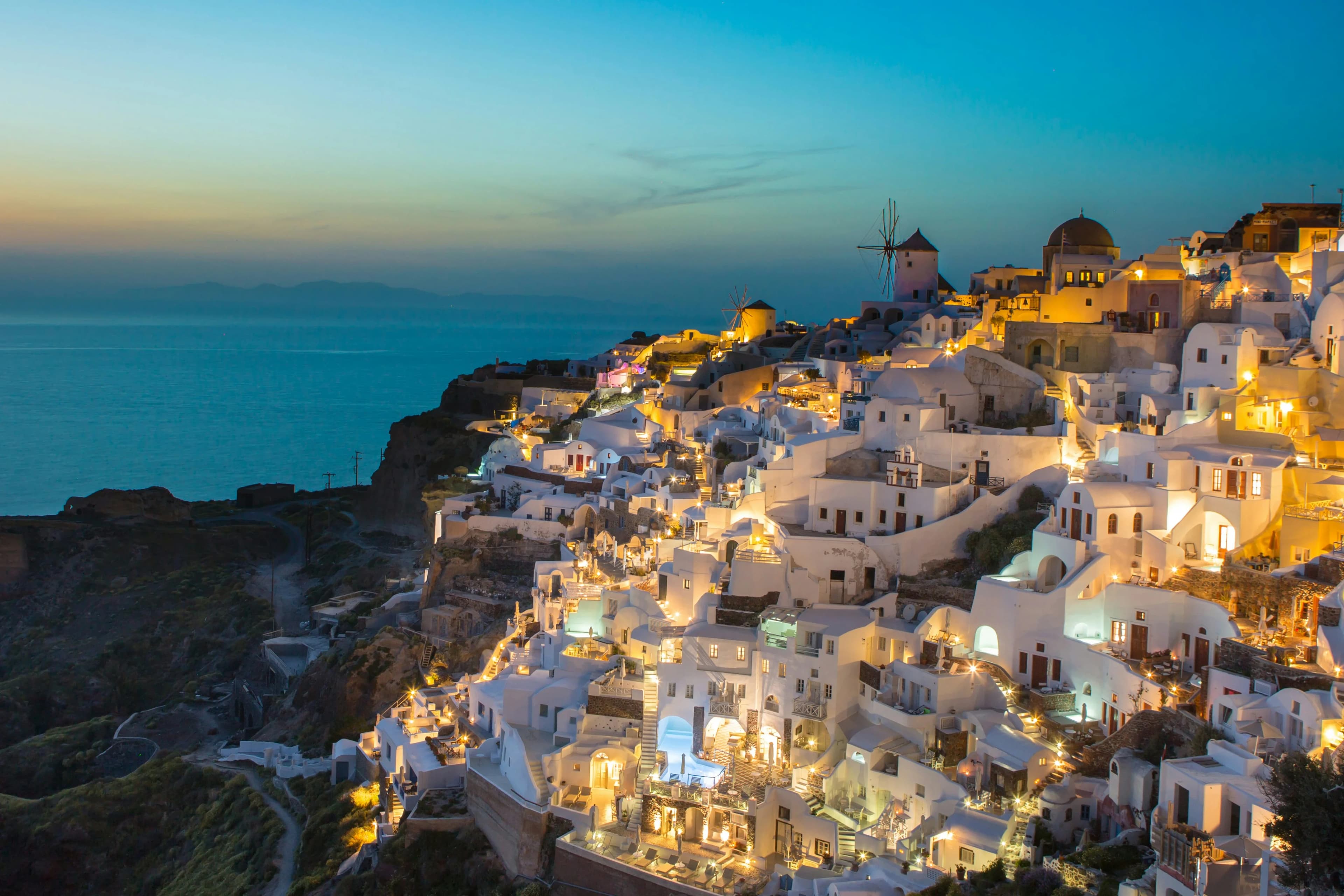
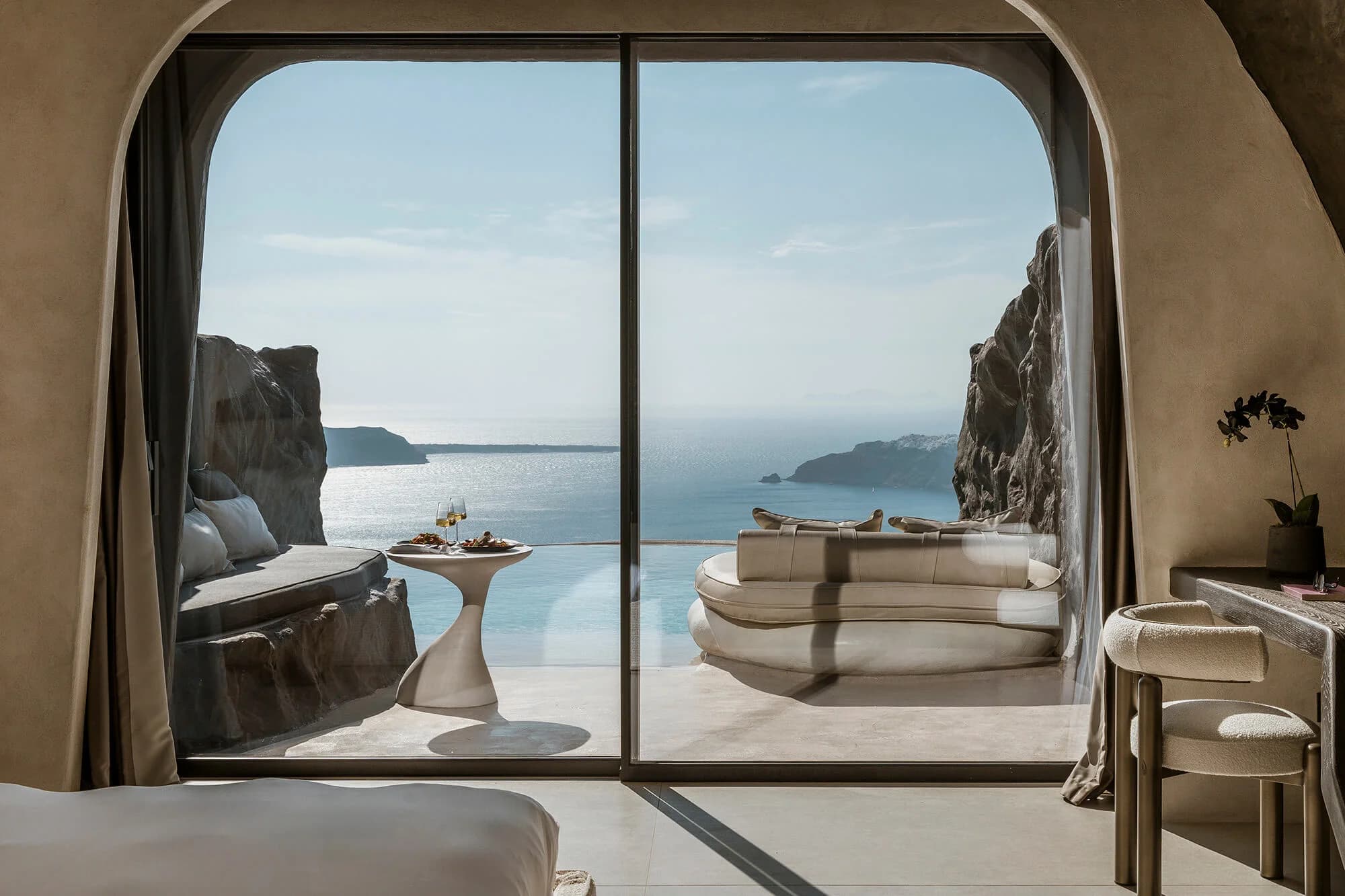
Oia sits at the northern tip of the caldera rim and remains the reference point for suite travel on the island. Properties here are carved directly into the volcanic rock, with suites that descend below street level into private cave structures. The spatial experience is specific: low ceilings, thick walls that hold the cool, and terraces that open directly onto the caldera drop. The village itself is pedestrianized for the most part, which means arrival logistics require planning but also guarantees a quality of silence rare for a destination of this profile.
Imerovigli and Firostefani
Positioned between Oia and Fira along the caldera path, these two settlements offer a quieter register. Imerovigli sits at the highest point of the caldera rim and is frequently cited by repeat visitors as the preferred base for those who prioritize elevation, undisturbed views, and proximity without the foot traffic of Oia. Firostefani operates as a transition zone: close enough to Fira for practical access, yet sufficiently removed to maintain a residential calm.
Fira
The island's capital functions as the commercial and logistical hub. For suite travelers, Fira is most relevant as a point of access rather than a destination in itself. That said, a number of properties along the caldera edge in Fira deliver genuine suite experiences, particularly for those arriving late in the season or requiring proximity to the port and transport connections.
Perivolos and the eastern coast
The black sand beaches of the eastern and southern coast represent a different Santorini entirely. The volcanic sand beaches at Perivolos and Perissa attract a younger, more active traveler profile. Suite properties here tend toward the contemporary resort format rather than the cliff-carved cave aesthetic. For families or travelers who want beach access integrated into their stay, this corridor is the practical choice.
When to visit Santorini for a luxury suite experience
The Santorini season compresses sharply. The island operates at full intensity from late April through late October, with July and August representing peak occupancy across all suite categories.
For suite travelers who prioritize availability, service quality, and spatial calm, May, June, and September are the structurally superior months. Temperatures are warm but not oppressive, the light is clear and directional (particularly important for caldera-facing suites), and the properties are operating at full staff capacity without the pressure of maximum occupancy.
October represents an increasingly attractive window for experienced travelers. The crowds thin, the light shifts to a warmer register, and several properties extend their season specifically to accommodate guests who have learned to avoid the summer peak. Rates in October also tend to reflect a meaningful reduction from the July and August benchmarks.
The island closes substantively between November and March. A small number of properties remain operational, but suite availability is limited and the infrastructure around dining and excursions is correspondingly reduced.
Understanding luxury standards in Santorini
Greece does not operate the same formal palace designation system as France. The closest equivalent in the Greek hospitality context is the five-star superior classification, which a number of Santorini properties hold. However, the classification system is a floor, not a ceiling. The actual differentiators in Santorini suite travel are architectural: the depth of the cave construction, the quality of the terrace and plunge pool positioning, the precision of the caldera sightline, and the ratio of private outdoor space to interior volume.
The cave suite format is specific to the Cyclades and to Santorini in particular. These are not rooms with a cave aesthetic applied decoratively. They are spaces genuinely excavated from volcanic rock (called asypalaia), where the thermal properties of the stone regulate temperature naturally and the structural geometry creates a sense of enclosure that has no direct equivalent in conventional hotel architecture.
Top-tier suite properties in Santorini typically offer private plunge pools, butler or dedicated concierge service, in-suite dining capabilities, and curated excursion programming that includes private yacht access, helicopter transfers, and private wine experiences at the island's volcanic vineyard estates.
How to choose the right suite in Santorini
The primary decision axis in Santorini is caldera-facing versus non-caldera. This is not a minor preference. A caldera-facing suite with a private plunge pool and an unobstructed western exposure delivers a categorically different spatial experience from a suite positioned on the inland or eastern side of a property. The sunset orientation matters architecturally and experientially, and the price differential between caldera and non-caldera suites at the same property is typically significant.
The second decision axis is cave construction versus conventional build. Cave suites require physical comfort with low, curved ceilings and non-linear floor plans. They are not universally suited to every traveler. For those who respond to them, the sensory experience (the cool density of the rock, the muffled acoustics, the precise relationship between interior darkness and exterior light) is the defining memory of the stay.
Arrival logistics also require consideration. Santorini's caldera-rim properties are not accessible by vehicle. Most suites in Oia, Imerovigli, and Firostefani require a combination of vehicle transfer to the village entrance and then manual luggage porterage along stone paths. This is a functional reality of the island's topography and should factor into decisions for guests traveling with significant luggage, mobility considerations, or with young children.
Finally, the island's water source is entirely desalinated. Premium properties manage this without perceptible quality impact, but it is a detail worth understanding as part of the broader picture of what operating in a volcanic island context means for hospitality infrastructure.
Why a curated selection by La Suite matters in Santorini
Santorini generates an extraordinary volume of hotel content. The challenge for the discerning traveler is not finding options. It is filtering the genuinely exceptional from the aspirationally positioned. The island's visual language is powerful enough that well-photographed mediocrity can circulate as a luxury product.
La Suite applies an editorial standard that privileges direct verification over promotional inventory. The criteria are architectural specificity, positional integrity (caldera sightline quality, terrace privacy, pool alignment), service structure, and the suite's capacity to function as a complete spatial experience rather than an upgraded room. In a destination as saturated with content as Santorini, that filter is the most practical tool a suite traveler has.