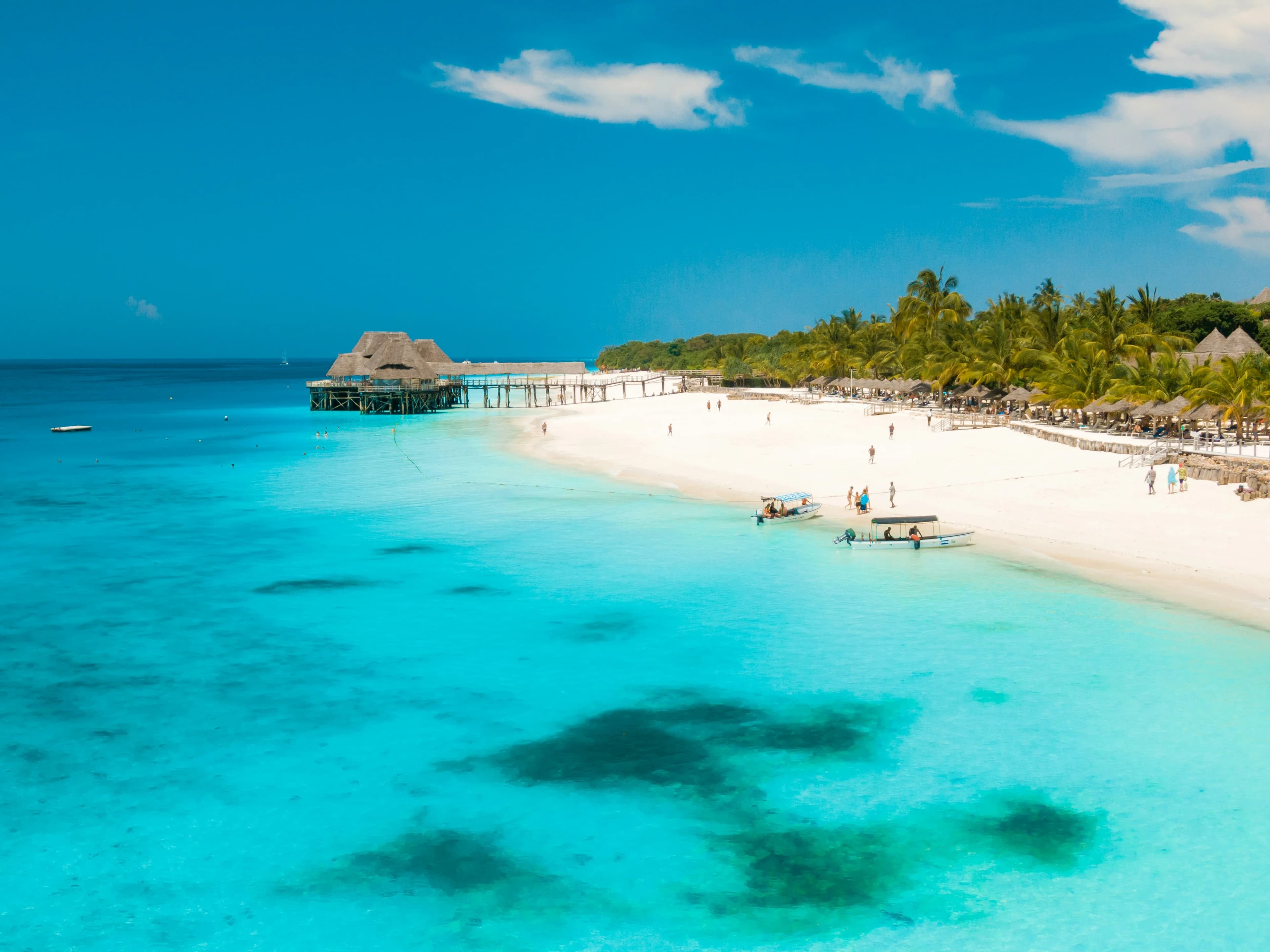
Where to stay in Zanzibar: understanding the island's distinct areas
Stone Town
The UNESCO-listed historic quarter of Stone Town sits on the western tip of the island and functions as its cultural and architectural core. The labyrinthine streets, coral stone buildings, and carved Omani-influenced doors create an urban environment unlike anywhere else in the Indian Ocean. Luxury hotel suites here occupy converted merchant houses and historic residences, offering guests proximity to the Forodhani waterfront, the Old Fort, and the House of Wonders. This is the appropriate base for travelers whose priority is cultural immersion rather than beach access.
The north coast: Nungwi and Kendwa
Nungwi, at the northern tip of Unguja, offers one of the few coastlines on the island where the tide does not recede dramatically, making it suitable for swimming at most hours. The area has developed steadily as a destination for high-end resort properties, with a concentration of luxury hotels offering direct beach access, expansive suite terraces, and unobstructed views of the Mozambique Channel. Kendwa, immediately south of Nungwi, maintains a slightly more contained atmosphere with a narrower strip of properties.
The east coast: Paje, Matemwe, and Michamvi
The east coast of Zanzibar operates on a different rhythm. The tidal swing here is pronounced, with low tide exposing wide flats of pale sand that stretch several hundred metres from the shore. Matemwe, in the northeast, offers the clearest water and the most direct views toward Mnemba Atoll, a private conservation area known for its coral reef. The luxury hotel properties along this stretch tend toward the intimate and architecturally considered, with suites designed to frame the ocean rather than simply face it. Paje, further south, has a stronger connection to the kite-surfing community but retains several boutique properties of genuine distinction.
The south and southwest
The southern reaches of the island around Kizimkazi are less developed and offer a different proposition: proximity to spinner dolphin populations in the bay, a slower pace, and properties that use the relative seclusion as a design asset. This is the quieter register of Zanzibar, appropriate for travelers prioritising privacy above all else.
When to visit Zanzibar
Zanzibar has two distinct dry seasons, both relevant to suite availability and the quality of the outdoor experience. The principal dry season runs from June through October, with the short dry season occurring in January and February. During the long dry season, the southeast trades bring consistent wind, warm but manageable temperatures, and clear water conditions that favour both snorkelling and diving around Mnemba Atoll and Chumbe Island.
The long rains (Masika) fall between March and May, with April typically the wettest month. Some properties close partially or entirely during this period, and suite availability shifts accordingly. Travelers with flexibility tend to find that late June and September offer the most favourable combination of conditions, availability, and value relative to peak-season pricing.
The Zanzibar International Film Festival (ZIFF), held annually in Stone Town in July, draws a culturally engaged audience and coincides with the dry season peak. Eid celebrations, which follow the Islamic calendar and are observed widely across the island, bring a particular atmosphere to Stone Town and the coastal villages. Timing a visit around these moments adds a cultural layer that purely beach-focused itineraries tend to miss.
Local luxury standards: what distinguishes a high-end suite in Zanzibar
Zanzibar does not have a formal state designation equivalent to the French Palace label or the Italian Grand Hotel classification. The island's luxury market is instead defined by a set of qualities that experienced travelers and independent curators have come to recognise as the relevant markers of distinction.
The most considered properties on the island work with local materials and inherited architectural logic rather than importing generic resort aesthetics. Coral stone, makuti thatch (woven coconut palm), and carved Zanzibari hardwood appear in properties that have invested in authentic construction rather than decorative pastiche. Suite interiors in these buildings tend toward restraint: high ceilings, cross-ventilation designed to reduce reliance on mechanical cooling, and textiles sourced from the regional craft tradition.
Private plunge pools have become a near-standard feature in the upper tier of Zanzibar suites, but the quality of their integration into the suite's spatial logic varies considerably. The best examples use the pool as a structural element of the suite's relationship with the landscape, positioned to frame a specific view or to extend the interior living space outward toward the ocean or the garden.
Butler service, private beach sections, and direct access to on-site dive and water sports operations are characteristics of the island's leading luxury hotels. Guests seeking to explore Tanzania more broadly, including mainland safaris in the Serengeti or Ngorongoro, often use a Zanzibar suite as either the opening or closing chapter of a longer itinerary, and the best properties are accustomed to coordinating these transitions.
How to choose the right luxury suite in Zanzibar
The primary distinction to establish before selecting a suite in Zanzibar is the relationship between tidal patterns and your intended use of the beach. The east coast's dramatic tidal movement means that at low tide, the waterline may be several hundred metres from your suite terrace. For guests who want consistent swimming access from their immediate surroundings, the north coast properties around Nungwi are technically more suitable. For guests whose priority is visual drama, solitude, and the particular aesthetic of a wide tidal flat at golden hour, the east coast offers something the north does not.
Architectural character is the second axis of differentiation. Stone Town suites in historic buildings offer a fundamentally different spatial experience from purpose-built beach resort suites on the north or east coast. Both categories can reach the same level of service quality, but they address different intentions. If the texture of the island's Swahili and Omani heritage is relevant to your visit, Stone Town properties provide direct immersion. If the primary objective is oceanfront privacy and physical space, the resort category is more appropriate.
Suite size in Zanzibar tends to be generous by regional standards, but the configuration matters. Ground-floor suites with private garden access and a plunge pool serve a different guest profile than elevated suites with panoramic views. Traveling with children, or with a preference for indoor-outdoor flow, makes the garden suite format the more practical choice. Solo travelers and couples often find that an elevated position compounds the sensory impact of the ocean view in a way that justifies the trade-off in terms of direct outdoor access.
For context on how Zanzibar's luxury suite market fits within the broader Africa landscape, and how it compares with other Indian Ocean destinations, La Suite's editorial coverage provides a useful reference point.
The value of a curated selection in Zanzibar
Zanzibar's accommodation market has expanded considerably over the past decade. The volume of properties presenting themselves as luxury hotels has grown faster than the underlying quality has been able to keep pace with. For a traveler arriving without a prior relationship with the island, distinguishing between a property that has invested in genuine architectural integrity and one that deploys the vocabulary of luxury without the substance is not straightforward from a standard booking interface.
La Suite's approach to curation in Zanzibar is based on direct assessment of the qualities that define a genuinely exceptional suite: the spatial logic of the room, the quality of natural light and ventilation, the precision of service, and the property's relationship with its immediate landscape. The curated selection by La Suite is not a ranking system. It is a considered answer to the question of which properties on the island are worth the investment of time and money for a traveler who chooses suites deliberately. Explore the full Tanzania selection to understand how Zanzibar sits within a broader East African itinerary.