Understanding Busan as a luxury destination
The luxury hospitality landscape here reflects this complexity. Properties range from internationally branded hotels positioned along the Haeundae beachfront to smaller, design-forward establishments in the older neighborhoods of Nampo-dong and Gamcheon. For those exploring South Korea with a focus on suite-level travel, Busan functions as a compelling counterpoint to the capital, offering a slower rhythm and a stronger connection to the sea.
Best areas to stay in Busan for suite travelers
Haeundae
Haeundae is the city's most established luxury corridor. The district extends along a two-kilometer beach and contains the highest concentration of five-star properties. The surrounding streets hold the city's best Japanese and Korean fine dining, alongside the BIFF Square area and access to the Dongbaekseom peninsula. Suites in Haeundae tend to offer direct sea views and are architecturally oriented toward the Pacific horizon. This is the appropriate choice for travelers prioritizing amenity depth and proximity to the city's most polished infrastructure.
Centum City and Marine City
Adjacent to Haeundae, Centum City is built around the BEXCO convention center and Shinsegae, one of the world's largest department stores by floor area. Marine City, across the water, is characterized by its high-rise residential towers and marina positioning. Together, these districts represent Busan's most contemporary face. Suite travelers with an interest in architecture and urban density will find this area compelling, particularly when the city's skyline is illuminated after dark.
Gwangalli
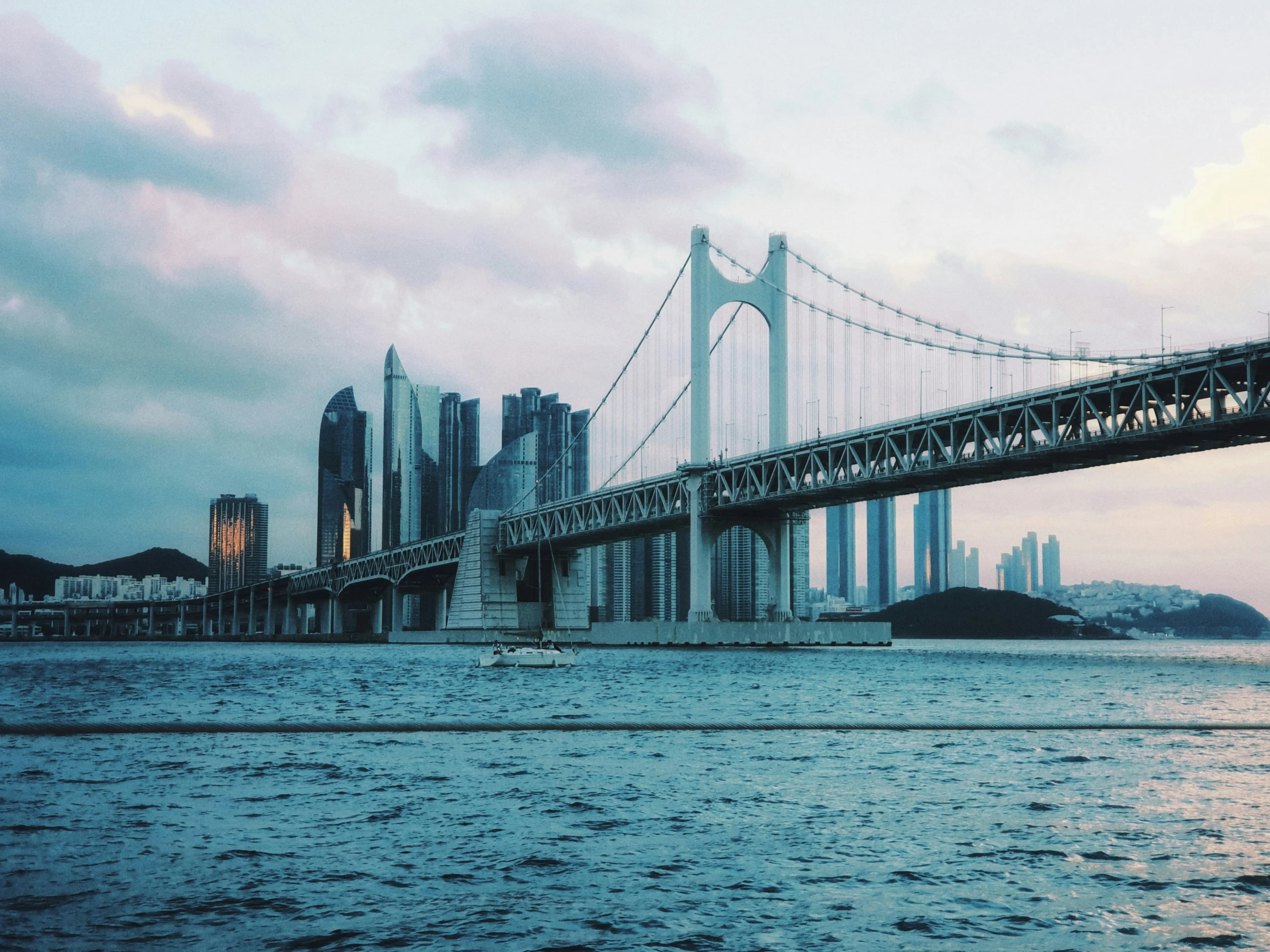
Gwangalli sits west of Haeundae and faces the Gwangan Bridge, a suspension structure that becomes a reference point for the district's visual identity. The beach here is slightly narrower but the atmosphere is less commercially pressured. Independent restaurants and rooftop bars line the streets behind the waterfront. For travelers seeking a suite experience with a more editorial quality, the accommodation options around Gwangalli offer a different texture from the Haeundae corridor.
Nampo-dong and the old port
The older districts around Nampo-dong and Jagalchi market represent Busan in its most historically grounded form. The Gamcheon Culture Village, built into the hillside above the port, is one of the city's most discussed visual landmarks. Accommodation in this area is less dominated by international hotel groups, making it relevant for travelers who prioritize character and neighborhood immersion over branded consistency.
When to visit Busan
Busan's climate is noticeably milder than Seoul's, moderated by its coastal position. The city avoids the extreme cold of northern Korean winters and receives less snow. Peak season runs from June through August, when the beaches are at full capacity and domestic tourism is at its highest. For suite travelers, this period requires advance planning, particularly for Haeundae properties, where availability narrows considerably.
The shoulder seasons of April to May and September to October offer a more considered travel window. Temperatures are comfortable, crowds are reduced, and the city's cultural calendar is active. The Busan International Film Festival, held each October, is one of Asia's most significant cinema events and brings a particular energy to the Haeundae district. Properties fill quickly during this period, and suite inventory should be secured early. Spring brings the cherry blossom season to parks such as Dalmaji-gil and Samnak Ecological Park, a period that is visually precise and relatively short.
Korean luxury standards and what to expect from top-tier suites
The Korean luxury hotel sector operates to exacting standards, particularly in the treatment of space and service. Korean hospitality culture places significant value on attentiveness without intrusion, a quality that manifests well at the suite level where staff-to-guest ratios are higher and service is more personalized.
A point of distinction in Busan is the presence of jimjilbang culture: the Korean tradition of gender-separated communal bathhouses. At the luxury end, this tradition is expressed through dedicated spa floors within five-star properties, often incorporating jade rooms, salt rooms, and multiple pool temperature sequences. For travelers accustomed to European spa traditions, the Korean iteration is more architectural in its approach to heat and water therapy. A well-chosen luxury hotel suite in Busan will typically provide privileged access to these facilities.
Korean cuisine in Busan carries a regional identity distinct from Seoul. The city is the origin of several dishes that have national recognition, including dwaeji gukbap (pork rice soup) and the raw fish preparations of the Jagalchi market. Top-tier hotels typically incorporate fine dining expressions of this regional cuisine alongside international options. Travelers who approach destination selection through a food lens will find Busan's culinary identity more pronounced than in many comparable coastal cities.
How to choose the best luxury suite in Busan
The primary decision for suite travelers in Busan is orientation: sea-facing or city-facing. Haeundae and Gwangalli properties typically maximize ocean exposure, while properties in Centum City and Marine City offer urban panoramas. Neither is categorically superior. The choice depends on whether the traveler prioritizes sensory connection to the coast or the visual density of a modern Korean skyline.
A second consideration is access to Korean wellness infrastructure. Not all hotels in Busan offer equivalent jimjilbang facilities, and for travelers to whom this is a priority, it warrants specific verification at the time of selection. La Suite's curation process accounts for this distinction, identifying which properties deliver the full expression of Korean spa culture at the suite level.
Travelers visiting during the Film Festival should also consider proximity to the primary venues, which are concentrated in Haeundae. Suite selection during this period is as much a logistical decision as an aesthetic one.
Why curated selection matters in Busan
Busan's hotel market contains a wide range of properties that market themselves at the luxury tier. The gap between the best and the adequate is significant, and the criteria for suite-level travel, space, natural light, service precision, and genuine privacy, are not consistently met across the market. La Suite applies a consistent editorial standard to its selection, filtering the Busan market to identify the properties that meet these criteria without exception.
For travelers approaching South Korea as a country with multiple destinations, understanding how Busan fits within the broader itinerary is also relevant. The city connects to Seoul by KTX high-speed rail in approximately two and a half hours, making a combined itinerary logistically straightforward. La Suite's curated selection across South Korea is structured to support this kind of multi-city approach, identifying properties in each context that maintain a consistent standard of suite-level experience.