Why Taormina commands attention in Italian luxury travel
Where to stay in and around Taormina
The historic centre
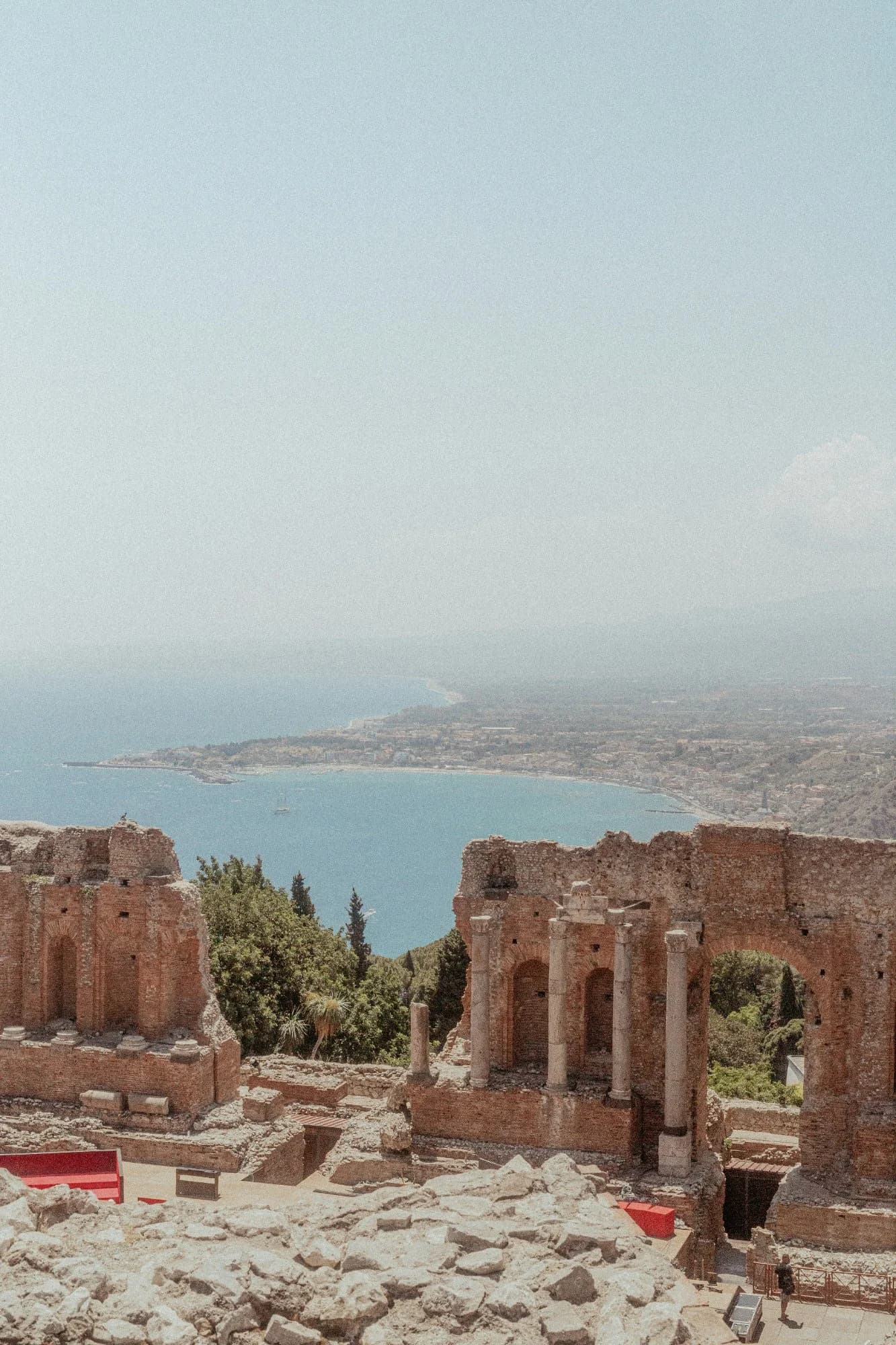
The medieval core of Taormina, centred on Corso Umberto I, contains the densest concentration of palazzi converted into high-end hotels. Properties here offer immediate access to the Teatro Greco, the Duomo, and the network of lanes that make the town legible only on foot. Suites in the historic centre tend to favour interior courtyard views or elevated terraces with partial sea sightlines. The architectural envelope is typically Baroque to late-19th century, with thick stone walls that keep spaces cool through the Sicilian summer.
The cliff edge and garden terraces
Several of Taormina's most significant hotels occupy the western cliff edge, where gardens cascade toward the valley below. These properties have been attracting a sophisticated international clientele since the 19th century, when Northern European artists and writers arrived in search of light and ruin. The spatial logic here is vertical: suites are positioned to maximise the panorama across the Ionian and toward Calabria on the mainland. This is the category of room where a private terrace is non-negotiable.
Isola Bella and the bay below
Directly below the clifftop town, the cove of Isola Bella offers a different register entirely. Pebble beaches, shallow turquoise water, and the small nature reserve island itself create an atmosphere that is quieter and more physically connected to the sea. Some properties operate between the cliff base and the shoreline, accessible by cable car from the town above. For travelers whose priority is water proximity over architectural grandeur, this lower zone is worth considering alongside the hilltop options.
When to visit Taormina
The season in Taormina is longer than most of Sicily. The town's elevation moderates summer heat, and properties remain open from March through November. The core season runs from May to October, with July and August the most heavily attended months, when the Teatro Greco hosts its annual arts festival (Taormina Arte) and demand for suites reaches its peak. Rates and availability reflect this sharply.
May and June offer the clearest light, cooler temperatures, and almond and citrus blossom on the surrounding terraces. September and October are frequently cited by returning visitors as the most satisfying months: the crowds have thinned, the sea retains its warmth from summer, and the angle of afternoon light on Etna is at its most architectural. For those prioritising suite availability and value, the shoulder season is the considered choice.
Winter in Taormina is mild by northern European standards (10 to 15 degrees Celsius in January and February), and a small number of properties remain open year-round for visitors who want the town without its summer population.
Local luxury standards: what defines a serious suite in Taormina
Sicily does not have a formal prestige classification equivalent to the French Palace designation. Quality at the top of the market is instead signalled by a combination of factors: conversion quality of historic buildings, garden provenance (some hotel gardens are themselves listed heritage sites), terrace scale, and the calibre of local material used throughout the interiors. Sicilian craftsmanship traditions, including hand-painted Caltagirone ceramic tilework, inlaid lava stone surfaces, and locally woven textiles, function as quality markers in the finest properties.
In Taormina specifically, the expectation at the luxury tier includes a private terrace with direct sea and Etna views, stone or tile floors (not carpet), and service that reflects the town's long history of hosting international guests. Properties that have been in continuous operation since the Belle Epoque era carry a particular patina of place that newer developments cannot replicate. This continuity matters to a certain type of traveler.
How to choose the right suite in Taormina
View orientation
Not all rooms described as having sea views are equal. The Ionian is to the east and northeast; Etna rises to the northwest. The finest suites capture both in a single sightline, particularly at dawn when both elements are at their most dramatic. When evaluating a suite, ask for the specific terrace orientation and the floor level before confirming.
Historic property versus contemporary conversion
Taormina's luxury stock divides broadly into properties of genuine historic age (19th century or earlier) and more recent constructions designed to complement the clifftop context. The historic properties offer architectural authenticity and established gardens; newer properties may offer larger suite footprints and more contemporary service infrastructure. Neither category is categorically superior; the choice depends on whether the traveler is there for the building as much as the view.
Access and mobility
Taormina's clifftop position means that the town itself involves significant gradient. The main corso is relatively flat, but arrival and departure typically require navigating narrow roads, cable car access to the beach, and limited vehicle access within the historic centre. For families with young children or travelers with mobility considerations, ground-floor suite categories and properties with dedicated transport arrangements are worth prioritising.
The value of curation in Taormina
Taormina has relatively few rooms at the genuine luxury tier. The town is small, the historic building stock is finite, and the number of suites with the right terrace orientation, authentic material palette, and service standard is limited to a handful of properties. The gap between a good hotel and an exceptional suite experience here is significant, and it is not always legible from general travel platforms.
La Suite curates only the properties that meet a consistent standard across architecture, service, and experiential specificity. In a destination where the wrong choice means looking at a car park rather than Etna, that curation is not incidental. It is the point. Our Italy selection reflects the same rigour applied across the country, with Taormina understood as one of its most architecturally precise luxury propositions.