Why Cascais commands serious attention from luxury travelers
For the traveler who selects destinations based on spatial quality, cultural depth, and architectural coherence, Cascais delivers consistently. The question is not whether to come. It is where to stay, and what standard to hold.
Best areas to stay in Cascais
The historic centre
The core of Cascais is walkable, contained, and genuinely pleasant. Palaces, municipal gardens, and 19th-century townhouses define the visual grammar. A luxury suite within or adjacent to this zone offers immediate access to the cultural infrastructure of the town: the museums, the market, the coastal promenade. Properties here tend toward the classical in their architecture, with interiors that either honour the original fabric or contrast it deliberately.
Cascais Vila and the coastal edge
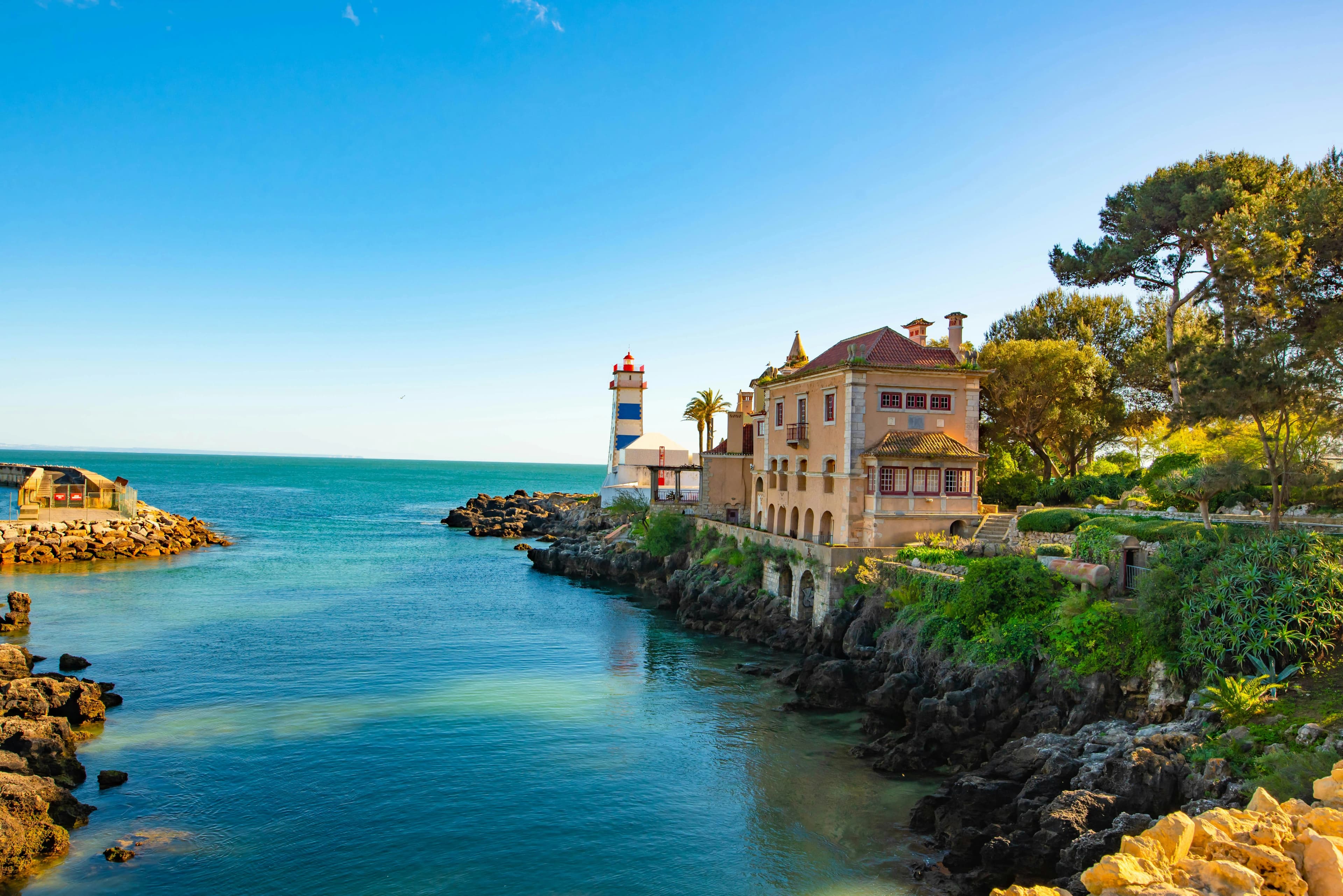
The area between the town centre and the Atlantic cliffs is where the most ambitious residential and hospitality projects have landed. Ocean exposure here is direct. The Boca do Inferno, a natural rock arch carved by centuries of Atlantic pressure, is within walking distance. Suites in this zone are typically oriented toward the water, with terraces and sight lines designed around the horizon. This is where the landscape does the heaviest work.
Quinta da Marinha and the golf corridor
West of the town centre, the terrain opens into estate country. Quinta da Marinha and the surrounding area constitute Cascais's most private residential enclave: walled properties, golf courses, equestrian facilities, and a marina. Hotels and resorts in this corridor offer a different register entirely. Space is generous. The pace is slower. For families, executives in retreat, or anyone requiring genuine privacy alongside Atlantic access, this western corridor is the correct choice.
When to visit Cascais
Cascais benefits from one of the most temperate climates in continental Europe. The Atlantic moderates summer heat in a way that inland Iberia cannot. July and August bring full sun and sea temperatures warm enough for extended swimming, but the coastal wind keeps conditions comfortable. These months also coincide with peak demand: availability in the finest properties contracts sharply, and rates reflect it.
September and October represent the most considered time to visit. The light shifts from the sharp white of high summer to something amber and more architectural. The tourist volume drops. Cultural programming in the broader Portugal calendar, including Lisbon's major festivals, trails into autumn. For suite travelers who prefer a property at full attention rather than full capacity, the shoulder season is the correct answer.
Spring, particularly April and May, offers a quieter alternative: mild temperatures, green terrain, and properties that have emerged from low-season maintenance. Winter in Cascais is mild by northern European standards, with temperatures rarely falling below ten degrees. The town functions year-round, and several of its landmark properties remain open and well-staffed throughout.
Local luxury standards: what to expect from top-tier properties in Cascais
Portugal does not have a formal Palace designation equivalent to France's classification system, but the country's leading properties operate to a standard that is immediately legible to experienced travelers. In Cascais specifically, the luxury hospitality landscape divides into three typologies.
The first is the grand hotel with historical lineage: properties that have served European aristocracy, heads of state, and culturally prominent guests since the late 19th or early 20th century. These hotels carry a particular weight. The architecture is load-bearing in a cultural sense. Suites in these properties tend toward high ceilings, period detailing, and a formality that is entirely unforced.
The second typology is the contemporary resort, typically positioned in the western corridor, designed around amenity depth: spas, multiple dining formats, golf access, and suite categories that tier from generous to genuinely extraordinary. These are properties built for extended stays and repeat visits.
The third is the boutique conversion: a historic villa, palace, or estate reimagined as a small hotel with a tightly curated suite offering. These properties trade in intimacy and authorship. The design decisions are more visible, the service ratios are higher, and the experience is more singular. Across Europe, this typology has become the preferred format for travelers who find large hotels impersonal.
How to choose the right suite in Cascais
Define your orientation
The first decision in Cascais is directional. Do you want the Atlantic as your primary visual reference, or do you want the town? Oceanfront suites offer horizon views and the acoustic register of the sea. Town-facing suites in the historic centre offer proximity to cultural life and a more grounded sense of place. Neither is superior. They are different experiences, and the choice should be deliberate.
Consider the architecture
Cascais has a genuinely varied architectural stock. 19th-century neoclassical buildings, Manueline details, mid-century modernist interventions, and contemporary resort design all exist within a small geographic radius. A suite in a converted palace reads differently from a suite in a purpose-built resort. Both can be exceptional. The question is which architectural language corresponds to your sense of a correct trip.
Assess the suite's operational logic
In any serious luxury hotel, the suite should function as a private residence for the duration of your stay. That means: a living area that is genuinely usable, not merely symbolic; a bathroom of sufficient scale; and a terrace or exterior space if the property's position warrants it. In Cascais, where the outdoor environment is part of the value proposition, a suite without meaningful exterior access is a reduced offer.
Practical considerations specific to Cascais
The Cascais-Estoril train line connects the town to Lisbon in approximately forty minutes, making day access to the capital entirely practical. For travelers who plan to use Cascais as a base for broader exploration of the Sintra-Cascais Natural Park, a property with vehicle access or a concierge equipped to arrange private transport is a material advantage. The park's terrain, which includes the Cabo da Roca, the westernmost point of continental Europe, is not fully accessible on foot from town.
The value of curation in a market like Cascais
Cascais is a small town with a concentrated luxury hospitality market. The number of properties operating at the standard that La Suite curates is limited, which is precisely why the selection process matters. The wrong choice in a market this contained is more visible than it would be in a larger city.
La Suite applies a consistent editorial standard to every property it lists. The criteria are architectural, spatial, and experiential. A suite must function at a level that justifies its position in a curated selection. In Cascais, that means properties where the ocean, the history, or the design intelligence of the building is doing active work, not merely providing a backdrop.
For travelers who have already decided that Cascais is the correct destination, the remaining question is which property will make that decision feel fully realised. That is the work La Suite does. Explore the curated selection and identify the suite that corresponds to your standard.