Why Quebec City rewards the suite traveler
Best areas to stay in Quebec City
Upper Town and the Plains of Abraham
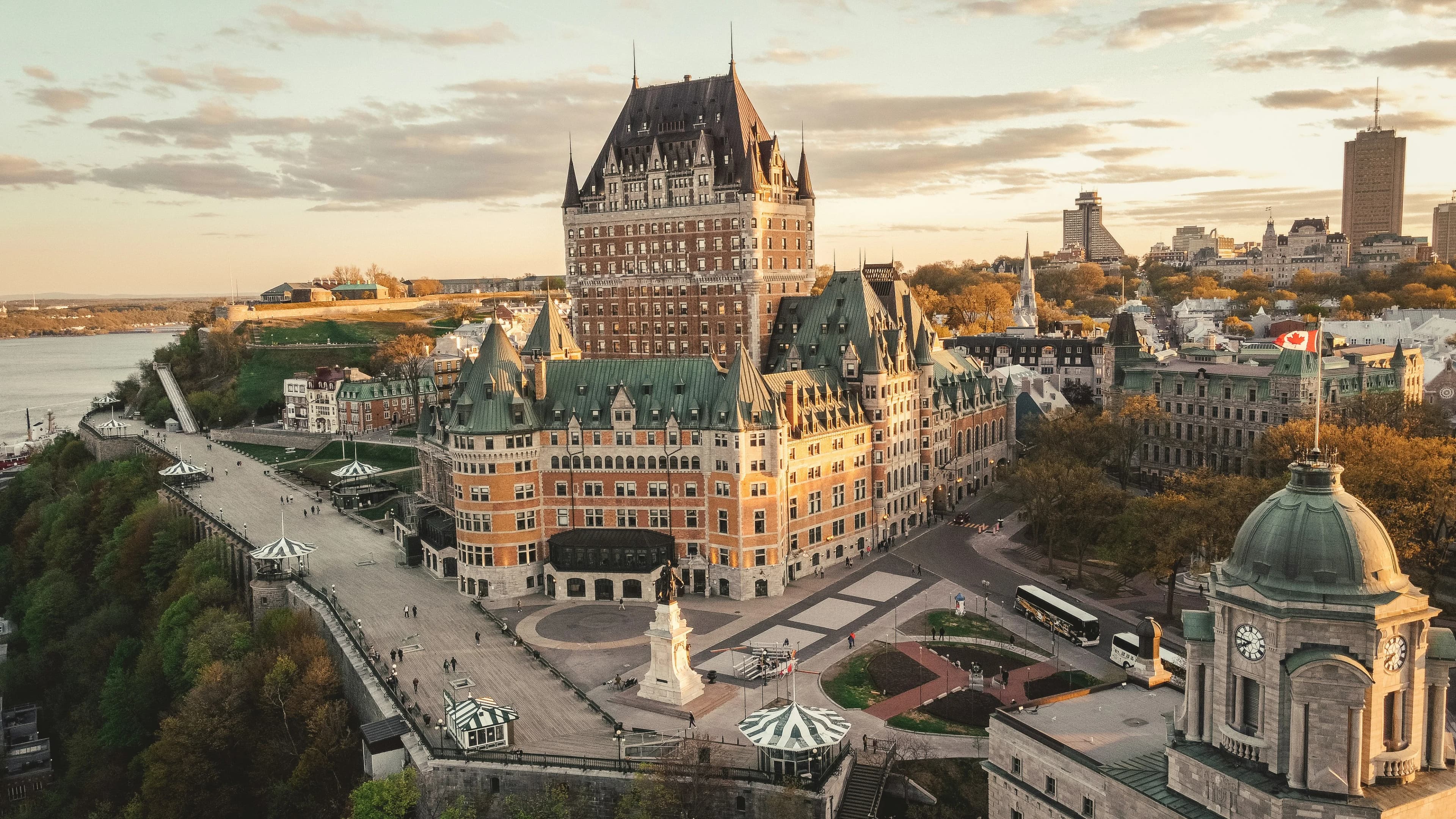
The Upper Town (Haute-Ville) is the historic and institutional core. This is where the major luxury hotels are concentrated, positioned along the Cap Diamant promontory with views across the St. Lawrence River and toward the Laurentian plateau beyond. Properties here benefit from proximity to the fortifications, the Governors' Promenade, and the institutional fabric of the provincial capital. Suites in this area tend to occupy buildings of significant historical weight, often dating to the late nineteenth or early twentieth century, and the architectural experience is embedded in the stay itself. The Plains of Abraham, the site of the 1759 battle that determined the fate of New France, adjoin this area and provide an unusual urban park of considerable scale.
Lower Town: Saint-Roch and Basse-Ville
The Lower Town has undergone a sustained period of architectural and cultural investment. The Saint-Roch district, once a working-class industrial quarter, is now home to independent restaurants, design studios, and a younger creative economy. Basse-Ville, the original commercial port district, retains its warehouse-scale buildings and cobblestone character. Luxury hotel offerings here are more boutique in orientation, generally smaller in scale, with a sharper editorial point of view. For travelers who prefer contemporary interiors set within heritage shells, this is the more textured choice.
The Laurentian region and beyond
Quebec City functions well as a base for excursions into the broader province. The Charlevoix region, designated a UNESCO Biosphere Reserve, lies roughly ninety minutes northeast along the St. Lawrence and offers a dramatically different landscape: river cliffs, fjords, and a concentration of serious culinary producers. The Laurentian Mountains to the northwest offer four-season resort infrastructure. These territories fall within the broader context of North America's most underexplored luxury travel geography.
When to visit Quebec City
Quebec City operates as a year-round destination, with each season presenting a distinct experiential register. Winter is the most culturally specific period. The Quebec Winter Carnival, held in February, is the largest winter festival in the world and transforms the city into a social environment that is genuinely unlike anything else in Canada. Snow accumulation is reliable, temperatures regularly fall below minus fifteen Celsius, and the visual character of the city under winter light is architecturally precise. For suite travelers, this is also a period of real value: rates are competitive relative to summer, and the city's interior culture (restaurants, galleries, historic institutions) is fully active.
Summer, from June through September, brings the warmest temperatures and the highest concentration of cultural programming, including the Festival d'été de Québec, one of the larger outdoor music festivals in North America. Autumn is brief but visually and gastronomically significant: the foliage across the Laurentian plateau is at its most intense from late September through mid-October, and the regional agricultural harvest supports a restaurant culture of notable quality. Spring is the quietest period and offers the most competitive suite pricing.
Local luxury standards: what to expect from top-tier properties in Quebec City
Quebec City's luxury hotel market is shaped by its relatively compact size and its strong historical identity. Unlike Montreal, which has a broader and more internationally diverse hotel offering, Quebec City's top-tier properties tend to operate within a French-Canadian cultural framework. The service register is formal but not stiff, influenced by French hospitality conventions while maintaining a particular local directness.
The city does not have a formal designation equivalent to France's Palace classification, but the leading properties operate at a standard consistent with five-star international benchmarks. Suite configurations in the most significant buildings are often defined by heritage architecture: ceiling heights, window proportions, and floor plans that reflect the building's original function. For travelers accustomed to purpose-built luxury towers, this is a different spatial grammar, one that rewards appreciation of historical construction rather than pure contemporary minimalism.
Gastronomy is central to the luxury proposition here. Quebec City has a restaurant culture that draws seriously on the province's dairy, game, and agricultural production. A suite stay at a top-tier property typically includes access to dining that reflects this regional specificity, which is one of the genuine differentiators of this city versus other North American destinations.
How to choose the best luxury suite in Quebec City
The primary decision is between the Upper Town and Lower Town, which present meaningfully different experiences. Travelers who prioritize views of the St. Lawrence, proximity to the major heritage sites, and the grandeur of nineteenth-century hotel architecture will find the Upper Town the correct choice. Those who prefer smaller-scale boutique properties, contemporary design sensibility, and integration into the city's current creative culture will find more of interest in Basse-Ville and Saint-Roch.
Within any property, the suite floor and orientation matter considerably. River-facing rooms command the most significant views and are worth the premium. In winter, the additional space of a suite provides genuine comfort during extended indoor periods. In summer, properties with terraces or private balconies offer a qualitatively different relationship with the street life below.
Practical considerations include the city's walkability (the historic core is compact and best navigated on foot), parking infrastructure (limited in the walled city, so properties with valet are preferable), and the relative absence of direct international flights (most international arrivals connect through Montreal or Toronto, adding a segment to the journey).
The value of curation for Quebec City suite travel
Quebec City's hotel market is not large. There are a finite number of properties that genuinely meet the standards expected by suite travelers at the higher end of the market. The challenge is not scarcity of information but scarcity of reliable editorial judgment: most aggregator platforms surface the same inventory without meaningful differentiation between a suite that simply has a separate sitting room and one that offers a qualitatively distinct spatial and service experience.
La Suite's approach to curation is editorially specific. For a city like Quebec City, where the number of genuinely exceptional properties is small, precision matters more than volume. The curated selection by La Suite identifies the properties where the suite experience is architecturally considered, service-calibrated, and contextually appropriate to this particular city. That filtering saves time and eliminates the category errors that come from booking on scale rather than judgment.