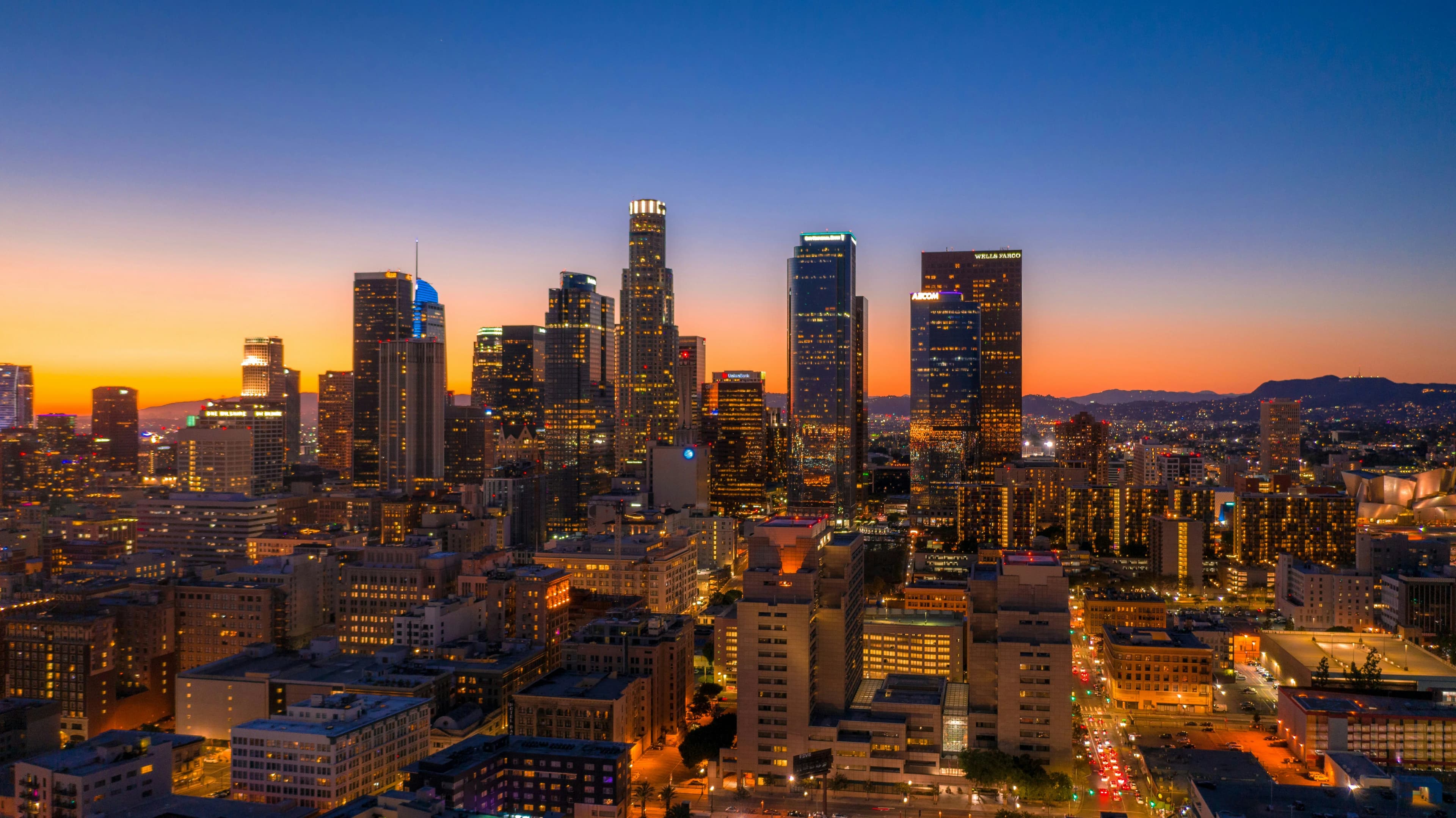
Why Downtown Los Angeles changed the terms for luxury hotel suites
The neighborhood rewards travelers who engage with it on its own terms. Distances are walkable. The cultural calendar is dense. The food scene, anchored by the Grand Central Market corridor and the Arts District, operates at a level that competes with any American city. A well-chosen luxury suite here functions as a base for serious urban exploration, not simply a place to sleep between activities.
The distinct zones of Downtown Los Angeles
Bunker Hill
Bunker Hill is the civic and cultural apex of downtown. The Walt Disney Concert Hall, the Broad Museum, the Museum of Contemporary Art, and the Colburn School occupy a concentrated geography that makes this area the most architecturally significant precinct in Los Angeles. Hotels in this zone tend toward the formal and the established. Suites here offer proximity to institutions that define the city's cultural identity at the highest level. For travelers whose itinerary centers on the performing arts or museum programming, Bunker Hill provides a logical and considered base.
The Historic Core and Broadway corridor
The Historic Core contains some of the most significant early twentieth-century commercial architecture in the western United States. The Bradbury Building, the Million Dollar Theatre, and the Grand Central Market anchor a corridor that has been subject to sustained adaptive reuse. Hotels here often occupy former bank headquarters or department stores, and the suite experience reflects that architectural inheritance: high ceilings, generous floor plates, and materiality that references the building's original function. This is the area for travelers who respond to layered history embedded in the built environment.
The Arts District
East of downtown proper, the Arts District operates on a different spatial and social frequency. The industrial scale of former warehouses and cold storage facilities has been converted into gallery spaces, restaurants, and boutique hotel properties. The aesthetic is deliberate and anti-monumental. Suites in this zone tend to be loft-format, with concrete, steel, and natural light doing structural work that more conventional luxury hotels accomplish through soft furnishings. For design-literate travelers, the Arts District offers a suite experience that is genuinely specific to this city and this moment.
South Park and the Financial District
South Park, anchored by Crypto.com Arena and the Los Angeles Convention Center, attracts a different traveler profile. The Financial District, immediately adjacent, houses corporate headquarters and the infrastructure of the city's commercial economy. Luxury hotel suites in this zone prioritize efficiency: meeting room access, connectivity, and the kind of service architecture that supports a schedule built around professional commitments. The experience is polished and functional rather than experiential in the Arts District sense.
When to stay in Downtown Los Angeles
Los Angeles maintains a Mediterranean climate that makes year-round travel practical. That said, the calendar has distinct rhythms that matter for suite planning. The awards season, running from January through March, concentrates a specific cultural energy in the city. Downtown participates in this through screenings, industry events, and the programming associated with the Academy Awards, which takes place at the Dolby Theatre in Hollywood but draws its social activity across the broader metropolitan area.
The summer months bring the largest visitor volumes, which affects both suite availability and pricing. Travelers with flexibility in their schedule benefit from the shoulder seasons: April through May, and October through November. The weather remains temperate, cultural programming is active, and the competitive pressure on suite inventory is reduced. The Los Angeles Philharmonic season at the Walt Disney Concert Hall runs from September through June, making autumn a particularly well-structured time to visit Bunker Hill.
For travelers planning around North America-wide cultural events, DTLA's calendar also includes Art Week, typically held in September, which brings institutional and gallery programming to a concentrated geography accessible from a downtown base.
Understanding luxury standards in Downtown Los Angeles
The United States does not operate a formal national hotel classification equivalent to France's Palace designation. Luxury positioning in American hotels is communicated through Forbes Travel Guide star ratings and AAA Diamond classifications, with Five Star and Five Diamond designations representing the highest tiers. In practice, the experiential markers of top-tier suites in Downtown Los Angeles include butler service or dedicated concierge access, suite-specific amenities programs, private check-in processes, and the kind of spatial generosity that distinguishes a genuine suite from a large room with a sitting area appended.
The adaptive reuse context of many downtown properties adds a layer of complexity. A suite in a converted historic building may have architectural character that exceeds its formal classification. Ceiling heights, original detailing, and the spatial logic of a former commercial building can produce a suite experience that is more distinctive than a conventionally constructed luxury hotel of equivalent or higher rating. This is precisely the territory where curation adds value: formal classification alone does not fully describe what a suite in Downtown Los Angeles actually delivers.
How to choose the right luxury suite in Downtown Los Angeles
The first variable is purpose. A suite selected for cultural immersion (proximity to Bunker Hill institutions, walkability to the Arts District) requires a different location logic than one selected for business travel or for a family requiring multiple bedrooms and privacy across floor area. Downtown is compact enough that most key sites are within a fifteen-minute radius, but the character of each zone is sufficiently distinct that location choice shapes the texture of the stay in material ways.
The second variable is architectural preference. Travelers who prioritize historic fabric should focus on the Historic Core. Those who respond to industrial conversion aesthetics should look at the Arts District. Bunker Hill and South Park offer more conventional luxury hotel architecture, with the amenity packages and service infrastructure that larger properties typically provide.
Floor and aspect matter more in Downtown Los Angeles than in many comparable cities. The skyline is a genuine asset, and suites with city-facing terraces or floor-to-ceiling glazing oriented toward Bunker Hill or toward the San Gabriel Mountains to the north offer spatial experiences that ground-level rooms cannot replicate. Inquiring specifically about aspect and floor when selecting a suite is not optional; it is the difference between a competent stay and one that uses the city as a genuine design element.
The value of curation in Downtown Los Angeles
Downtown Los Angeles now contains a sufficient number of luxury hotel properties that selection requires genuine editorial judgment. The market includes historic conversions, purpose-built luxury towers, boutique independents, and international brand flagships. Each operates to a different standard and delivers a different experiential proposition. The gap between a well-chosen suite and a poorly chosen one, at equivalent price points, is significant.
La Suite applies a consistent curatorial framework to this selection process. The criteria are spatial, experiential, and architectural. Properties are evaluated on what they actually deliver in suite format, not on brand recognition or marketing positioning. For a destination as architecturally varied and commercially active as Downtown Los Angeles, that discipline is what makes the difference between a list and a curated selection.