Amanjena Resort, Marrakesh
Elegant Accommodations Amanjena Resort in Marrakech offers luxurious rooms with air-conditioning, balconies, and modern amenities. Each room includes a private pool, mini-bar, and free WiFi, ensur

Marrakech divides naturally into distinct residential and architectural zones, each carrying a different register of luxury. Understanding these zones is the first step toward a considered choice.
27 hotels available

Elegant Accommodations Amanjena Resort in Marrakech offers luxurious rooms with air-conditioning, balconies, and modern amenities. Each room includes a private pool, mini-bar, and free WiFi, ensur

Surrounded by a large garden with an outdoor pool, Hôtel Dar Rhizlane is located in L’Hivernage, Marrakesh, 1.2 mi from Jamaâ El Fna Square. It features a spa. Each air-conditioned room has Moroccan

Four Seasons is a 3-minute drive from the Menara Gardens. It offers an outdoor swimming pool surrounded by palm trees, sunbeds and a rooftop terrace. A wellness center and free Wi-Fi are available. R

professional

The Akabar sits in the residential area of L’Hivernage and is decorated in Moroccan style. It offers an outdoor pool surrounded by palm trees and air-conditioned rooms with balcony. The famous Mohamm

professional

Offering a heated, outdoor swimming pool and a terrace with a view on the surrounding palm grove and Atlas Mountains, this elegant hotel is set 4.3 mi from central Marrakech. It has a free Wi-Fi inter

professional

professional

Comfortable Accommodations IZZA Marrakech in Marrakech offers rooms with air-conditioning, private bathrooms, and modern amenities. Each room includes a mini-bar, free WiFi, and a work desk. E

professional

professional

Set in Marrakech’s Palmeraie, Ksar Char-Bagh offers Moroccan style accommodations in a garden with fig and olive trees. It has 3 swimming pools and a terrace with sun beds. The air-conditioned rooms

A luxury outdoor swimming pool and a spa with massages are featured at La Sultana Marrakech. It is a 10 minute walk from Jamaâ El Fna Square and features a rooftop terrace. A Moorish décor and Morocc

professional

Comfortable Accommodations Longue vie Hotels in Marrakech offers family rooms with air-conditioning, private bathrooms, and balconies. Each room includes a mini-bar, TV, and free WiFi. Excepti

Located conveniently in Marrakesh, Maison Zamane has air-conditioned rooms, an outdoor swimming pool, free WiFi and a shared lounge. Among the various facilities are a terrace, a restaurant, as well a

Set in 20 Hectares, Mandarin Oriental, Marrakech is overlooking the Atlas Mountains and set in Marrakech. It is located 10 minutes' drive from Jemaa El Fna square. The accommodations features 58 priv

Nobu Hotel Marrakech offers a rooftop swimming pool, 2 restaurants and a lounge bar with an art gallery. You can browse the on-site luxury shops or walk the 15 minutes to the Royal Palace and Jamaâ el

Located in Marrakesh, 5.3 miles from The Orientalist Museum of Marrakech, Palais Ronsard Relais & Chateaux provides accommodations with an outdoor swimming pool, free private parking, a fitness center
Hotels in the area, but in a neighbouring town.

professional

In the heart of an oasis, 9.3 mi from Marrakech Airport, Residence Dar Lamia Marrakech offers rooms, apartments and villas, an outdoor swimming pool surrounded by a garden with deckchairs, and a spa.

Set in Marrakech, 7.5 mi from Yves Saint Laurent Museum, The Oberoi Marrakech offers accommodations with a restaurant, free private parking, free bikes and an outdoor swimming pool. Each accommodation
The medina is the historic heart of the city, a UNESCO-listed labyrinth of narrow derbs, souks, and centuries-old merchant architecture. Within this fabric, the riad format has become the dominant expression of high-end hospitality. A riad is an inward-facing courtyard house, typically two or three storeys, organized around a central garden or pool. The finest riad properties have been restored with serious architectural investment, often combining original zellij tilework, carved plasterwork, and cedar ceilings with contemporary plumbing and climate systems. Suites in top-tier riads offer a paradox that few other cities can deliver: complete acoustic privacy within meters of one of the world's most active public spaces. Staying inside the medina means proximity to Djemaa el-Fna, the dyers' quarter of Bab Debbagh, and the historic Ben Youssef Madrasa. Logistics, however, require thought. Most vehicles cannot penetrate the medina's inner derbs, making arrival by foot from a designated drop-off point standard practice.
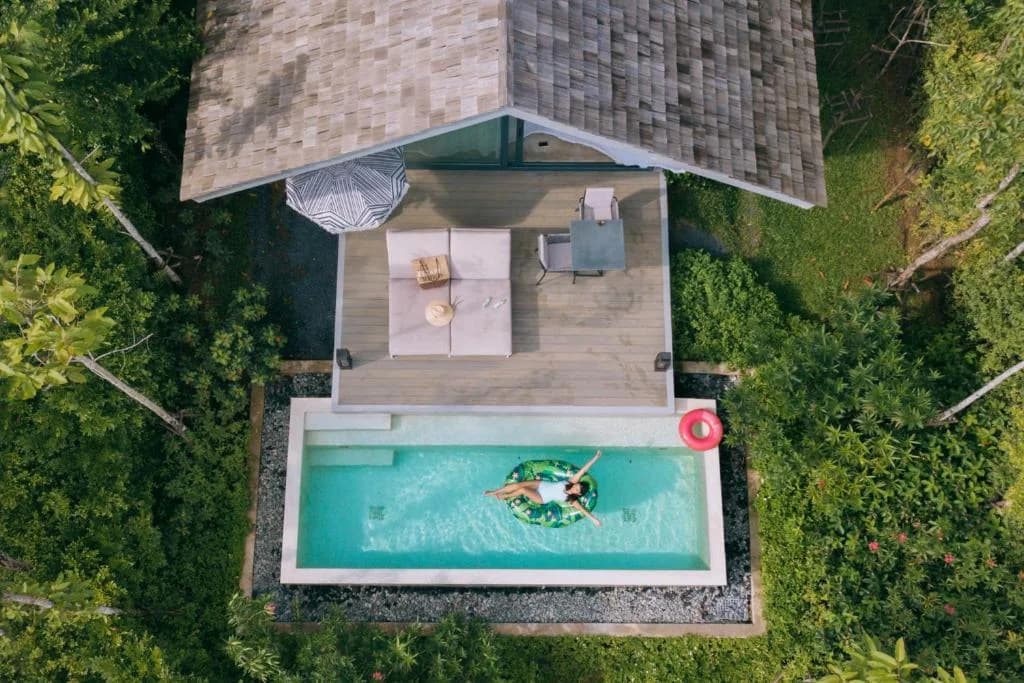
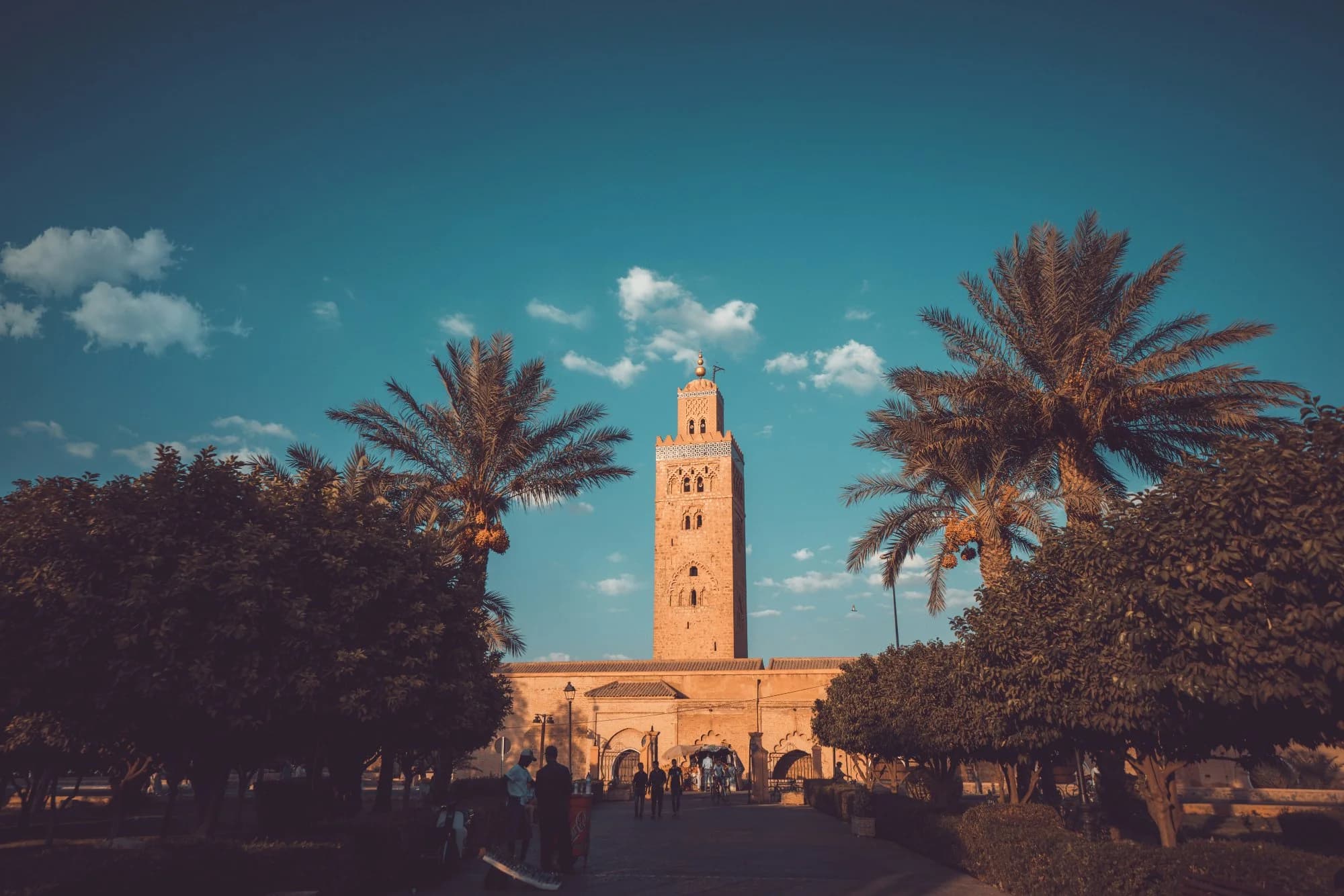
The Palmeraie, a palm grove stretching northeast of the medina, has historically attracted large resort-format hotels and private villas. Properties here offer space, grounds, and separation from the city's density. Suites in this zone tend toward garden pavilions, private pool configurations, and compound-style layouts. The trade-off is distance from the cultural core, which requires a vehicle for most excursions. For travelers whose primary interest is rest, or who are combining Marrakech with Atlas Mountain itineraries, the Palmeraie calibration makes sense. The Hivernage district, adjacent to the Menara Gardens and the Koutoubia Mosque, offers a middle register: closer to the medina than the Palmeraie, with wider streets and more conventional hotel building typologies.
Marrakech has a semi-arid climate with clearly defined seasons. Spring (March to May) and autumn (September to November) represent the most balanced windows. Temperatures in these months typically range between 18 and 28 degrees Celsius, which allows for both outdoor dining and comfortable movement through the medina on foot. Summer (June through August) sees temperatures routinely exceed 38 degrees Celsius. Many international travelers avoid this period, which can translate to better suite availability and more attentive service ratios at certain properties, though outdoor terrace use is limited to early morning and evening. Winter (December to February) is mild by northern European or North American standards, with daytime temperatures around 18 to 22 degrees Celsius. This is a peak period for European travelers seeking warmth, and availability at top properties can tighten considerably. The Marrakech International Film Festival, held annually in late November or early December, draws a significant cultural audience and affects both pricing and availability at the city's most prominent addresses. Booking well in advance for this window is standard practice among experienced travelers.
Marrakech does not operate under a French-style Palace designation system, but the city has developed its own recognizable hierarchy of quality. At the top sit properties that combine authentic architectural heritage with contemporary service standards. Several key markers define what separates a genuinely high-caliber suite from a well-photographed alternative.
First, material authenticity. The finest suites in Marrakech use original or carefully sourced zellige, tadelakt (a traditional Moroccan lime plaster finish), and carved cedar. Properties that replicate these materials in synthetic form occupy a different tier regardless of their room rate. Second, the relationship between interior and outdoor space. Marrakech architecture is organized around the sky, the courtyard, and the roof terrace. A suite that lacks a private or semi-private outdoor component misses one of the city's essential spatial propositions. Third, service calibration. The best properties in the city operate with staff-to-guest ratios that allow for named, personalized service. This is not universal across four-star and five-star designations, making direct curation more reliable than star classification alone. Fourth, acoustic management. Given the medina's intensity, the best suites are designed around sound attenuation, using thick walls, interior gardens, and considered room placement to create genuine quiet.
The decision between a medina riad suite and a Palmeraie resort suite is largely a question of intent. Travelers seeking cultural immersion and architectural intimacy belong in the medina. Travelers seeking expansive outdoor space, privacy from the city's sensory density, or a resort-style rhythm will find more coherence in the Palmeraie or Hivernage zones. A second consideration is scale. The most sought-after riad suites exist within properties of four to twelve rooms total. This means exclusivity and discretion are structural, not merely promised. Larger five-star hotels in Marrakech can also deliver suite-level quality, but the experiential register is different: more international, less specifically Moroccan. Neither is inherently superior, but the distinction is worth naming before committing. Travelers combining Marrakech with Atlas excursions or desert itineraries should also factor transfer logistics into their suite choice. Properties with strong concierge infrastructure and established driver networks simplify multi-day routing considerably. Finally, verify terrace access. Marrakech's rooftop culture is one of the city's architectural signatures. A suite with private rooftop access in the medina delivers a perspective on the city that ground-level spaces simply cannot replicate.
Marrakech has a dense and uneven hospitality market. The city's visual identity translates well to photography, which means that the gap between a property's online presentation and its actual standard can be considerable. La Suite approaches the Marrakech market as an editorial exercise, not a directory. Each property in the curated selection has been assessed against criteria that go beyond star classification: material quality, spatial logic, service ratios, and the coherence between architecture and experience. For travelers who assign real value to their time and to the quality of their environment, a curated selection by La Suite removes the primary friction in planning a high-end stay in Marrakech. The decision is not simplified. It is clarified.

The medina offers the most architecturally distinctive luxury suites, particularly within restored riad properties featuring original Moroccan tilework and courtyard design. The Palmeraie is the preferred zone for travelers seeking larger grounds, private pools, and separation from the city's density. The Hivernage district sits between the two in terms of both geography and experiential register.
A riad is a traditional Moroccan courtyard house, inward-facing and typically built around a central garden or water feature. In Marrakech, the finest riads have been restored by architects and designers with serious investment in material authenticity, combining historic craftsmanship with contemporary infrastructure. The format delivers exceptional privacy and spatial quality within the medina, making it the city's most distinctive luxury accommodation typology.
Spring (March to May) and autumn (September to November) offer the most balanced climate for visiting Marrakech, with comfortable temperatures suited to both indoor and outdoor experiences. The Marrakech International Film Festival period in late November and early December creates high demand at the city's top properties. For winter travel, booking several months in advance is advisable given the influx of European visitors seeking warmth.
A luxury suite in Marrakech typically offers a private outdoor component, whether a courtyard section, terrace, or rooftop, which is central to the architectural logic of the city's finest properties. Suites in top-tier riads also benefit from the inward-facing structure of the building, which provides acoustic isolation that standard rooms in the same property may not deliver. The ratio of interior volume to guests is also considerably higher, enabling a more calibrated service experience.
Staying inside the medina is entirely practical for experienced travelers, though it requires awareness of one logistical reality: most inner derbs are inaccessible by vehicle. Arrival and departure typically involve a short walk from a designated vehicle drop-off point, assisted by staff. Top-tier medina properties manage this transition efficiently and it does not diminish the quality of the experience. Security within curated riad properties is managed through controlled entry and discreet staffing.
Material authenticity is the primary differentiator in Marrakech: properties using genuine tadelakt plaster, hand-cut zellige tilework, and carved cedar ceilings occupy a different category from those using replicated finishes. Private or semi-private outdoor space is a second essential criterion, given how Moroccan architecture is organized around terraces and courtyard living. Service ratios and acoustic quality are the third and fourth considerations, both of which are difficult to assess from photography alone and benefit from editorial curation.
For travel during peak periods (December through February and the film festival window in late November), booking three to six months in advance is standard practice for the city's top properties, many of which have a limited number of suites. During shoulder season (spring and autumn), a six-to-eight-week lead time is typically sufficient, though specific suite categories at smaller riad properties can fill earlier. La Suite's curated selection reflects real-time availability and editorial filtering simultaneously.
Yes. The riad format is structurally suited to privacy: its inward orientation, limited room count, and controlled entry design mean that guest movements are largely invisible from the street and from other guests. Several top-tier properties in Marrakech operate with fewer than ten rooms total, which makes incidental encounters with other guests rare. For high-profile travelers seeking full discretion, entire riad buyouts are also a recognized practice at the most sought-after addresses.
Tadelakt is a traditional Moroccan lime-based plaster finish, polished with smooth stones and treated with black soap to create a water-resistant, slightly luminous surface. It has been used in Moroccan hammams and interiors for centuries. In a contemporary luxury suite context, the presence of authentic tadelakt is a reliable marker of investment in material quality and craft integrity, distinguishing a property with genuine architectural commitment from one that has applied a visual aesthetic without the underlying substance.
Several properties in Marrakech offer suite configurations suited to families or small groups, including interconnecting riad suites that can be reserved as a private cluster, or standalone villa units within larger compound properties in the Palmeraie. The inward courtyard structure of a riad is particularly well suited to families with children, as the central garden or pool creates a contained, supervised outdoor space. La Suite's curated selection includes properties with verified multi-room suite configurations for group travel.