The distinct character of Milan's luxury neighborhoods
Check out our selection of the most beautiful luxury hotel suites in Milan.
The area around the Quadrilatero della Moda, bounded by Via Montenapoleone, Via della Spiga, Via Sant'Andrea, and Corso Venezia, remains the densest concentration of international fashion and design in any European city. Suites in this zone place guests within walking distance of the major ateliers, the flagship architecture of global luxury brands, and some of the most formally composed streets in northern Italy. The sensory experience here is controlled and precise: stone facades, measured proportions, very little noise.
The Brera district, immediately to the northwest, offers a different register. Its 18th-century grid of narrow streets, the presence of the Pinacoteca di Brera, and a long-standing community of galleries and independent design showrooms give it a quieter, more considered identity. Luxury hotels in this area tend to favor interior refinement over street presence.
The Porta Nuova and Isola districts represent Milan's contemporary architectural statement. The Bosco Verticale towers, the redesigned Piazza Gae Aulenti, and a sequence of corporate headquarters from internationally recognized architects have repositioned this zone as the city's most visually assertive neighborhood. Suites here are frequently in modern properties with floor-to-ceiling glazing and elevated city views.
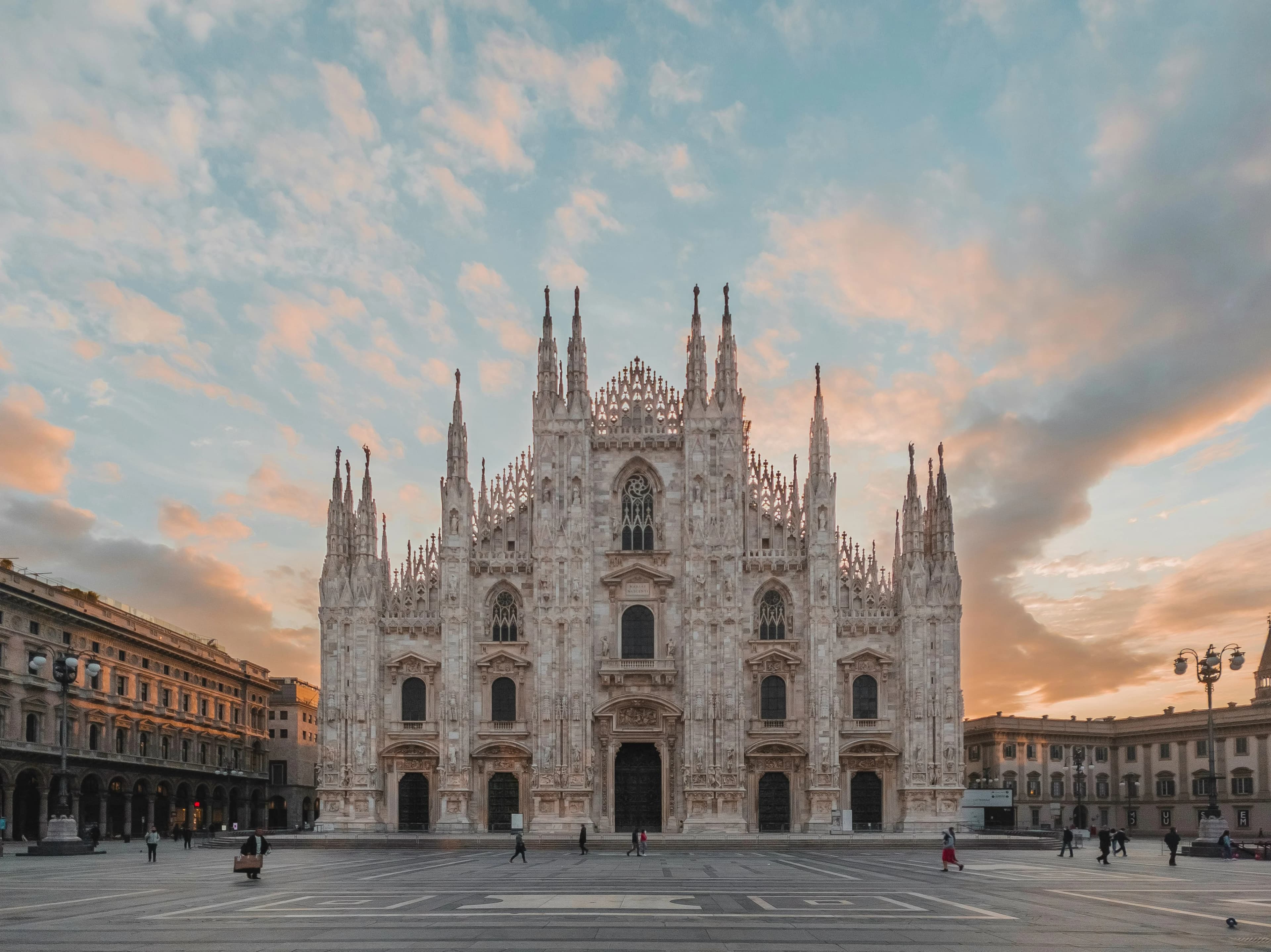
The area around the Duomo and Galleria Vittorio Emanuele II anchors the historic center. Staying here means proximity to the most visited architectural monuments in the city, as well as access to the retail and cultural axis that runs from Piazza del Duomo northward.
To learn more about Milan, check out our Milan guide to discover more about the city, its history, and its architecture, and find out how to choose the right hotel suite.
When to visit Milan for a luxury suite experience
Milan's calendar is structured around two dominant forces: the fashion weeks and the Salone del Mobile. These events shape hotel availability, pricing, and the social atmosphere of the entire city.
Milan Fashion Week occurs twice yearly, in February and September, covering both womenswear and menswear collections. During these weeks, the Quadrilatero and Brera concentrate the highest density of industry figures, press, and private events. Suite availability tightens considerably, and properties in the central zones are typically fully committed well in advance.
The Salone del Mobile, held annually in April, is among the most significant design and furniture fairs in the world. It draws buyers, architects, and creative directors from across Europe, the United States, and Asia. The event extends far beyond the Fiera Milano exhibition center: the Fuorisalone activations spread across the entire city, turning entire districts into temporary exhibition spaces. For design-literate travelers, this is the defining Milan experience.
Outside these peak periods, April, May, and September through October offer the most measured conditions for a visit. Temperatures are moderate, the city is active without being overwhelmed, and suite rates reflect a less constrained market. August sees a significant portion of Milanese residents leave the city, resulting in quieter streets and reduced restaurant availability.
Understanding luxury hotel standards in Milan
Italy does not operate a separate national designation equivalent to the French Palace classification, but Milan's top-tier hotels align with the standards of the Leading Hotels of the World and the Preferred Hotels and Resorts networks, in addition to the five-star superior category recognized under Italian hospitality regulations.
The city's legacy grand hotels, several of which have operated continuously for over a century, are characterized by neoclassical or Liberty-period architecture, formal service structures, and suites conceived as residential compositions rather than oversized guest rooms. These properties typically feature butler service, in-room dining menus developed by executive chefs with independent reputations, and concierge teams with direct relationships across the cultural and commercial life of the city.
A parallel category exists in the form of design hotels, properties where the architectural brief took precedence over historical continuity. Several internationally recognized architects and interior designers have contributed to this segment in Milan, producing suites with a fundamentally different spatial logic: fewer decorative layers, more deliberate material choices, and a stronger relationship between the room and the view it frames.
How to choose the right luxury suite in Milan
The most consequential decision when selecting a luxury hotel suite in Milan is the relationship between location and purpose. A traveler attending the Salone del Mobile will have different spatial and logistical requirements from someone in the city for a week of private dining, cultural visits, and fashion appointments.
Architecture matters in a city this dense and this visually coherent. The choice between a 19th-century palazzo conversion and a contemporary tower suite is not purely aesthetic: it determines the quality of natural light, the acoustic environment, the proportions of living and sleeping areas, and the nature of outdoor space. Terraces in Milan are rare and consequential. A suite with a private terrace overlooking a cortile or a rooftop with a direct sightline to the Duomo represents a genuinely different category of experience.
Suite size should be assessed in relation to the length of stay and the nature of the visit. For stays exceeding four nights, a suite with a separated living room and dedicated workspace becomes a functional requirement rather than an indulgence. Milan is a working city, and its best suites are designed to accommodate professional life alongside leisure.
Service infrastructure is a further differentiator. The best luxury hotels in Milan maintain relationships with private drivers, personal shoppers at the major houses, access to private dining rooms at Michelin-starred restaurants, and direct channels to cultural institutions. These are not standard features: they require deliberate selection.
Why a curated selection by La Suite matters in Milan
Milan presents a dense and sometimes opaque hotel market. The volume of properties claiming luxury positioning has expanded significantly over the past decade, and the distance between marketing language and the actual suite experience is not always visible from a standard booking interface.
La Suite applies a consistent editorial framework to every property it lists. The selection is assessed on spatial quality, service architecture, location coherence, and the specific experience delivered at suite level. Properties that perform well in the lobby or at the restaurant but deliver a generic room experience at the suite tier do not meet the curation threshold.
For a city as exacting as Milan, where the traveler's reference points are likely to include private residences, design week installations, and Michelin tables, the accommodation must hold its own against the broader experience. The curated selection by La Suite is built on that standard.
To combine professional success with the Milanese way of life, explore our exclusive selection of the finest executive suites in Milan, designed to transform your business trips into an exceptional experience in the heart of the design capital.