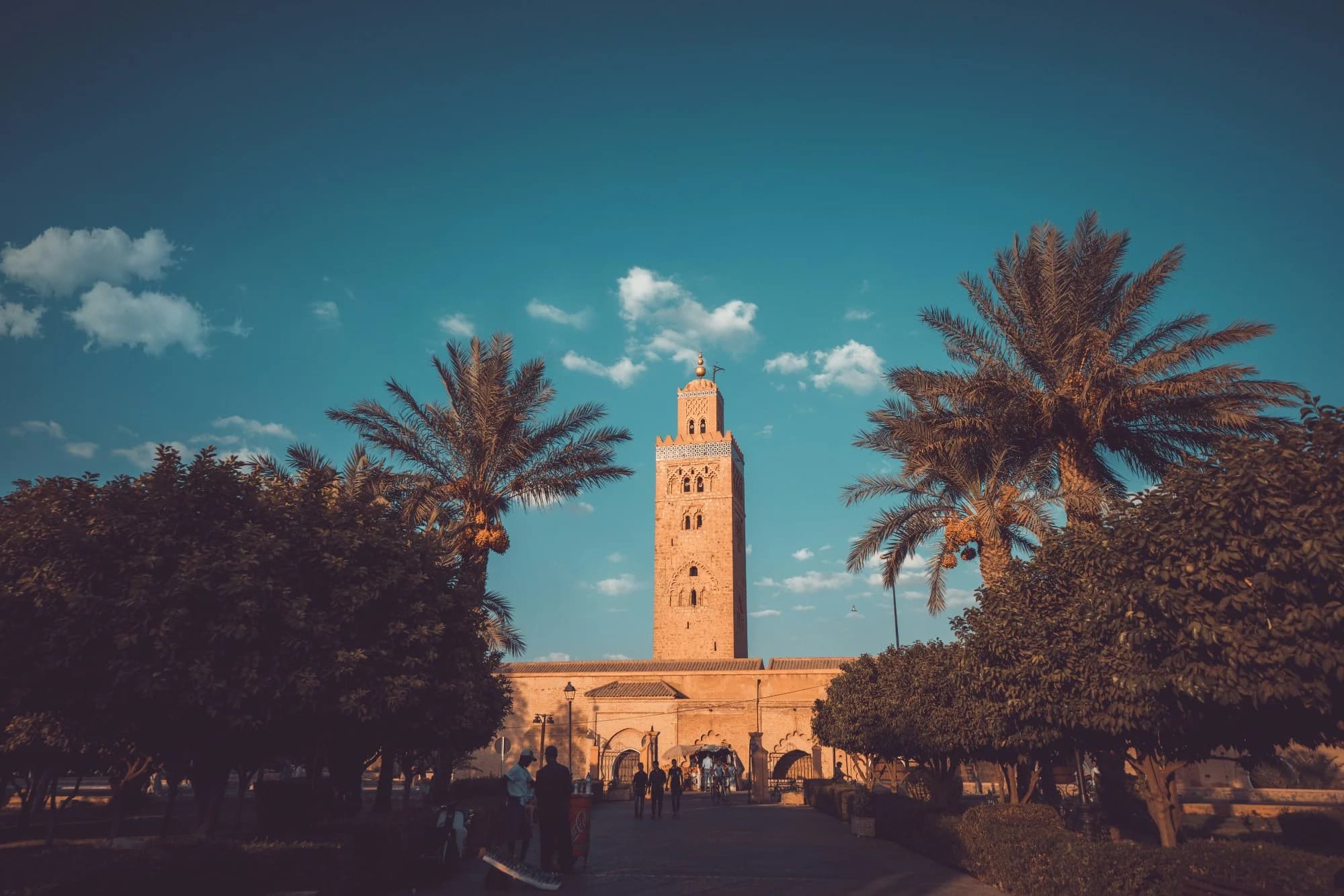
Agdal in the context of Marrakesh's luxury landscape
Best areas within Marrakesh for luxury suite stays
The medina and its riad tradition
The historic medina remains the reference point for immersive Moroccan luxury. Riads converted into high-end properties offer suites arranged around internal courtyards, with zellij tilework, carved cedar ceilings, and plunge pools concealed behind unmarked exterior walls. This is a fundamentally inward-looking architecture: the street reveals nothing, while the interior is dense with craft and sensory detail. Suites in this zone tend toward the intimate rather than the expansive.
Hivernage and the Palmeraie
Hivernage, immediately adjacent to the Jemaa el-Fna, developed as Marrakesh's first modern luxury corridor during the mid-twentieth century. Large hotel properties with gardens, pools, and ballrooms characterize this district. The Palmeraie, a palm grove stretching north of the city, offers a different proposition entirely: resort-scale properties with substantial suite inventories, equestrian facilities, and spa infrastructure set against an arid, flat landscape that reads as theatrical in its own right.
Agdal and the new city
Agdal and the adjacent Gueliz district form Marrakesh's contemporary spine. Hotels here tend to be more recent constructions, with larger room footprints, international brand affiliations, and facilities calibrated to business travelers as much as leisure guests. For those prioritizing suite size, connectivity, and proximity to the city's modern commercial infrastructure, this zone is rational and efficient without sacrificing access to Marrakesh's cultural core.
When to visit Marrakesh for a suite stay
Marrakesh operates within a semi-arid climate, which produces sharp seasonal contrasts. The months of March through May offer the most comfortable conditions: temperatures are moderate, the city's gardens are at their most considered state, and major cultural programming, including the Marrakesh International Film Festival held annually in December and various art events across the calendar, creates distinct peaks in demand. October and November offer a similar temperate window after the intensity of summer. July and August bring extreme heat, regularly exceeding 38 degrees Celsius, which concentrates life around hotel pools and interior spaces. This is when suite infrastructure, particularly private terraces and plunge pools, justifies its premium most clearly. The lowest occupancy period, January through February, offers competitive rates and cold but clear conditions.
Local luxury standards: what to expect from a top-tier suite in Morocco
Morocco does not operate a formal palace hotel classification equivalent to France's distinction, but the country's luxury hospitality landscape has developed a coherent set of references. The converted riad model remains the most distinctly Moroccan luxury format: privately owned historic houses restructured around traditional courtyard geometry, with suites sized between 40 and 120 square meters depending on the property's footprint. Materials are central to the experience. Tadelakt (a polished lime plaster finish), hand-cut mosaic tile, and carved plasterwork known as gebs are the primary architectural vocabularies. In higher-grade properties across Morocco, these elements are sourced from the same artisanal workshops that have supplied Moroccan royal architecture for generations. International luxury brands operating in Marrakesh, particularly in Hivernage and the Palmeraie, conform to their global suite standards while incorporating local material references. The result is a hybrid product that is internationally legible but geographically specific in its surface treatment.
How to choose the right suite in Agdal and Marrakesh
Architecture: historic versus contemporary
The fundamental choice in Marrakesh is between historic fabric and modern construction. Riad suites offer craft density, intimacy, and cultural specificity. Contemporary properties offer larger footprints, more predictable mechanical systems (air conditioning calibrated to larger volumes, lift access, consistent water pressure), and the logistical reliability that extended stays or families tend to require. Neither is superior; the decision is a function of what the stay is for.
Space and configuration
Marrakesh suites vary considerably in configuration. Riad properties frequently offer suites that span entire upper floors, with private roof terraces that function as outdoor living rooms. Resort properties in the Palmeraie offer ground-floor suites with direct garden or pool access. For families or groups, the question of interconnecting rooms or villa-format accommodation becomes relevant; the Palmeraie and Agdal zones offer more flexibility in this regard than the constrained footprints of medina riads.
Proximity and access
Agdal's location places it within ten to fifteen minutes by car from both the medina and Marrakesh Menara Airport. This geographic centrality is practically useful for itineraries that combine cultural visits with departures or arrivals at irregular hours. The neighborhood's street structure also makes private vehicle access straightforward, which is not always the case in the narrow lanes of the medina.
The value of curated selection in Marrakesh
Marrakesh's luxury hotel market has expanded significantly over the past two decades, producing a wide range of properties that describe themselves in similar terms. The practical challenge for a discerning traveler is distinguishing between properties where the suite product genuinely delivers on its material and spatial promises and those where the photography has outpaced the reality. La Suite applies an editorial filter to this market, focusing on properties where the suite experience, not simply the hotel category, meets the standards expected by guests who choose suites deliberately. Across Marrakesh's districts, from the medina to Agdal, the curated selection at lasuite.com prioritizes spatial generosity, material quality, and service calibration over brand recognition alone. Africa's luxury hospitality landscape is developing rapidly, and Morocco sits at its most refined edge. A considered selection matters here more than in markets where product consistency is already established.