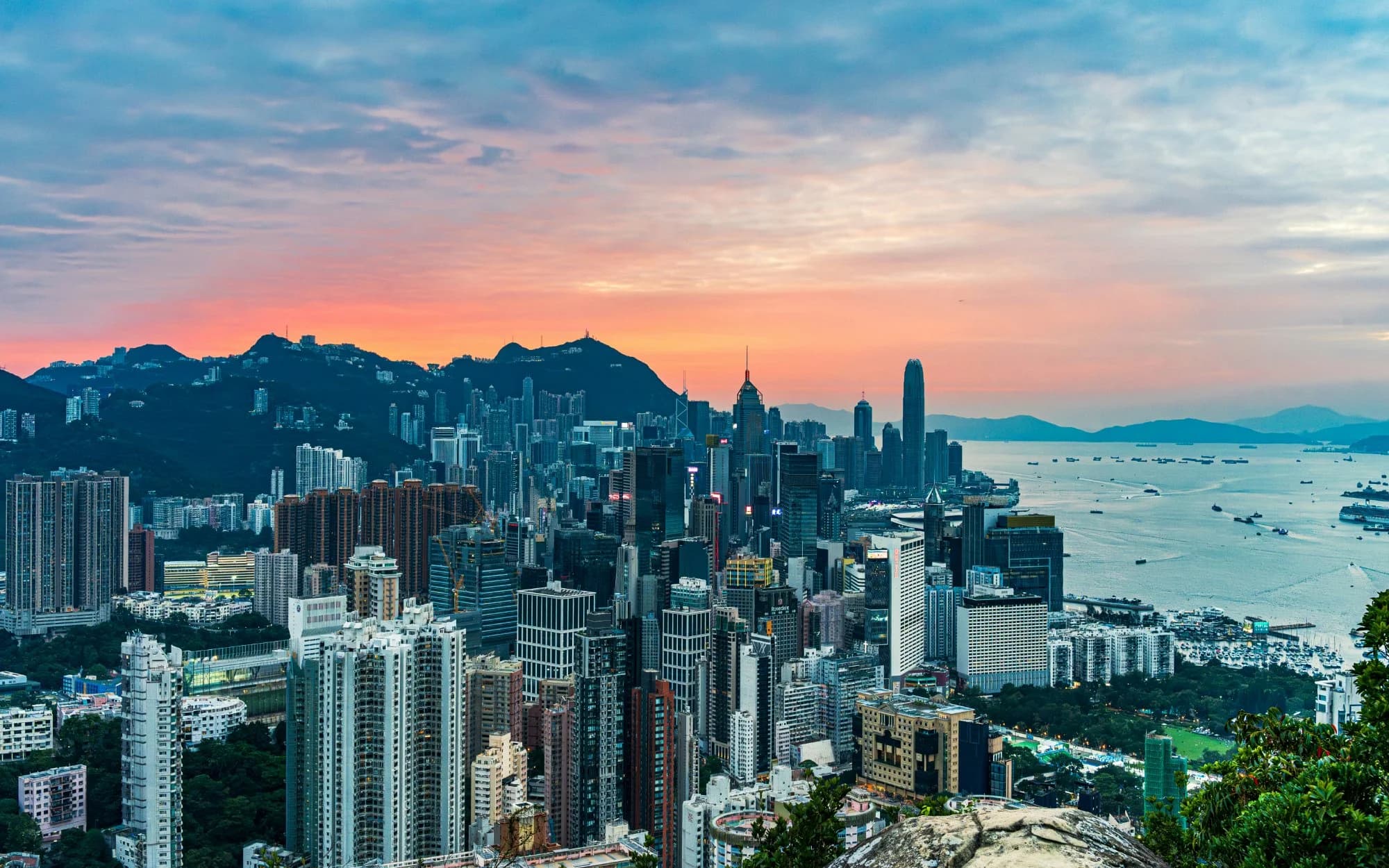
The distinct areas of Hong Kong Island for luxury stays
Central and Admiralty
Central is the island's financial spine, a dense vertical corridor where glass towers sit immediately adjacent to colonial-era government buildings. Admiralty, its eastern continuation, houses some of the island's most significant corporate addresses and cultural institutions. Luxury hotels in this corridor cater primarily to a business-first traveler who nonetheless expects sensory precision: harbour-facing suites, high floors, and materials that signal restraint rather than excess. Proximity to the MTR and the Airport Express link makes this zone logistically efficient for any itinerary anchored in Hong Kong.
The Peak and Mid-Levels
Rising steeply above Central, the Mid-Levels and Victoria Peak represent Hong Kong Island's residential prestige belt. The elevation translates directly into unobstructed views across the harbour toward Kowloon. Suites in this zone tend to emphasise residential scale: larger floor plates, private terraces, and a quieter acoustic environment that contrasts sharply with the intensity of the streets below. The Peak Tram, operating since 1888, remains the most direct vertical connector between these two registers of the city.
Wan Chai and Causeway Bay
Moving east from Central, Wan Chai and Causeway Bay offer a denser, more heterogeneous urban fabric. These neighbourhoods hold significant cultural infrastructure, including the Hong Kong Convention and Exhibition Centre and the Hong Kong Arts Centre. For travelers engaged with the city's contemporary art and design scene, a suite in this corridor provides immediate access to gallery openings, design weeks, and the social circuits that parallel the city's commercial calendar.
Aberdeen and the southern districts
The southern side of Hong Kong Island operates at a different pace. Aberdeen Harbour retains its identity as a working waterfront, while Stanley and Repulse Bay face the South China Sea rather than Victoria Harbour. Luxury accommodations on this side of the island offer a genuinely different spatial proposition: ocean-facing suites, lower ambient noise, and proximity to beach clubs and hiking trails across the island's green belt.
When to visit Hong Kong Island
The optimal window for a suite-based visit to Hong Kong Island falls between October and early December. Humidity drops significantly, temperatures settle between 18 and 25 degrees Celsius, and the light quality across Victoria Harbour acquires a clarity that the summer months rarely permit. This period also coincides with Art Basel Hong Kong's satellite programming and several significant cultural events that draw an international design-literate audience.
March and April bring Art Basel Hong Kong itself, typically one of the most significant annual gatherings of the global art market in Asia. Suite demand in Central and Wan Chai peaks sharply during this period, and advance planning is essential. The summer months from June through September are characterised by high humidity, frequent typhoons, and compressed availability at premium properties. Travelers who visit during this period should confirm typhoon policies with their hotel directly.
The period around Chinese New Year, which falls between late January and late February depending on the lunar calendar, brings a distinct social energy to the island. Public spaces are activated differently, restaurants operate on modified schedules, and the harbour fireworks display on New Year's Eve represents one of the most architecturally framed light events in the region.
Local luxury standards on Hong Kong Island
Hong Kong does not operate a formal palace classification equivalent to France's distinction for its leading hotels. Instead, the market self-regulates through a combination of international brand positioning, architectural investment, and service-to-space ratios that are immediately legible to experienced travelers.
The island's top-tier suites are typically characterised by harbour-view orientation, dedicated butler or concierge infrastructure, and floor plates that exceed what comparably priced suites would offer in most European capitals. Many of the island's leading luxury hotels have undergone significant renovation cycles in the past decade, resulting in a contemporary residential aesthetic that privileges material quality and spatial generosity over decorative accumulation.
Service culture in Hong Kong's premium hotels reflects the city's broader professional ethos: precise, efficient, and notably multilingual. Cantonese, Mandarin, and English are standard across front-of-house operations at any serious property. For travelers arriving from the United Kingdom or the United States, the operational familiarity of the service environment reduces friction without diminishing the sense of being in a genuinely distinct cultural context.
How to choose the best suite on Hong Kong Island
The primary variable in any Hong Kong Island suite decision is orientation. A harbour-facing suite on a high floor in Central or Admiralty delivers one of the most architecturally specific urban views available anywhere: the neon-and-glass skyline of Kowloon reflected across Victoria Harbour, with the density of the island's own towers framing the foreground. This is a view that repays investment and should be treated as a core selection criterion rather than an optional upgrade.
Beyond orientation, floor height matters structurally. The island's topography means that lower floors in many Central properties face directly into adjacent towers rather than outward. The difference between the 20th and 40th floor at many properties is qualitatively significant, not merely symbolic.
For travelers prioritising space over views, the southern districts and the Mid-Levels offer suite configurations with larger footprints and terrace access. These properties trade harbour panoramas for residential quietude, a meaningful trade for longer stays or family configurations.
Connectivity is a practical consideration that should not be underweighted. The MTR network is exceptionally efficient, and a suite in Admiralty or Central places the traveler within a short commute of every significant district on both sides of the harbour. Properties further from MTR stations require more deliberate planning around transportation, particularly during peak commuting hours.
The value of curation on Hong Kong Island
The luxury hotel market on Hong Kong Island is both deep and complex. International chains operate flagship properties alongside independent hotels, and the range of suite configurations, price points, and experiential registers is genuinely wide. For a traveler arriving without prior knowledge of the island's geography and hotel landscape, the volume of options can obscure rather than clarify the decision.
La Suite approaches Hong Kong Island with the same editorial discipline it applies across all destinations in Hong Kong: a focus on suites that justify their position through spatial quality, service consistency, and contextual intelligence. The selection prioritises properties where the suite itself, not merely the hotel brand, is the primary argument for staying. In a market where brand familiarity can sometimes substitute for genuine product quality, that distinction matters. The curated selection by La Suite is designed to make the right choice immediately legible, regardless of how frequently the traveler has visited the island before.