Understanding Rotorua as a luxury destination
For the design-literate traveler, Rotorua presents an unusual challenge: the environment itself is the attraction. Choosing where to stay is therefore not an afterthought. A luxury hotel suite here should operate in direct dialogue with the geothermal setting, the lake views, and the surrounding forests. The quality of that relationship determines the quality of the stay.
The distinct areas within and around Rotorua
The lakefront and city centre
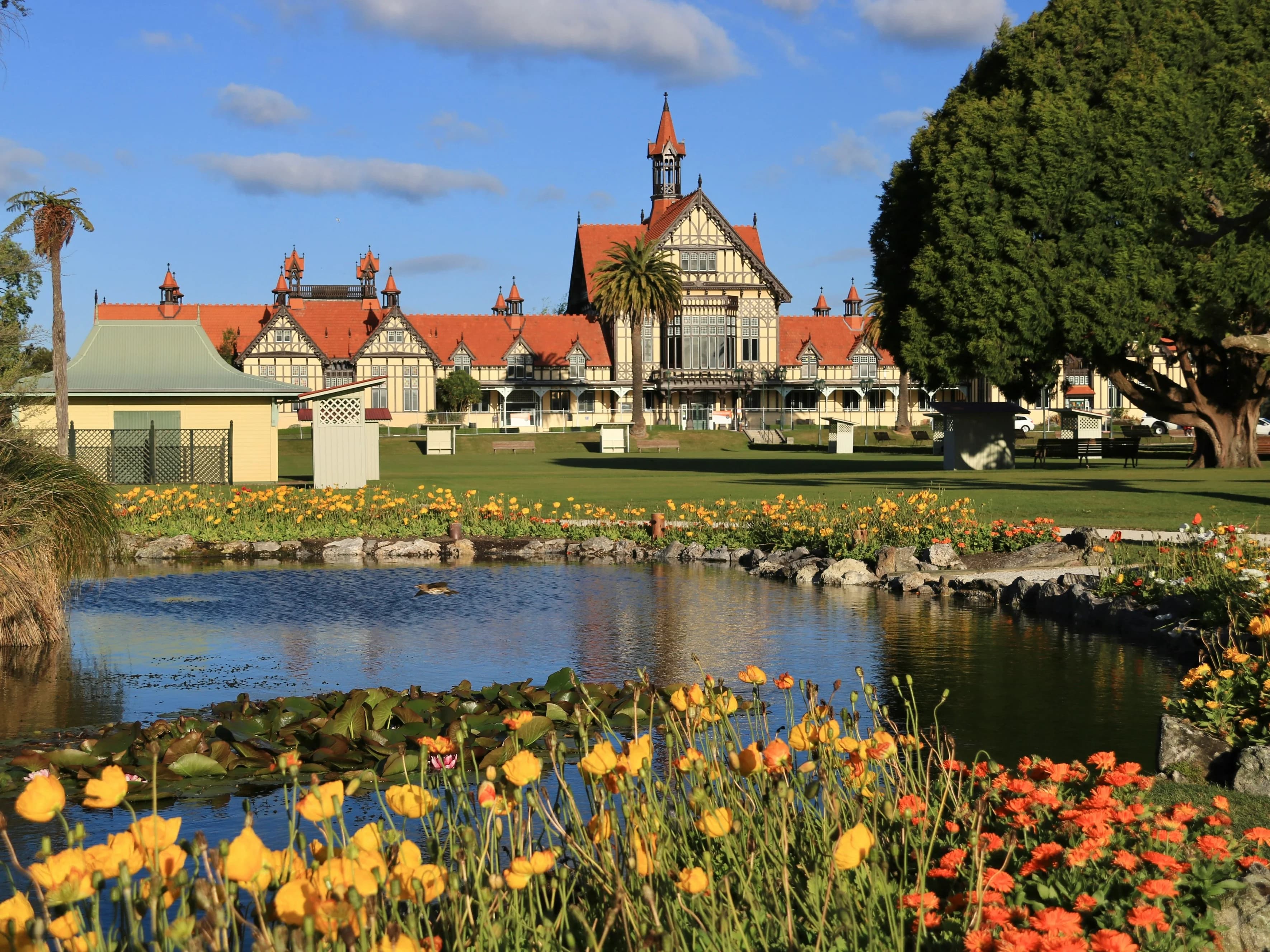
The lakefront corridor offers the clearest views across Lake Rotorua, a body of water that stretches roughly 80 square kilometres and carries both visual and cultural weight. Hotels positioned along this edge benefit from morning light that reads differently at altitude and latitude from almost anywhere else. The city centre itself is compact and walkable, with the Government Gardens, the historic Bath House building, and Te Puia all within reach. Suites in this zone suit travelers who want proximity to cultural institutions and dining without sacrificing the landscape connection.
The Waikite Valley and rural perimeter
Beyond the urban core, the Waikite Valley and the rural southern perimeter offer a different register entirely. Here, accommodation sits within working geothermal landscapes: boiling springs, silica terraces, and native bush that transitions from lowland fern cover to dense podocarp forest. Properties in this zone prioritise seclusion and thermal access over urban convenience. For travelers whose primary interest is restorative immersion, this is the more compelling address.
Hamurana and the northern lake shore
The northern shore of Lake Rotorua, anchored by the Hamurana Springs Reserve, is among the quieter approaches to the region. Ancient redwood groves and natural spring-fed pools define the experience here. The pace is slower, the density of visitors thinner, and the spatial quality of the surrounding landscape more intimate. Boutique properties in this area tend toward smaller footprints with stronger connections to the immediate environment.
When to visit Rotorua for a luxury suite stay
Rotorua operates year-round as a destination, but the timing of a visit shapes the experience considerably. New Zealand's summer (December through February) brings longer daylight hours, warmer air temperatures, and higher demand across the accommodation market. Advanced planning is essential during this period, particularly for properties with limited suite inventory.
Autumn (March through May) is increasingly regarded as the optimal window. The landscape softens into amber and ochre tones in the surrounding forests, temperatures remain comfortable, and the visitor density drops measurably. Thermal bathing in cooler ambient temperatures carries a particular sensory logic during this season.
Winter (June through August) is underrated for a certain profile of traveler. Rotorua's geothermal heat means that outdoor thermal experiences remain fully operational regardless of air temperature. Mist rising from the earth against a cold, clear sky is one of the region's more arresting visual signatures. Suite rates can be more accessible during this period, with better availability across properties.
Matariki, the Maori New Year marked by the rise of the Pleiades star cluster, is observed in late June or early July and has been a national public holiday in New Zealand since 2022. Cultural programming in Rotorua during this period is significant and worth coordinating a visit around.
Local luxury standards: what to expect from top-tier suites in Rotorua
New Zealand does not operate a formal hotel classification system equivalent to France's Palace designation or Italy's five-star gran turismo category. Quality is assessed through independent review bodies, international luxury travel consortia (including Relais and Chateaux and Small Luxury Hotels of the World), and editorial curation.
In Rotorua specifically, the most distinctive luxury suites tend to share several characteristics. First, direct or facilitated access to geothermal bathing, whether private pools fed by natural mineral water or spa programmes built around the region's thermal chemistry. Second, a spatial relationship with the landscape that is deliberate rather than incidental: suites designed to frame the lake, the forest, or the steam fields rather than simply occupy a floor plan. Third, integration of Maori cultural elements that goes beyond decoration. The most considered properties engage with local iwi (tribal communities) to ensure that cultural storytelling, food, and design are handled with authentic authorship.
Expect suite categories to range from lake-view rooms with private balconies to standalone villas with dedicated thermal pools and butler access. The benchmark for genuine luxury in this region is the degree to which the suite removes the friction between the traveler and the landscape.
How to choose the right luxury suite in Rotorua
Thermal access as a primary criterion
In few destinations does a single amenity category matter more. The presence or absence of a private geothermal pool attached to a suite is a decision that shapes the entire stay. Shared thermal facilities, while often well-designed, deliver a categorically different experience from a private soak at dusk with unobstructed views. Confirm the source and temperature range of the thermal water, as properties vary significantly in the quality and mineral composition of their water supply.
Architecture and materiality
Rotorua's most thoughtful properties work with local materials: native timber, volcanic stone, and organic textiles that carry the region's palette. Suites in this tradition tend to age better aesthetically and create a more coherent sensory environment than those that import a generic international luxury language. When reviewing suite photography, look for spatial restraint and material authenticity over surface opulence.
Cultural positioning
Rotorua is one of the most significant centers of Maori culture in New Zealand. Properties that acknowledge this through genuine engagement, rather than tokenistic gesture, offer a richer context for the stay. Look for accommodation with documented relationships with local Maori communities, or those that incorporate te reo Maori (the Maori language) and tikanga (customs) into the guest experience with transparency.
The value of curation in a market this specific
Rotorua's luxury accommodation market is smaller and more specialist than major international gateway cities. The range of genuinely distinguished suites is not broad, which makes the quality of the selection process more consequential. A curated approach removes the noise of aggregator platforms, where volume and commission structures tend to distort visibility.
La Suite's editorial approach to destinations like Rotorua applies the same standards used across the broader New Zealand portfolio: spatial quality, design integrity, cultural authenticity, and the degree to which a property earns its positioning within the landscape it occupies. The curated selection by La Suite exists precisely for destinations where the margin between a good stay and an exceptional one is determined by decisions that are not visible in a standard booking interface.