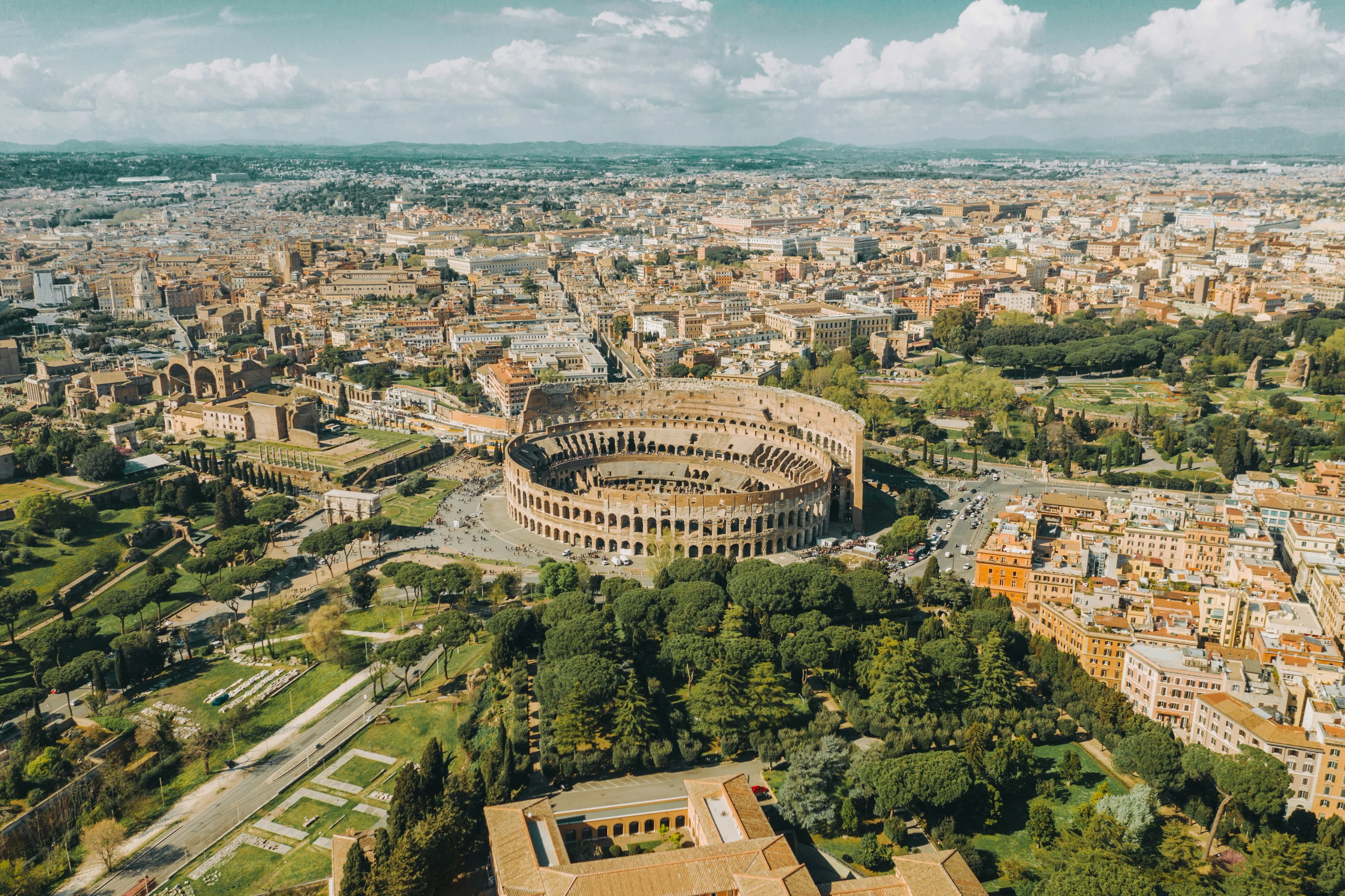
Why Borgo stands apart within Rome
For travelers seeking a luxury hotel suite in Rome, Borgo offers something the more fashionable neighbourhoods cannot replicate: genuine historical density combined with relative calm. The crowds that mass along Via della Conciliazione tend to dissolve quickly once you step a block north or south. What remains is a quarter that feels inhabited rather than performed, where Roman families have lived alongside pilgrims and diplomats for generations.
Best areas within Borgo for luxury stays
The Tiber-facing edges
Properties along the Tiber embankment benefit from some of the most architecturally significant views in Rome. The Castel Sant'Angelo, originally Hadrian's mausoleum and later a papal fortress, anchors the eastern boundary of Borgo with a mass that few urban landmarks in Italy can match. Suites on the upper floors of hotels positioned near the Lungotevere command unobstructed sightlines toward this structure and across the river toward the Prati district.
The internal grid of Borgo Pio
The narrow lanes of Borgo Pio itself preserve a texture closer to medieval Rome than almost anywhere else within the historic centre. Hotels occupying converted palazzo structures here tend to offer interiors of considerable character: vaulted ceilings, stone staircases, inner courtyards that buffer street noise entirely. For travelers who value spatial and material authenticity, this area within Borgo rewards careful selection.
When to visit Borgo and the wider Rome area
Rome operates on a calendar shaped by religion, academia, and climate in roughly equal measure. For luxury travelers, the most considered windows are late September through November and March through May. These periods offer tolerable temperatures (typically 15 to 22 degrees Celsius), reduced pedestrian congestion around the Vatican, and a cultural programme that includes museum exhibitions, concert seasons, and major ecclesiastical events that carry genuine ceremonial weight.
The weeks surrounding Easter are a specific case. Borgo becomes the staging ground for some of Catholicism's most significant public rituals, including the Via Crucis at the Colosseum and the Easter Sunday mass in St Peter's Square. For travelers with an interest in the choreography of institutional ceremony at scale, this period is without parallel in Europe. Hotel availability in Borgo tightens considerably during Holy Week, and suite inventory at the better properties is typically absorbed months in advance.
August presents the inverse condition: the city empties of Romans, temperatures regularly exceed 35 degrees Celsius, and the neighbourhood loses some of its quotidian life. Travelers who do visit in August will find reduced rates at certain properties, though the sensory experience of Borgo in August is a specific and demanding proposition.
Understanding luxury hotel standards in Rome
Italy does not operate the French Palace classification system, but Rome has its own hierarchy of prestige that any serious traveler should understand before selecting a suite. At the apex sit properties that have historically hosted heads of state, diplomats, and cultural figures of international standing. These hotels are characterised not by a government designation but by the cumulative weight of their provenance: the age of the building, the calibre of past guests, the quality of the interior architecture, and the consistency of their service model over decades.
Within Borgo specifically, the luxury hotel offer is more intimate than in the Via Veneto corridor or the area around the Spanish Steps. Properties here tend to be smaller, often occupying converted religious or civic buildings, and the suite product reflects that scale. Expect rooms with genuine historical fabric: original stone floors, frescoed ceilings in certain configurations, and proportions that speak to the building's original purpose rather than to a contemporary hospitality template.
Service in Rome's top-tier hotels is characterised by a particular kind of formality that is warmer and less codified than its Parisian equivalent. Staff at the best properties typically have multi-generational relationships with the institution, and that continuity is reflected in the granularity of local knowledge they carry.
How to choose the right luxury suite in Borgo
The primary distinction to establish early is between a converted historic structure and a purpose-built or extensively renovated hotel. Both have merit, but they offer fundamentally different sensory and spatial experiences. A converted palazzo suite in Borgo will typically feature irregular room geometry, windows positioned for light rather than view, and acoustic conditions shaped by centuries-old masonry. A renovated property may offer more predictable comfort metrics while still incorporating historical elements in its public spaces.
Floor selection matters considerably in this neighbourhood. Upper floors in taller buildings occasionally offer rooftop or high terrace access with views toward the Vatican dome, a spatial relationship that is genuinely rare and commands a corresponding premium. Ground floor and lower floor suites in converted structures tend to benefit from courtyard access and greater insulation from external noise, but sacrifice that vertical relationship with the cityscape.
Proximity to Via della Conciliazione, the broad processional avenue connecting Castel Sant'Angelo to St Peter's Square, is a double-edged consideration. Properties on or immediately adjacent to this axis have architectural significance but also carry elevated noise and pedestrian traffic. The internal streets of Borgo Pio offer greater tranquility at the cost of some direct sightlines.
The value of a curated selection in this neighbourhood
Borgo's hotel offer is smaller and less well-documented than Rome's more prominent luxury corridors. The consequence is that general booking platforms tend to surface the same handful of well-marketed properties while overlooking smaller converted residences and boutique palazzo hotels that may offer a more considered suite experience. The information asymmetry here is real and consequential for travelers who are allocating significant budget to their accommodation.
La Suite's curation of Rome is built on direct knowledge of the suite inventory across the city's distinct quarters, including Borgo. Rather than ranking by star count or review volume, the selection is assessed on spatial quality, material authenticity, service consistency, and the specific experience each suite delivers within its neighbourhood context. For a district as particular as Borgo, that granularity is not optional. It is the only reliable basis for a decision at this level of investment.