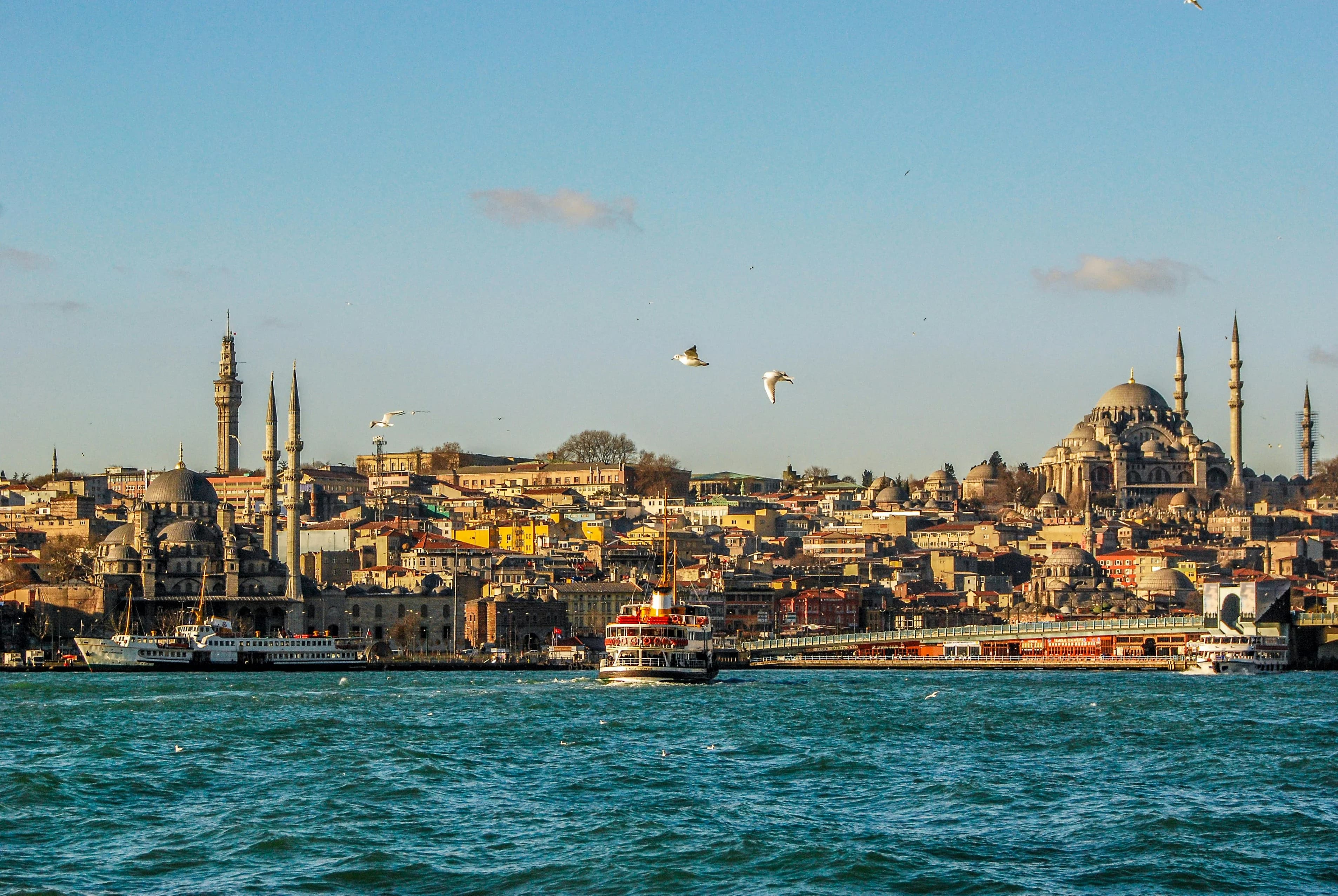
Karaköy as a base for exploring Istanbul
What distinguishes Karaköy from other Istanbul districts is its texture. The streets are narrow and layered: fish markets give way to specialty coffee roasters, which give way to industrial loft conversions housing architecture studios. The neighborhood attracts a local creative class that has no particular interest in performing for tourists, which gives it a social density that feels earned rather than curated for consumption.
The distinct character of different parts of the district
The waterfront corridor
The stretch immediately along the Karaköy waterfront, from the Galata Bridge toward the Tophane ferry terminal, carries the most visual weight. Nineteenth-century stone customs buildings, converted into hotels and cultural spaces, face the Bosphorus directly. Properties here offer views across the water to the Üsküdar skyline on the Asian shore, a prospect that changes register entirely at dusk. A luxury hotel suite on this corridor combines maritime atmosphere with immediate urban connectivity.
Upper Karaköy and the Galata approach
Moving inland and uphill toward the Galata Tower, the neighborhood becomes denser and more residential in character. This zone, sometimes called Upper Karaköy, has attracted independent restaurants, design-oriented retail, and smaller boutique hotel operations that prioritize material finish over room count. The architecture here mixes Ottoman-era residential buildings with early Republican facades, and the street-level activity is quieter and more concentrated than on the waterfront.
Tophane and the gallery district
The Tophane quarter, at the southeastern edge of Karaköy, contains Istanbul's most significant concentration of contemporary art galleries. Istanbul Modern, the city's primary museum of modern and contemporary art, relocated to a new waterfront building in this zone. For culturally motivated travelers, proximity to Tophane is a meaningful consideration when selecting a luxury suite, as the gallery circuit is walkable and operationally dense during the Istanbul Biennial, held every two years in September and October.
When to visit Karaköy
Istanbul operates on a broadly Mediterranean climate, but with meaningful variation. Spring, from late March through May, offers mild temperatures, lower humidity, and the most favorable light for the city's characteristic stone surfaces. This is generally the strongest season for a considered visit to Karaköy, as the waterfront terraces become usable, the gallery season is active, and hotel availability remains rational before the peak summer period.
September and October represent a second high-quality window. Temperatures moderate from the summer peak, the Istanbul Biennial activates the Tophane gallery zone in biennial years, and the Bosphorus retains enough warmth for waterfront dining. The Istanbul Design Biennial, held in alternate years, also concentrates cultural programming in the broader Beyoğlu and Karaköy area during this period.
Summer, from June through August, brings heat, humidity, and significantly elevated hotel rates across the city. Demand for luxury hotel suites in the most sought-after properties peaks during this window, and advance reservation lead times extend considerably. Winter offers the lowest rates and a more local atmosphere, but some waterfront amenities operate on reduced schedules.
Local luxury standards in Istanbul and Karaköy
Turkey does not operate the French-style Palace classification system, but Istanbul's top-tier hotel market is substantive and internationally benchmarked. The city's most significant luxury properties are affiliated with global groups including Four Seasons, Mandarin Oriental, and Çırağan Palace Kempinski, the latter occupying a nineteenth-century Ottoman imperial palace on the Bosphorus shore in the Beşiktaş district.
Within Karaköy specifically, the luxury positioning tends toward design-led boutique properties rather than grand-scale palace hotels. The neighborhood's architectural stock, primarily converted warehouses and historic commercial buildings, lends itself to suite formats that emphasize spatial volume, exposed original materials, and considered contemporary interiors. Expect high ceilings, stone or timber structural elements, and views oriented toward the water or the Galata Tower silhouette. For a broader view of what Turkey offers across its full luxury hotel spectrum, the contrast between Karaköy's urban precision and the resort typologies of the Aegean coast is instructive.
Service standards in Karaköy's better properties reflect Istanbul's cosmopolitan orientation: multilingual staff, familiarity with international guest expectations, and an operational fluency that extends to restaurant reservations, gallery access, and Bosphorus boat arrangements.
How to choose the best luxury suite in Karaköy
Prioritize view orientation
In a waterfront district, view orientation is a primary variable. Suites facing the Bosphorus and the Asian shore carry a premium that is architecturally justified: the water view in Istanbul has a visual weight that is difficult to replicate from an interior-facing room. If the visual dimension of a stay matters to you, specify water-facing orientation at the point of reservation rather than treating it as a secondary preference.
Consider architectural format
Karaköy's luxury hotel stock divides broadly between converted historic buildings and purpose-built contemporary properties. Converted buildings offer material authenticity and spatial idiosyncrasy: original stone vaults, irregular floor plans, and ceiling heights that modern construction rarely replicates. Purpose-built properties offer acoustic precision, technical specification, and a more predictable spatial logic. Neither format is categorically superior; the choice reflects what kind of sensory experience you are optimizing for.
Assess proximity to specific cultural programs
If your visit is structured around specific cultural events, proximity to the Istanbul Modern, the gallery cluster in Tophane, or the ferry terminals for Bosphorus access should influence property selection. Walking distance in Karaköy is short in absolute terms but variable in gradient: the district is hilly, and the distance between the waterfront and upper Galata involves a meaningful vertical climb.
The value of a curated selection in Karaköy
Karaköy is a compact district, but the luxury hotel market within it is not uniformly consistent. Properties marketed with similar positioning deliver meaningfully different experiences in terms of suite volume, material quality, and operational attentiveness. The gap between a well-reviewed property and one that meets the specific standard required for a considered stay is not always visible from standard booking interfaces.
La Suite's editorial approach to Karaköy, and to Istanbul more broadly, applies the same criteria used across the Middle East and international portfolio: spatial generosity, architectural coherence, service calibration, and a suite format that justifies the category rather than simply applying the label. The curated selection by La Suite is designed to reduce the decision friction specific to this district, where the volume of options and the variability of standards make independent research time-intensive and imprecise.