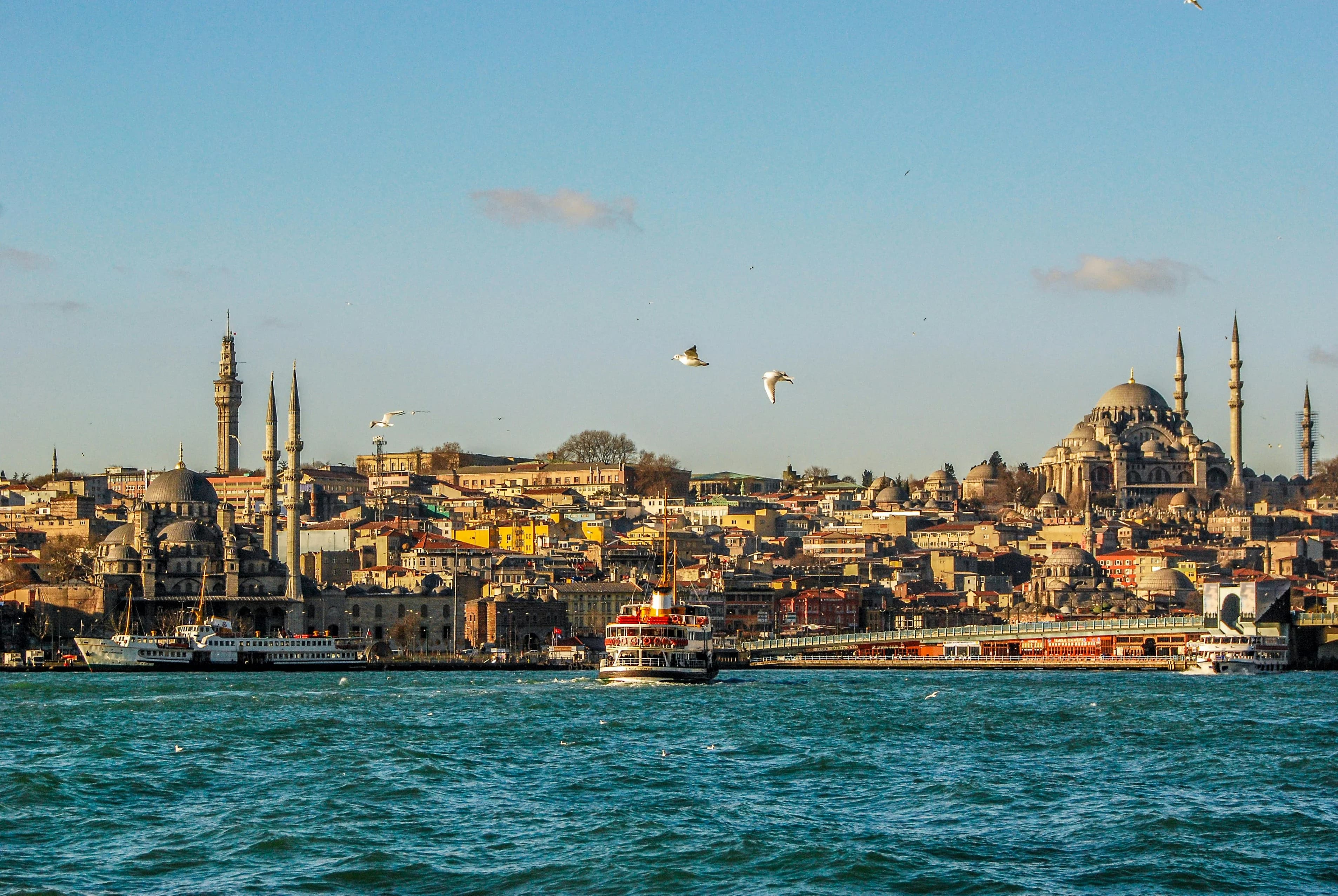
Staying in Sultanahmet: what the neighbourhood offers the suite traveller
The neighbourhood is bounded to the north by the Golden Horn and to the south by the Sea of Marmara, giving several properties lateral sea views that shift with the season and the hour. The Bosphorus strait is visible from elevated positions within the district, providing a geographic orientation that is rare in a dense urban context.
Areas within and around Sultanahmet worth understanding
The historic core
The immediate surroundings of the Hagia Sophia and the Blue Mosque form the densest concentration of visitor traffic in the city. Properties positioned within this core trade on proximity, and the best among them manage to absorb that proximity without transmitting its noise or congestion into the guest experience. Ottoman-era stone construction, thick walls and internal courtyard layouts contribute to acoustic insulation in the more considered properties.
The slopes toward the Sea of Marmara
As the district descends southward toward the Marmara coastline, the streetscape becomes quieter. Properties on these slopes often have sea-facing terraces and benefit from prevailing breezes off the water. Suite travellers who prioritise a view over immediate monument access tend to gravitate toward this micro-zone within the neighbourhood.
Cankurtaran and the adjacent residential streets
The Cankurtaran quarter, immediately east of the main monuments, retains a more residential character. Ottoman timber houses, some converted into boutique properties, line narrow streets that feel architecturally coherent. For travellers seeking texture and relative quiet alongside historical proximity, this sub-district warrants attention. The broader context of luxury suite travel in Turkey is useful here: the Ottoman heritage typology found in Cankurtaran is specific to Istanbul and has no direct equivalent elsewhere in the country.
When to visit Sultanahmet
Istanbul operates across a genuine four-season calendar, and the timing of a visit to Sultanahmet affects the experience materially. Spring, from late March through May, brings moderate temperatures and manageable visitor volumes. The light in this period is clear and the city's abundant tulip plantings, a tradition dating to the Ottoman era, are visible in the public gardens around Topkapi Palace.
Autumn, from September through November, is considered by many regular visitors to be the optimal period. Temperatures remain comfortable, summer crowds have receded, and the cultural season in the city is active. Museum programming and classical music events in the broader city provide additional context for a stay.
Summer brings heat and peak visitor numbers to Sultanahmet in particular, given its status as the primary tourist district of the city. Properties with air-conditioned suites and private outdoor terraces or rooftop access become significantly more functional during July and August. The Ramadan period, which shifts annually according to the lunar calendar, brings a distinct atmospheric character to the neighbourhood, particularly in the evenings, when the mosques and surrounding streets take on a different quality of activity.
Winter is undervisited and, for a certain type of traveller, specifically appealing. The monuments are accessible without queuing, the covered bazaars are navigable, and the occasional snowfall on the domes of the Blue Mosque and Hagia Sophia produces an image of the city that is uncommon in travel documentation.
Local luxury standards in Sultanahmet
Turkey does not operate a state-administered palace hotel category in the formal sense used in France. However, a distinct typology has emerged in Sultanahmet: the converted Ottoman structure. Historic hamams, mansions known as konaks, and stone-vaulted Byzantine foundations have been adapted into accommodation over the past two decades. The quality of these conversions varies considerably. At the upper end, the original architectural fabric is preserved and integrated into the suite design, with period stonework, original timber ceilings and proportioned rooms that reflect the spatial logic of their historical function.
The category of suite available in this district ranges from rooms in boutique properties with five or six keys in total, to larger hotel suites in international-brand properties positioned on the Marmara waterfront. The suite traveller should understand this distinction clearly: the boutique Ottoman conversion offers architectural specificity and operational intimacy, while the larger waterfront property offers standardised service infrastructure and scaled amenity provision. Neither is categorically superior; the choice depends on the traveller's priorities. For a broader understanding of the regional luxury context, the Middle East luxury suite landscape provides useful comparative framing.
How to choose the right suite in Sultanahmet
Architecture versus amenity
The most common trade-off in this neighbourhood is between architectural authenticity and amenity breadth. A converted Ottoman property may offer a suite with original vaulted ceilings and a private hammam, but limited fitness facilities or restaurant options on site. A larger international property will provide a broader service infrastructure but a less architecturally specific environment. Identifying which variable takes precedence is the first practical step in the selection process.
View orientation
In Sultanahmet, view orientation is a meaningful variable. Suites facing the Sea of Marmara offer a different quality of light and a different acoustic environment from those oriented toward the monument district. Bosphorus views, technically visible from elevated positions in the neighbourhood, are less consistently available than in districts further north along the strait such as Besiktas or Nisantasi.
Access and transfer
Sultanahmet is reachable directly by tram from Istanbul Airport via a transfer at Kabatas. The tram line terminates at the Sultanahmet stop, directly adjacent to the Hippodrome and the main monument cluster. Vehicular access to some of the narrower streets in the district is restricted, which is a practical consideration for guests arriving with significant luggage. The most considered properties communicate transfer logistics clearly in advance.
The value of a curated selection in Sultanahmet
The volume of accommodation in Sultanahmet is high relative to the neighbourhood's size. The quality range is correspondingly wide. A curated selection by La Suite addresses this directly: each property included in the platform's inventory has been assessed against criteria that include spatial quality, service consistency and architectural integrity. In a district where marketing language frequently overstates the quality of a conversion or the accuracy of a view, an editorially accountable selection reduces the decision cost for the traveller considerably. The full La Suite inventory for Istanbul luxury hotel suites provides the broadest entry point, with Sultanahmet properties filterable by position and typology.