Comfortable Accommodations AKEKURE Kyoto Shirakawa in Kyoto offers four-star comfort with air-conditioning, private bathrooms, and city or river views. Each room includes a bathrobe, tea and coffee ma

Higashiyama, the Eastern Mountain district of Kyoto, occupies a narrow corridor between the Higashiyama mountain range and the city's historic centre. Its preservation is not accidental. The district was designated under Japan's traditional buildings district conservation laws, which regulate exterior alterations with considerable strictness. The result is a neighbourhood where the built environment has remained coherent across generations: machiya townhouses with latticed wooden facades, stone-set lanes such as Ninenzaka and Sannenzaka, and a sequence of temples and shrines including Kiyomizudera, Kodaiji, and Chion-in that anchor the district's southern and northern reaches.
30 hotels available

Comfortable Accommodations AKEKURE Kyoto Shirakawa in Kyoto offers four-star comfort with air-conditioning, private bathrooms, and city or river views. Each room includes a bathrobe, tea and coffee ma

Open from February 2015, Aoi Hotel Kyoto is located a 5-minute walk from Kawaramachi Station and a 13-minute walk from Yasaka Shrine. It offers simply furnished rooms and free WiFi access. Guests can

Elegant Accommodations Banyan Tree Higashiyama Kyoto in Kyoto offers a 5-star experience with family rooms and interconnected rooms. Each room features air-conditioning, a private bathroom, and mo

Elegant Accommodations Capella Kyoto in Kyoto offers a 5-star hotel experience with family rooms and modern amenities. Guests enjoy free WiFi, a hot spring bath, spa facilities, and a wellness cen

Cross Hotel Kyoto is set in Kawaramachi Sanjo and provides rooms with warm wooden decor featuring Kyoto-style architecture and free WiFi. Hankyu Kawaramachi Station is a 6-minute walk away, while Sanj

Elegant Accommodations Fauchon Hotel Kyoto in Kyoto offers a 5-star experience with spa facilities, a fitness center, restaurant, bar, and free WiFi. Guests enjoy mountain and river views from the

Elegant Accommodations Genji Kyoto, a Member of Design Hotels in Kyoto offers a 4-star experience with a sun terrace, garden, and free WiFi. Guests enjoy private check-in and check-out, a lounge,

GOOD NATURE HOTEL KYOTO has a fitness center, garden, a restaurant and bar in Kyoto. With free WiFi, this 5-star hotel offers room service and a 24-hour front desk. The property is 1.1 miles from the

Located in Kyoto, a 9-minute walk from Samurai Kembu Kyoto, Hilton Kyoto provides accommodations with a fitness center, private parking, a restaurant and a bar. The property is around 1.2 miles from H

Awarded two pavilions by the Michelin Guide 2020, Hotel Alza Kyoto is located near the Kamo River and within Gion District, a 2-minute walk from Sanjo Station. Some rooms feature the views of Kamo Riv

Open from September 2017, The Celestine Kyoto Gion is set in Kyoto, a 10-minute walk from Gion-Shijo Station. Guests can walk to Kiyomizu-dera Temple in 15 minutes from the property. Free WiFi is feat

Comfortable Accommodations Hotel Yuraku Kyo-yasaka in Kyoto offers family rooms with air-conditioning, private bathrooms, and modern amenities. Each room includes a bathrobe, free toiletries, and

Elegant Accommodations Imperial Hotel, Kyoto offers a 5-star experience in Kyoto, Japan. Guests enjoy spa facilities, a sauna, fitness center, indoor swimming pool, and free WiFi. Dining and L

Comfortable Accommodations KIORI Collection Gokomachi in Kyoto offers family rooms with air-conditioning, private bathrooms, and free toiletries. Each room includes a work desk, TV, and carpeted f

Marufukuro features free bikes, fitness center, a garden and shared lounge in Kyoto. Providing a restaurant, the property also has a terrace, as well as a sauna. The property is a 12-minute walk from

Comfortable Accommodations NOHGA HOTEL KIYOMIZU KYOTO in Kyoto offers comfortable rooms with air-conditioning, private bathrooms, and modern amenities. Each room includes a tea and coffee maker, refri

Elegant Accommodations Park Hyatt Kyoto in Kyoto offers a 5-star experience with spa facilities, sauna, restaurant, bar, and hot tub. Guests enjoy private check-in and check-out, a fitness center,

Saka Hotel Kyoto offers accommodations in Kyoto. Guests can enjoy the on-site restaurant. All rooms come with a flat-screen TV. You will find a coffee machine in the room. All rooms include a private

Elegant Accommodations Six Senses Kyoto in Kyoto offers luxurious rooms with air-conditioning, private bathrooms, and modern amenities. Guests enjoy garden or city views from balconies or terraces

Opened in April 2017, Solaria Nishitetsu Hotel Kyoto Premier is set in Kyoto, a 2-minute walk from Sanjo Station on the Keihan Line. There is a public bath and 24-hour front desk at the property. Eac

Downtown Kyoto is not a district that announces itself. It operates on a grid system inherited from the Tang Dynasty capital of Chang'an, and its luxury offer is proportionally restrained. The area bounded by Shijo Avenue to the south, Oike Avenue to the north, the Kamo River to the east, and Nishiki to the west constitutes what most visitors identify as the commercial and cultural centre of the city. For suite travellers, it functions as the most practical and culturally saturated base in all of Kyoto.

To understand Sanjo is to understand how Kyoto organizes itself. The city's streets follow a grid inherited from the Tang Dynasty capital of Chang'an, and Sanjo-dori, the avenue that gives the district its name, runs east to west as one of the oldest and most historically significant axes in the city. Unlike the heavily trafficked thoroughfares further south, Sanjo retains a texture that rewards slower movement. Independent craft shops, century-old sake merchants, and quietly serious restaurants sit beside contemporary design studios. The neighborhood does not announce itself. It is discovered incrementally, which is precisely the quality that appeals to a certain kind of traveler.

The area surrounding Kyoto Station occupies the southern flank of the city. It is not the most photogenic quarter by conventional standards, but it is one of the most strategically positioned. Hiroshi Hara's 1997 station building, a civic structure of genuine architectural ambition, anchors a precinct that connects seamlessly to the rest of Kyoto by subway, bus, and rail. For travelers arriving from Tokyo on the Shinkansen or transiting through Kansai International Airport, the district eliminates unnecessary transfer time and keeps the full city within a fifteen-minute radius.
For the traveller selecting a luxury hotel suite in this neighbourhood, the architectural context is part of the offering. The best properties here integrate their design language with the surrounding fabric, whether through the use of traditional materials, the orientation of rooms toward garden views, or the application of wabi-sabi principles to interior composition. This is not a district where scale and spectacle define luxury. Restraint, proportion, and material authenticity are the operative values.
Kyoto is a city of distinct micro-territories, and Higashiyama occupies a specific position within that geography. Where Gion, immediately to the west, carries the cultural weight of the geiko and maiko tradition, and Fushimi to the south is associated with sake brewing and Shinto pilgrimage routes, Higashiyama is defined above all by its relationship to Buddhist temple culture and its exceptional concentration of preserved streetscapes.
The neighbourhood divides loosely into two zones. Southern Higashiyama, centred on the approach to Kiyomizudera, is the more visited section and carries a higher density of craft shops, tea houses, and pilgrimage traffic. Northern Higashiyama, extending toward Nanzenji and the Okazaki museum district, is quieter, more residential in character, and home to some of the area's most considered luxury accommodations. Properties in the northern section tend to offer greater privacy and a stronger sense of remove from the pedestrian circuits of the tourist economy.
The district's seasonal character is pronounced. Spring, specifically late March through mid-April, brings cherry blossoms to Maruyama Park and the grounds of Chion-in, drawing significant visitor volumes to the area. Suite availability during this period contracts sharply, and the properties that maintain allocation for discerning travellers tend to do so through direct relationships or through curated booking channels.
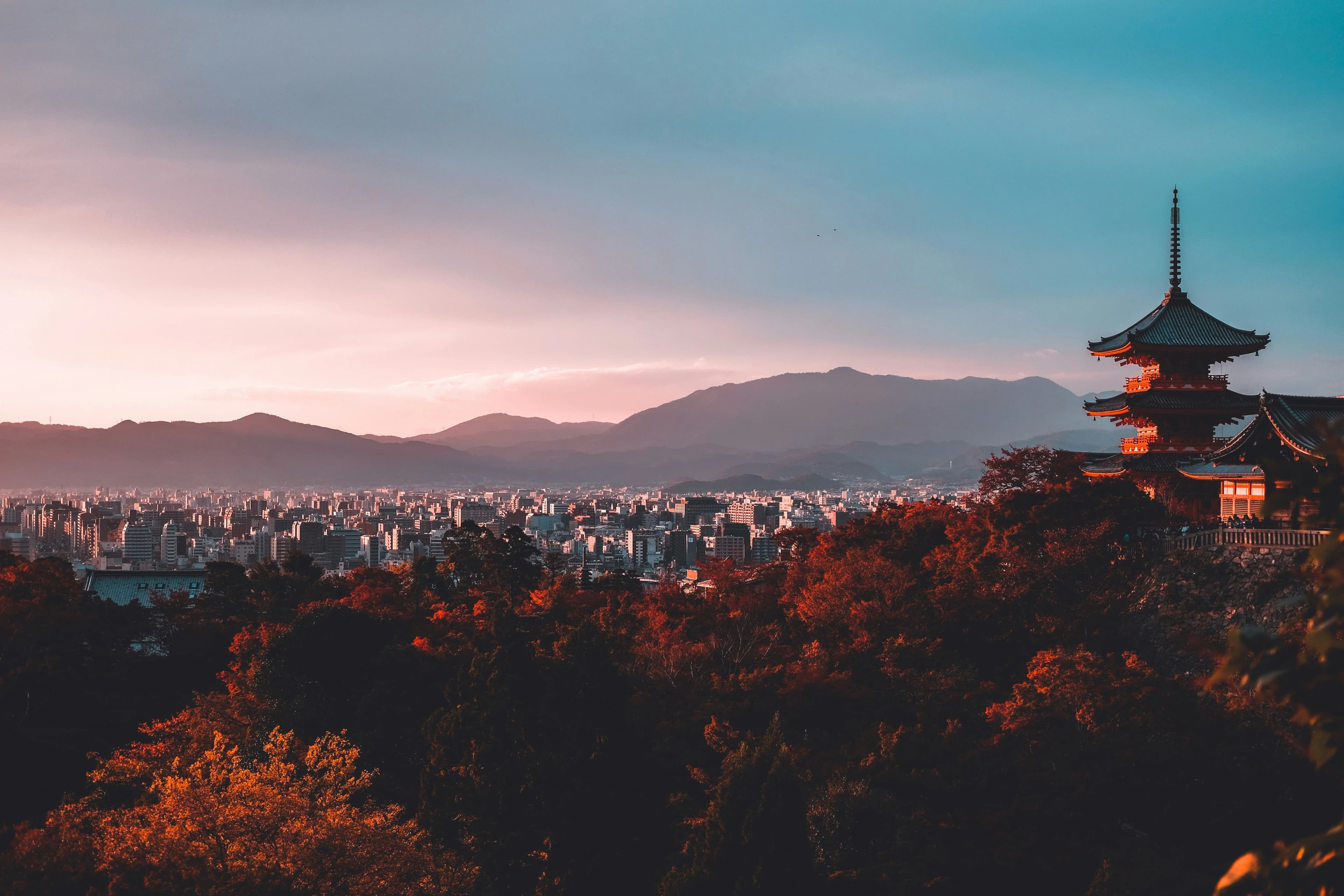
Autumn, from mid-November through early December, produces the district's most visually precise moment: the maple canopy across Higashiyama's temple grounds shifts through amber and crimson in a sequence that is specific to the light conditions of this mountain-facing corridor. The evenings cool rapidly, and the combination of low pedestrian traffic after dusk and the illuminated temple precincts creates a quality of experience that is difficult to locate elsewhere in Japan.
Summer in Higashiyama is warm and humid, with the Gion Matsuri festival in July drawing broader crowds to adjacent neighbourhoods. Winter, particularly January and February, offers the quietest conditions for a stay, with occasional snow on the stone lanes and temple rooflines producing a visual register that has been documented in Japanese woodblock printing for centuries. Suite rates in this period are generally at their most accessible.
The luxury hotel vocabulary in Higashiyama differs from that of international business districts or coastal resort zones. The operative category here is not the grand hotel but the ryokan, the traditional Japanese inn, in its most refined contemporary expression. A high-grade ryokan in this district will offer suites furnished in a manner that draws directly from the sukiya architectural tradition: tatami flooring, tokonoma alcoves with seasonal flower arrangements, shoji screens that modulate natural light across the course of the day, and engawa verandas oriented toward private garden compositions.
Service in these properties follows the omotenashi model, a philosophy of anticipatory hospitality that operates without the transactional register common in Western luxury hotels. Kaiseki dining, the multi-course meal form rooted in the tea ceremony tradition, is frequently available on-property or through closely affiliated establishments. Some properties maintain private onsens (thermal bathing facilities) within suite accommodations, which represents the highest tier of offering in this category.
Western-format luxury hotels also operate in and near Higashiyama, offering larger room footprints, international amenity standards, and a different spatial experience. The choice between these two formats is one of the primary decisions a traveller must make when approaching this district, and it is one that benefits from precise guidance rather than generalised recommendation.
Several variables shape the suite selection process in this neighbourhood. Garden orientation is a primary consideration: the finest rooms face private courtyard gardens, and the difference in experience between a garden-facing suite and a street-facing room is significant. Light quality in Higashiyama follows a specific pattern, with eastern exposures receiving morning light filtered through the mountain canopy and western exposures catching afternoon warmth.
Floor level matters differently here than in a conventional hotel context. Many traditional properties are low-rise by design, and the ground-level suite with direct garden access may represent a higher category of experience than an elevated room with a broader view. Conversely, some contemporary properties positioned at the district's edges have developed roof-level or elevated suites that offer sightlines across the temple roofscape, which constitutes a specific and valuable experiential proposition.
Proximity to the primary pilgrimage lanes is a practical consideration. Ninenzaka and Sannenzaka carry heavy pedestrian traffic between approximately 9:00 and 17:00, and properties located directly on these routes require careful acoustic management. The better properties have addressed this through construction; the question is worth verifying at the suite level rather than at the property level.
The supply of genuinely high-quality suite accommodation in Higashiyama is limited, and the market is not transparent. Some of the most considered properties operate with minimal online presence, relying on word-of-mouth and specialist channel relationships to maintain occupancy. The gap between a property that presents well photographically and one that delivers a coherent experience at suite level is significant in this neighbourhood, where the design language is specific and the standards of material quality are exacting.
La Suite's curated selection for Kyoto and its districts is built on direct knowledge of the properties that consistently meet the criteria of spatial integrity, service calibration, and contextual authenticity. Across Asia, La Suite applies the same editorial discipline: the selection is not a catalogue but a considered shortlist. For a neighbourhood as specific as Higashiyama, that discipline is not a convenience; it is the basis on which a genuinely good decision can be made.

Northern Higashiyama, in the vicinity of Nanzenji and the Okazaki district, generally offers quieter conditions and a higher concentration of properties with private garden suites and ryokan-format accommodation. Southern Higashiyama, near Kiyomizudera, is more accessible to the principal sightseeing routes but carries greater daytime pedestrian traffic.
A luxury ryokan suite is typically furnished with tatami flooring, shoji screens, a tokonoma alcove, and in the finest examples, a private onsen bath and engawa veranda facing a curated garden. A Western-format hotel suite in or near Higashiyama will offer larger square footage, international bed formats, and a different service register, with the choice depending primarily on whether the traveller prioritises cultural immersion or conventional luxury amenity.
Autumn, from mid-November to early December, is widely regarded as the most precise season in terms of sensory experience, with the maple canopy across the temple grounds at its most vivid. Spring cherry blossom season is also exceptional but requires considerably more advance planning, as suite availability contracts significantly during that period.
For cherry blossom season (late March to mid-April) and autumn foliage season (mid-November to early December), booking six to twelve months in advance is advisable for the most sought-after properties. Outside these peak windows, three to four months of lead time is generally sufficient, though the smallest and most considered ryokan properties may have limited inventory at any point in the year.
Many of the higher-grade ryokan properties in Higashiyama include kaiseki dinner and a traditional Japanese breakfast within the room rate, which is a standard feature of this accommodation format at its most refined level. Some properties operate their own kaiseki restaurants; others maintain relationships with nearby establishments. It is worth confirming the dining arrangement at the time of reservation, as this forms an integral part of the stay's value.
Higashiyama is not within comfortable walking distance of Kyoto Station, which sits in the city's southern sector. The most practical approaches are by taxi, by bus along the city's eastern corridors, or by subway to Higashiyama Station on the Tozai Line, which places travellers in the northern portion of the district. Many luxury properties offer transfer arrangements as part of their arrival service.
At the highest tier, a luxury suite in Higashiyama will include a private outdoor or semi-outdoor bath, either in the form of a hinoki (cypress wood) tub or a stone-set onsen basin, positioned to face the suite's private garden. Additional features at this level typically include a dedicated sitting room, a separate dressing area, and in-room tea ceremony equipment. Not all properties in this category offer private baths at suite level, so this is a specific point to verify.
Higashiyama's luxury hospitality is shaped by the omotenashi philosophy of anticipatory, non-transactional service, which differs from the amenity-driven model common in Tokyo's international luxury hotels or the resort-focused properties of coastal Japan. The emphasis is on precision, quiet attentiveness, and the integration of the stay with the cultural and sensory context of the district, rather than on scale or visible display.
Traditional ryokan suites in Higashiyama are often designed around the communal floor-level living format, with futon bedding arranged by staff each evening, which can accommodate family configurations in a single suite space. Some properties offer connecting room arrangements or larger suite formats suited to families with children. Western-format hotel suites in adjacent areas typically offer more conventional family configurations, including separate sleeping areas and standard bed formats.
The supply of high-quality suite accommodation in Higashiyama is limited and the market is not fully transparent, with some of the most considered properties maintaining minimal digital presence. A curated selection by La Suite applies direct editorial knowledge to identify the properties that genuinely meet the criteria of spatial integrity, material authenticity, and service calibration specific to this district, reducing the risk of a misaligned booking in a neighbourhood where the difference between properties can be considerable.