Best areas to stay in the U.S. Virgin Islands for a luxury suite experience
St. Thomas: access and elevation
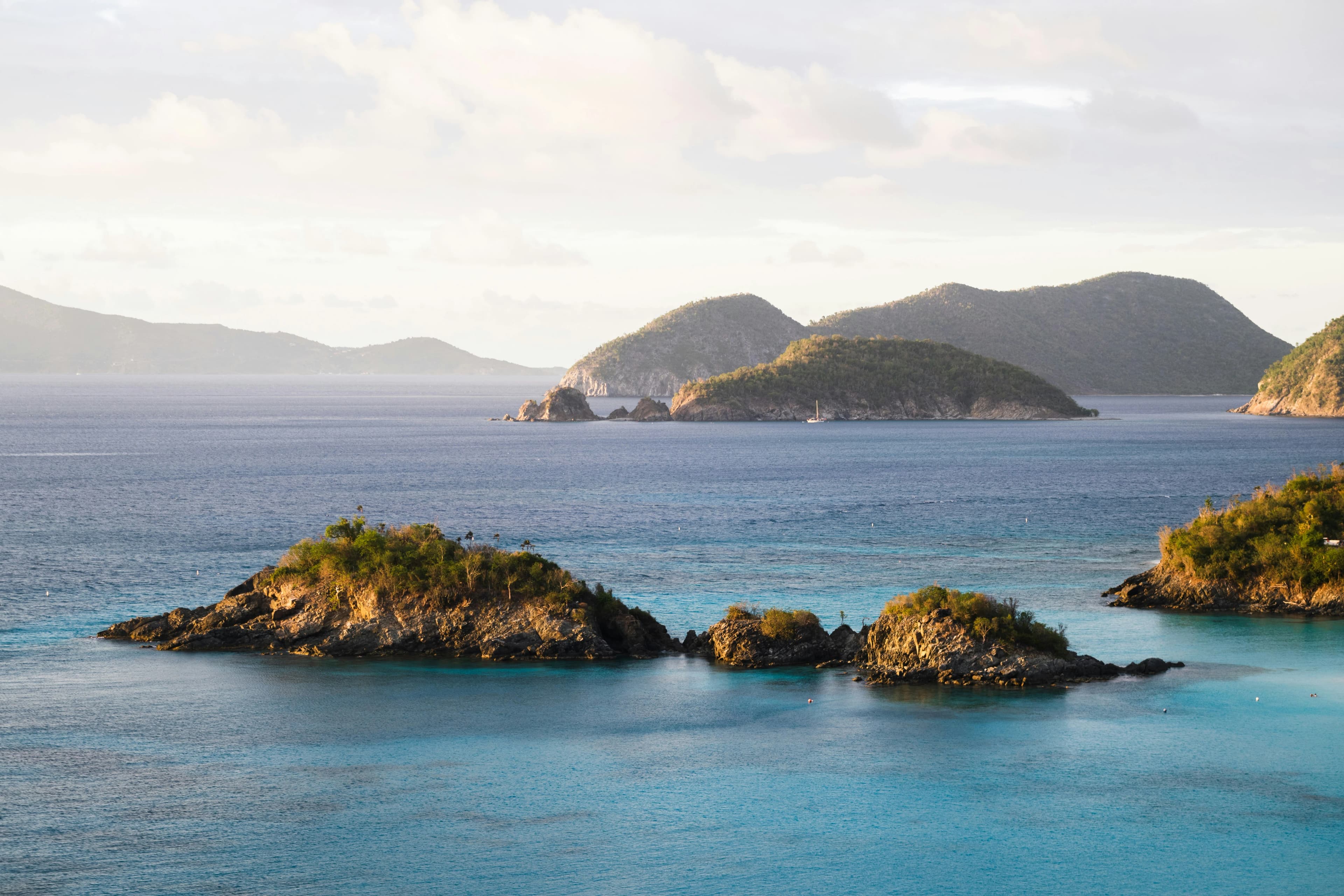
Charlotte Amalie, the capital, functions as the main port of entry and the commercial hub of the territory. The island's topography is pronounced: hillside properties command views over the harbor and the surrounding cays that are genuinely architectural in their framing. The eastern end of St. Thomas, particularly the area around Red Hook and the Ritz-Carlton enclave, offers a quieter residential tone. Luxury hotels here tend toward resort scale, with suites that integrate outdoor terraces and ocean sightlines as structural elements of the room design.
St. John: land preservation and controlled density
Roughly 60 percent of St. John's land area falls within the Virgin Islands National Park, a designation that has permanently constrained development density. The result is one of the most land-protected luxury environments in the Caribbean. Properties here operate at smaller scale, and suites are often oriented toward the hillside or beachfront positions within Coral Bay and the Cruz Bay corridor. The absence of large resort infrastructure is not a limitation but a defining quality: privacy is structural rather than manufactured.
St. Croix: historical depth and slower pace
The largest island in the territory, St. Croix sits roughly 40 miles south of St. Thomas and operates on a distinctly different rhythm. Christiansted and Frederiksted, the two main towns, carry Danish colonial architecture that dates to the 18th century. The island's plantation-era estates have been selectively converted into boutique properties. Suites here tend toward historical character rather than resort scale: stone walls, restored mahogany details, and proportions that reflect the original construction period. This is the choice for travelers who weight cultural density over proximity to other islands.
When to visit the U.S. Virgin Islands for a luxury hotel stay
The U.S. Virgin Islands operate within a tropical climate moderated by the northeast trade winds, which sustain relatively consistent temperatures year-round. The high season runs from mid-December through April, aligned with the North American and European winter. This period concentrates demand, and suite availability at leading properties contracts significantly. Advance planning of three to six months is standard practice for premium room categories during this window.
The summer months, May through August, offer lower occupancy and more favorable rate structures, though heat and humidity are higher. The Atlantic hurricane season formally runs from June through November, with peak activity concentrated in August and September. Travelers booking during this period should confirm cancellation and rebooking policies with precision.
The shoulder periods, April to May and November to early December, represent a considered choice for experienced travelers: reduced competition for suite inventory, more consistent service attention, and access to the landscape before or after the peak density. The St. Croix Food and Wine Experience, typically held in the spring, draws a culturally oriented audience. The St. Thomas International Regatta, held in late March, creates a specific demand spike across the territory's better properties.
Local luxury standards: what defines a top-tier suite in the U.S. Virgin Islands
The U.S. Virgin Islands do not operate a formal national hotel classification system equivalent to France's Palace designation. Properties are subject to standard U.S. hospitality and safety regulations, but there is no official luxury tier label unique to the territory. Assessment of quality therefore depends on independent verification: global brand affiliation, design investment, service ratios, and the structural qualities of the suite itself.
At the highest tier, suites in the territory are defined by several consistent characteristics. Outdoor living space is not optional: a private plunge pool, an extended terrace, or a direct beach access point is the standard expectation. Interior proportions matter more than total square footage; the relationship between the interior and the exterior environment is the primary design variable. Air conditioning infrastructure in the Caribbean context must be robust and silent, a detail that separates genuinely considered properties from those operating at a lower standard.
Concierge capability is a meaningful differentiator in a small-island context. Private boat charters, access to protected snorkeling zones within the national park, connections to St. Croix's agricultural producers, and helicopter transfers between islands are all services that a capable luxury hotel suite concierge should be able to arrange without friction.
How to choose the best luxury suite in the U.S. Virgin Islands
The first decision is island selection, which functions as a proxy for the entire trip tone. St. Thomas is the pragmatic entry point: most direct flights land here, and the infrastructure is the most developed. St. John requires a ferry transfer of approximately 20 minutes from Red Hook, St. Thomas, and that additional step filters out a portion of the casual visitor volume. St. Croix requires a separate flight or ferry routing and operates as the most self-contained of the three islands.
The second consideration is suite orientation. Hillside suites offer protected views and cooler air circulation but require property transportation or a walk to beach access. Beachfront suites eliminate that friction but may expose guests to higher ambient noise and variable sand conditions depending on weather patterns. For families or groups, villa-format suites with separate sleeping quarters and shared outdoor space represent the most coherent configuration available in this market.
Third: evaluate the property's food and beverage program independently of its room quality. In a territory where leaving the property requires meaningful logistical planning, the on-site dining offer functions as part of the suite experience. Properties with direct relationships with local fishermen, St. Croix agricultural producers, or a wine program curated with the same attention as the room design are meaningfully different from those operating at a standardized resort-dining level.
Why a curated selection by La Suite matters in this destination
The U.S. Virgin Islands present a particular editorial challenge: a relatively small inventory of properties, a wide range of quality within the luxury price bracket, and limited independent verification available to travelers who have not previously visited the territory. Marketing materials across the Caribbean category trend toward uniformity, making differentiation by surface-level research difficult.
La Suite applies a consistent set of architectural, experiential, and service-quality criteria to every property in its selection. In the U.S. Virgin Islands context, this means filtering for suites where the outdoor-indoor relationship is genuinely designed rather than incidental, where privacy is structural rather than simulated, and where the service infrastructure matches the room rate. The curated selection by La Suite removes the due diligence burden from the traveler and replaces it with a precisely filtered shortlist calibrated to this territory's specific conditions.