Where to stay in Norway: distinct territories for luxury suite travelers
The western fjords
The fjord corridor stretching from Bergen northward through Sognefjord and into the Møre og Romsdal region defines Norway's most architecturally dramatic landscape. Properties here position the suite as an observatory: floor-to-ceiling glass, terraces suspended above still water, and an acoustic environment that is almost clinical in its stillness. Fjærland, at the end of the Sognefjord arm, offers a particular kind of seclusion that draws travelers seeking genuine withdrawal. Bekkjarvik, on the island of Huftarøy south of Bergen, offers a coastal counterpoint where fishing heritage and contemporary hospitality coexist without friction.
The Lofoten archipelago
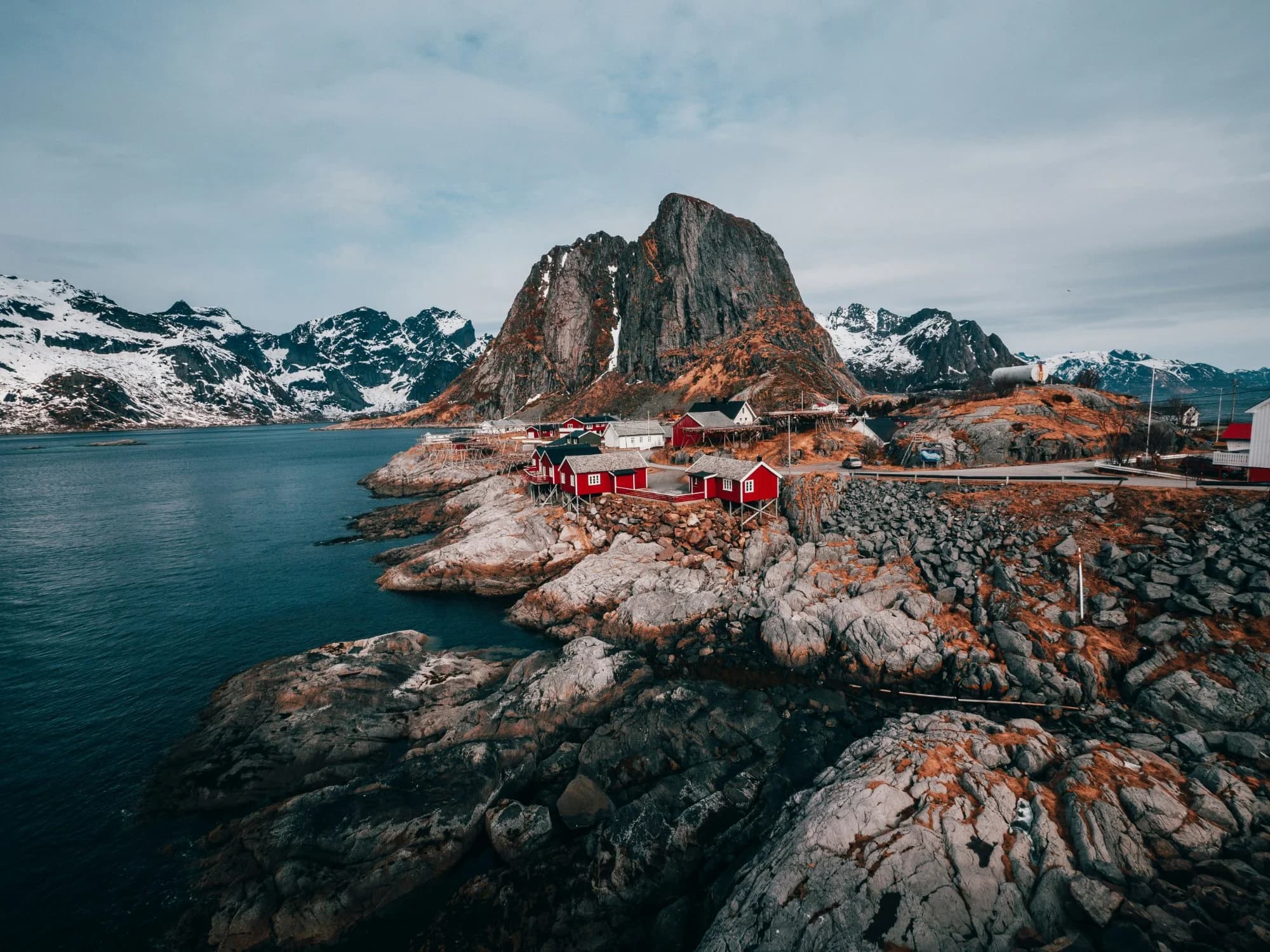
The Lofoten Islands represent one of the most photographically specific landscapes in Europe: jagged peaks rising directly from the sea, red and yellow fishermen's cabins called rorbuer converted into high-end accommodation, and an Arctic light that shifts in ways no other latitude replicates. Ramberg and Henningsvær anchor the archipelago's luxury offer with properties that use the vernacular rorbuer typology as a starting point for suite design rather than a nostalgic reference.
Oslo and the urban interior
The capital offers a different proposition entirely. Oslo has developed a contemporary hotel culture that reflects the country's architecture and design confidence: clean material palettes, restrained ornamentation, and a relationship between interior space and the fjord or forest beyond that is always considered. The Oslofjord provides a natural frame for waterfront properties, while the city's Tjuvholmen and Aker Brygge districts represent the most concentrated luxury hotel density.
The Møre og Romsdal coast and interior
Ålesund is architecturally singular: rebuilt almost entirely in Art Nouveau style after a fire in 1904, it offers a European elegance unusual in Norwegian urban contexts. Nearby Skodje provides quieter access to the same coastal landscape, while Øyer in the Gudbrandsdalen valley connects luxury hospitality to Norway's mountain culture, positioned near the Lillehammer region and accessible year-round.
South of Oslo: the quiet periphery
Kolbotn, just south of Oslo, represents a category of Norwegian hospitality that privileges forest immersion over urban convenience. Properties in this orbit suit travelers who want the capital within reach but prefer to sleep within a landscape rather than a city grid.
When to visit Norway for a luxury suite stay
Norway's appeal is genuinely seasonal in ways that affect the suite experience directly, not merely the weather.
The Northern Lights are visible roughly from late September through March, concentrated most reliably in the Lofoten Islands and the far north. Properties in Ramberg and Henningsvær are positioned specifically for this phenomenon: suites with glass ceilings, private outdoor decks, and wake-up services designed around geomagnetic activity forecasts. This is not incidental to the stay; it is its architecture.
The midnight sun runs from late May through late July across the Arctic Circle, and reaches its most dramatic expression in Lofoten and Tromsø. Experiencing continuous daylight from a suite with unobstructed northern exposure rewires the traveler's relationship with time in ways that are difficult to anticipate. The western fjords are most accessible and most visually resolved between May and September, when snow has cleared from higher elevations and boat travel on the fjords is practical.
Oslo and Bergen operate as year-round destinations. Bergen's cultural season, including the Bergen International Festival in late May and early June, draws a design-literate and musically informed audience for whom suite access in the city center carries particular value. Winter in both cities offers short days but a particular quality of Nordic light that suits interior architecture and the caliber of fireside suite design found at the best Norwegian properties.
Norwegian luxury hotel standards: what to expect from a top-tier suite
Norway does not have a formal palace hotel designation equivalent to France's official Palace label. The country's luxury hotel culture operates instead through a combination of international five-star ratings, Design Hotels membership, and the quality of architectural commissions. Several of Norway's most distinguished properties were designed by architects whose work is exhibited internationally, and the suite interiors reflect a Scandinavian material sensibility: natural oak, raw stone, sheepskin, linen, and glass as primary elements rather than decorative gestures.
The rorbuer tradition in Lofoten deserves specific mention. Originally built as seasonal fishermen's quarters on stilts above the sea, these structures have been converted and rebuilt by a generation of Norwegian hospitality operators into some of the most spatially resolved suites in northern Europe. The typology imposes constraints (compact footprints, low ceilings in some cases) that the best conversions resolve through material precision and the primacy of the water view.
Suite amenities at Norway's top properties typically include private saunas (a functional rather than decorative feature in this climate), outdoor bathing access in various forms, and in-room design objects sourced from Norwegian makers. Breakfast culture is serious: expect cold-smoked salmon, skyr, local cheeses, and breads that reflect genuine regional bakery traditions.
How to choose the right luxury suite in Norway
The primary decision axis in Norway is environmental: fjord, coast, mountain, or city. Each context produces a different kind of suite and a different kind of stay, and the distinction matters more here than in most European destinations because Norway's landscape is not background but content.
For travelers whose priority is the Northern Lights, location within the correct latitude band is non-negotiable. Properties in Lofoten are positioned correctly; properties in Oslo or Bergen are not. Conversely, travelers whose interest is architectural design and urban culture will find the fjord properties too remote for the rhythm they prefer.
Scale is also relevant. Norwegian luxury suites range from intimate rorbuer of 40 to 60 square meters above the sea to full-floor Oslo suites with panoramic fjord views and dedicated butler service. Families or travelers requiring separation between sleeping and living areas should prioritize the latter category. Couples traveling for immersive natural experience may find the smaller, more precisely designed rorbuer format more suited to their purpose.
Seasonal booking lead times are significant. Northern Lights season (October through February) sees peak demand for Lofoten suites from October onward; the best suites at the most recognized properties sell out several months in advance. Midnight sun season in June and July follows a similar pattern. Planning six to nine months ahead is practical rather than excessive for these periods.
Why a curated selection by La Suite changes the Norwegian decision
Norway has a relatively contained but architecturally serious luxury hotel market. The challenge is not volume but discernment: identifying which properties have genuinely resolved the relationship between their suite design and their landscape position, and which rely on the landscape alone to carry an otherwise ordinary hospitality experience.
La Suite's curated selection of 15 properties across Norway has been assembled with this distinction in mind. Each property has been evaluated on the quality of its suite architecture, the coherence of its material choices, the specificity of its location, and the degree to which the suite itself frames the Norwegian experience rather than simply accommodating it. The result is a set of options where the decision becomes a question of which Norway the traveler wants to inhabit, not which hotel offers the most amenities.