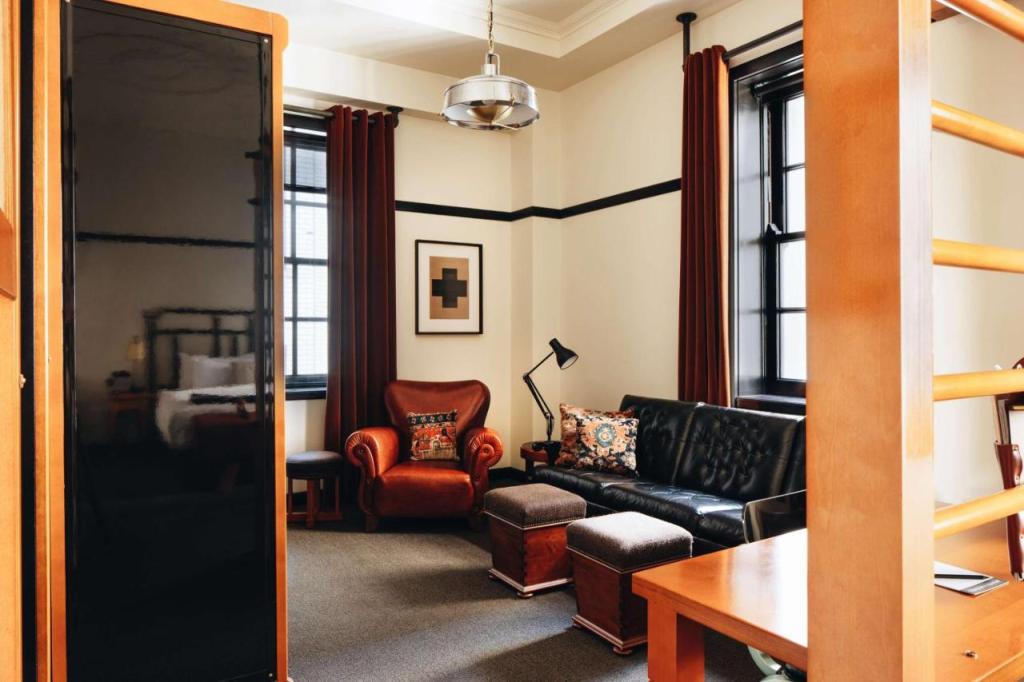
Where to stay in Indiana for a luxury suite experience
Indianapolis and the central corridor
The state capital remains the dominant address for luxury hotel inventory in Indiana. The city's downtown core has developed steadily around its convention infrastructure, Monument Circle, and a concentrated arts district. For suite travelers, Indianapolis offers properties positioned for both leisure and corporate stays, with access to the Indianapolis Museum of Art at Newfields, the historic Soldiers and Sailors Monument, and the Circuit of the Americas equivalent in American motorsport: the Indianapolis Motor Speedway. The central corridor connects Indianapolis to smaller cities such as Bloomington, home to Indiana University, where a quieter, more academic atmosphere shapes the hospitality offer.
Northern Indiana and the lakefront
The northern edge of the state, bordered by Lake Michigan, carries a different register entirely. The Indiana Dunes National Park, designated a national park in 2019, draws travelers seeking a combination of natural landscape and proximity to Chicago. Properties in this corridor serve a specific clientele: those seeking retreat from a major metropolitan center while retaining access to it. The South Bend area, home to the University of Notre Dame, adds an institutional gravity to the region's appeal.
Southern Indiana and the Ohio River valley
The southern tier of Indiana, along the Ohio River, offers a more historically layered experience. Small towns such as Madison and Corydon carry 19th-century architectural fabric that informs the character of boutique properties in the area. This is terrain for travelers interested in American vernacular architecture, river culture, and a pace that contrasts sharply with urban Indiana.
When to visit Indiana for a luxury hotel stay
Indiana's climate follows a classic continental pattern: cold winters, warm summers, and transitional seasons that each carry their own hospitality logic.
Late spring and early summer, from May through June, represent an optimal window. The Indiana Dunes are accessible without summer peak crowds, and Indianapolis enters its most active cultural calendar. The Indianapolis 500, held annually at the end of May, is one of the most significant motorsport events in the world and generates substantial demand for premium hotel inventory across the city. Travelers seeking suite availability during race weekend should approach reservations well in advance, as premium rooms are absorbed months before the event.
Autumn, from September through November, offers cooler temperatures, reduced occupancy rates in most properties, and the particular quality of light across Indiana's agricultural landscape. This is a productive season for leisure travelers who prefer a less pressured itinerary. Winter reduces demand significantly, which translates to stronger suite availability and, in some cases, more competitive positioning on rates at upper-tier properties.
Understanding luxury hotel standards in Indiana
Indiana does not operate within a designated prestige classification equivalent to the French Palace label or Japan's Ryokan tradition. The American luxury hotel landscape is governed primarily by brand affiliation, Forbes Travel Guide star ratings, and AAA Diamond designations. In Indiana, the upper tier of the market is anchored by flagship properties within major international hotel groups, alongside a smaller number of independently operated boutique hotels.
What distinguishes a genuinely high-performing suite in Indiana from a standard premium room is typically a combination of: square footage that allows for meaningful separation between living and sleeping areas, a level of finish that references the building's architectural context rather than generic hospitality specification, and a service model that extends beyond transactional front-desk interaction. In Indianapolis, several properties have invested in suite inventory that reflects the city's growth as a serious convention and cultural destination. In smaller Indiana markets, the boutique category tends to deliver more individualized spatial experiences, often within converted historic structures.
Travelers familiar with luxury hotel suites across the United States will find Indiana occupies a mid-tier position in terms of overall inventory volume, but individual properties can exceed expectations when the selection is approached with precision rather than assumption.
How to choose the right suite in Indiana
Several considerations are specific to the Indiana market and worth addressing directly before making a reservation.
First, purpose of visit shapes the optimal property type considerably. Indianapolis functions well as a base for a combination of cultural programming and business activity. The Indiana Dunes corridor serves a restorative, nature-adjacent brief. Southern Indiana suits travelers oriented toward historical and architectural exploration. Aligning the property type with the actual itinerary prevents the common error of booking urban infrastructure for a landscape-driven trip.
Second, architectural character matters. Indiana has a stock of late 19th and early 20th-century commercial buildings in its city centers, some of which have been converted into boutique hotel properties with genuine spatial character. These tend to offer suite experiences that are more considered in their design than new-build properties at a comparable price point. If architectural context is a priority, directing attention toward converted historic structures is a sound filter.
Third, access logistics are worth factoring in. Indiana is a driving state. Indianapolis International Airport connects well to major hubs, but movement within the state and to the Dunes region requires either a rental vehicle or planned ground transport. Properties in the northern corridor are within approximately one hour of Chicago O'Hare, which functions as an alternative entry point for international travelers.
For travelers exploring luxury hotel options across North America, Indiana represents a destination where curation matters more than in markets with a higher density of established luxury addresses. The difference between a well-chosen suite and a misaligned booking is more pronounced in a secondary market.
The value of a curated selection in Indiana
In destinations with deep luxury hotel infrastructure, the curation task is one of refinement within an established field. In Indiana, the task is different: it requires identifying which properties genuinely meet a high standard across space, finish, and service, within a market where the volume of truly premium options is more constrained.
La Suite approaches Indiana with the same editorial discipline applied to any destination in its portfolio. Each property is assessed against consistent criteria: suite typology, spatial quality, service model, and the degree to which the property reflects its geographic and cultural context. The result is a selection that removes the significant time investment required to distinguish genuinely high-performing properties from those that present well in marketing but underdeliver in experience.
For the traveler who allocates a suite stay deliberately, as a considered component of a broader itinerary rather than a default upgrade, this level of pre-qualification has direct value. Indiana has properties worth choosing. Finding them is where the curated selection by La Suite becomes the relevant instrument.