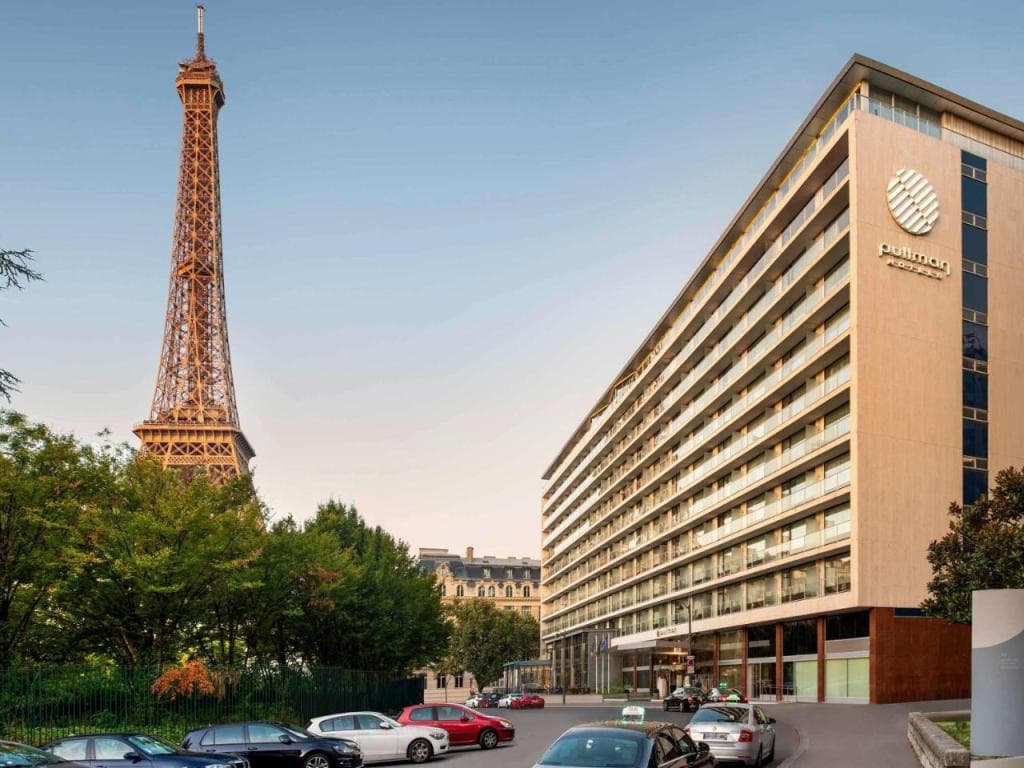
Two hundred rooms and suites, a quarter of them suite categories, behind a facade that has defined Parisian hospitality since 1925. This is where scale meets restraint, and where the listing page is the only way to understand how.

Step out onto a private terrace and the city unfolds beneath you: zinc rooftops, the Eiffel Tower catching the last light, nothing between you and the sky. No shared corridors, no neighbours overhead. Just space, air, and a view that changes with the hour. Here is a curated selection by La Suite of the penthouse suites that define this feeling in Paris.
7 hotels available

Two hundred rooms and suites, a quarter of them suite categories, behind a facade that has defined Parisian hospitality since 1925. This is where scale meets restraint, and where the listing page is the only way to understand how.

Five keys, three suite categories, no crowd. Maison Lavaud trades scale for intimacy in a quiet corner of the 14th arrondissement, with a spa bath and a hot tub doing the work most hotels need a wing for. The suite listing explains why so few rooms can feel like so much space.

Above the slate roofs of Montmartre, a rooftop restaurant frames the Eiffel Tower like a private exhibit. The Junior Suites here are the reason to climb the hill rather than stay below it.

Eleven suite categories, a private cinema, and a Starck signature that still reads as radical decades on. At Le Royal Monceau, the suites are the argument, not the amenity.

Four suite categories inside an 83-key address between Saint Germain des Prés and the Seine, where the Penthouse Suite tops a house once favoured by Camus and Boris Vian. The listing below is where the discovery starts.

Five suite categories face the Eiffel Tower directly, from balcony rooms to the 185 m² Signature Master Suite on the high floors. This is a case study in proximity: the monument is not a view here, it is a neighbor. The suite listing tells the rest.

Ten addresses only, two of them suites, set within a residential building steps from Opéra Garnier. This is Paris understood as a private floor plan rather than a hotel corridor, and the suite listing explains why.
A penthouse suite sits apart from the rest of the hotel. Top floor, private access, often its own terrace or wraparound windows. What it offers is distance: from the street, from other guests, from the ordinary hotel room experience. In Paris, this translates into a specific kind of view: rooftops in zinc, domes, spires, and on the right axis, the Eiffel Tower itself. The layout matters as much as the view. Many of these suites function as full apartments, with separate living and sleeping zones, sometimes multiple bedrooms, built for guests who want a residence rather than a room.
Light is the other defining factor. Top-floor suites in Haussmannian buildings often have higher ceilings and larger windows than the floors below, a structural quirk of 19th-century Paris that penthouse buyers and hotel guests alike have long understood. The result is a suite that reads less like hospitality and more like a private address.
Paris offers several distinct settings for a penthouse stay, each with its own register. Near the Eiffel Tower, upper-floor suites face the monument directly, a configuration unavailable almost anywhere else in the world. In Saint-Germain-des-Prés, penthouses sit above narrow streets dense with galleries and bookshops, the view more intimate than panoramic. Montmartre offers altitude by nature, its hilltop position giving even modest top floors a wide rooftop perspective. For a more residential, discreet address, the Marais and its converted hôtels particuliers provide penthouse apartments with courtyard views and exposed beams rather than glass towers. Each neighbourhood changes what the penthouse experience actually delivers.
The Penthouse Apartment at Maison Lavaud occupies the top of a private mansion, a residential scale rarely found in a hotel setting. At Terrass" Hotel, the penthouse suite looks directly onto the Eiffel Tower from Montmartre's elevated position, a panoramic axis few addresses can claim. The Signature Suite at Pullman Paris Tour Eiffel sits at 159 metres, a high-floor configuration with a direct tower view. For those seeking heritage architecture, the Royal Monceau Suite at Hôtel Le Royal Monceau Raffles Paris and the Suite Princière at Le Bristol Paris offer upper-floor scale within two of the city's most established palace properties. At Hôtel de Pourtales, the Three-Bedroom Loft Apartment extends the penthouse format to a full multi-bedroom layout, suited to groups or families wanting a shared top-floor residence.
Before reserving, confirm the orientation of the suite. A penthouse billed as having an “Eiffel Tower view” can mean anything from a direct, unobstructed sightline to a partial angle glimpsed between buildings. Ask for exact floor and window orientation, not just the suite name. Check whether the terrace, if one exists, is private and accessible directly from the suite, or shared with other rooms on the same floor. Verify elevator access: some top-floor suites in older Haussmannian buildings require a final flight of stairs, which matters for guests with luggage or mobility needs. Finally, clarify the layout. “Penthouse” can describe anything from a single elevated room to a multi-bedroom apartment; the suites listed above range across that spectrum, so match the configuration to how many guests you're travelling with and whether you need separate living and sleeping spaces.
For context on how these suites compare across the city, the Ultimate Guide to Hotel Suites in Paris and the piece on Suites with Eiffel Tower Views to Book for Two both offer useful reference points before deciding.

A penthouse suite is defined by its position on the top floor of the building, usually with private access and often its own terrace or wraparound windows. In Paris, this typically means higher ceilings than lower floors and, depending on orientation, a direct view over rooftops or toward the Eiffel Tower. Many penthouse suites also function as full apartments, with separate living and sleeping areas rather than a single room.
Ask the hotel directly for the suite's exact floor level and window orientation rather than relying on the suite name alone. Request recent photographs taken from inside the suite, not just marketing images of the building exterior. A direct view of a landmark like the Eiffel Tower is a specific sightline, and it is worth confirming whether the view is unobstructed or partial.
Booking several months ahead is advisable, since penthouse and top-floor suites exist in limited numbers per hotel. Spring and early autumn tend to see higher demand for suites with outdoor terraces, given more favourable weather for using them. If a specific view or date matters, earlier booking gives more flexibility on exact suite selection.
Yes, several penthouse suites are designed as multi-bedroom apartments suited to families or small groups. The Three-Bedroom Loft Apartment at Hôtel de Pourtales and the Seven-Bedroom House at Maison Lavaud are examples of penthouse-style layouts built for multiple guests sharing one residence. Always check the exact bedroom count and configuration, since “penthouse” does not always indicate multiple rooms.
A penthouse suite differs primarily in position, privacy and layout, while a junior suite is typically a single room with a separate sitting area on a standard floor. Penthouses sit on the top floor, often with private terraces and panoramic views unavailable to lower-floor rooms. The price difference reflects this exclusivity of position rather than only square footage.
Some do, but not all, so this should be confirmed directly with the hotel before booking. Suites such as the Penthouse at Terrass" Hotel are specifically positioned to take advantage of outdoor space and panoramic views. Where a terrace exists, it is worth asking whether it is private to the suite or shared with adjacent rooms on the same floor.