

The Suites at the Bvlgari Hotel Milan
BY Jules Peulet

Just steps from Via Montenapoleone, Bvlgari Hotel Milano stands as the most singular jewel case in the fashion capital. Here, the jewelry heritage of a Roman house is reflected in every proportion, every material, every angle of light. An immersive report at the heart of a hotel conceived as a piece of high jewelry.
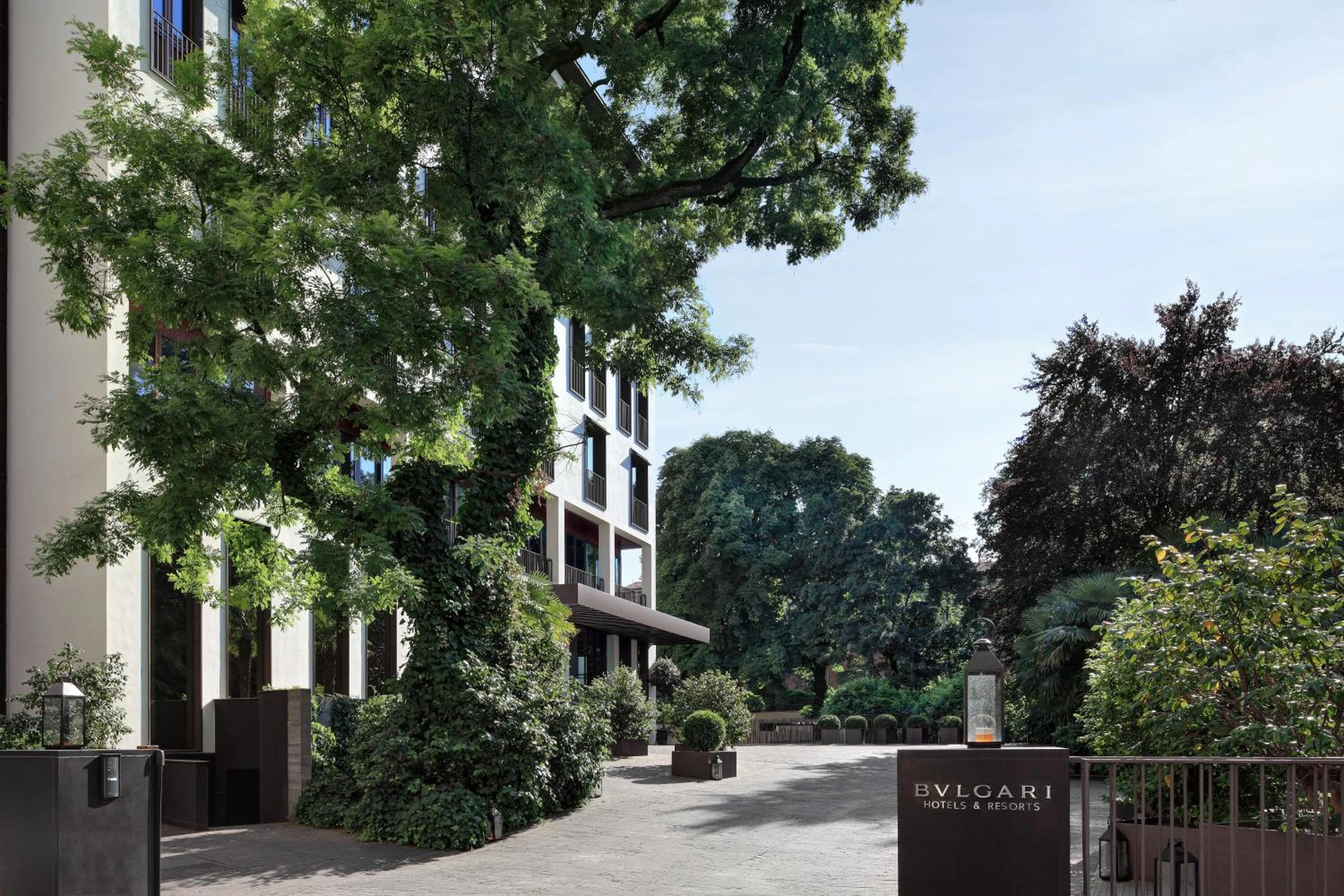
The Bulgari Hotel Milan occupies a distinctive position within Milan's hotel landscape. It does more than offer exceptional accommodation: it translates, in stone, wood and polished metal, the aesthetic grammar of a house founded in Rome in 1884. Within fewer than forty-seven rooms and suites, this five-star establishment concentrates a density of details that belongs more to the realm of jewellery craftsmanship than to classical interior decoration.
The genesis of a hotel conceived as a jewel case
When Bvlgari decided to extend its universe into hospitality in the early 2000s, Milan became the natural choice. The city shares with the Roman house an innate sense of formal rigour, a capacity to bring together classical heritage and radical modernity. The choice of location confirms this logic: a characterful nineteenth-century building, discreet from the street, positioned just a few metres from Via Montenapoleone and the Quadrilatero della Moda.
The Milanese architectural firm Antonio Citterio Patricia Viel was appointed to design the entire property. The brief was as precise as it was demanding: to make each space a natural extension of Bvlgari's identity, without ever falling into ostentation. The result is an interior that speaks in a hushed voice, yet with absolute authority.
The chosen materials tell this story in themselves: dark teak wood with warm reflections, travertine marble with precisely oriented veins, patinated bronze on handles and frames. Nothing is neutral; everything is deliberate.
A tour of the signature suites: materials, light, proportions
An architecture of intimacy
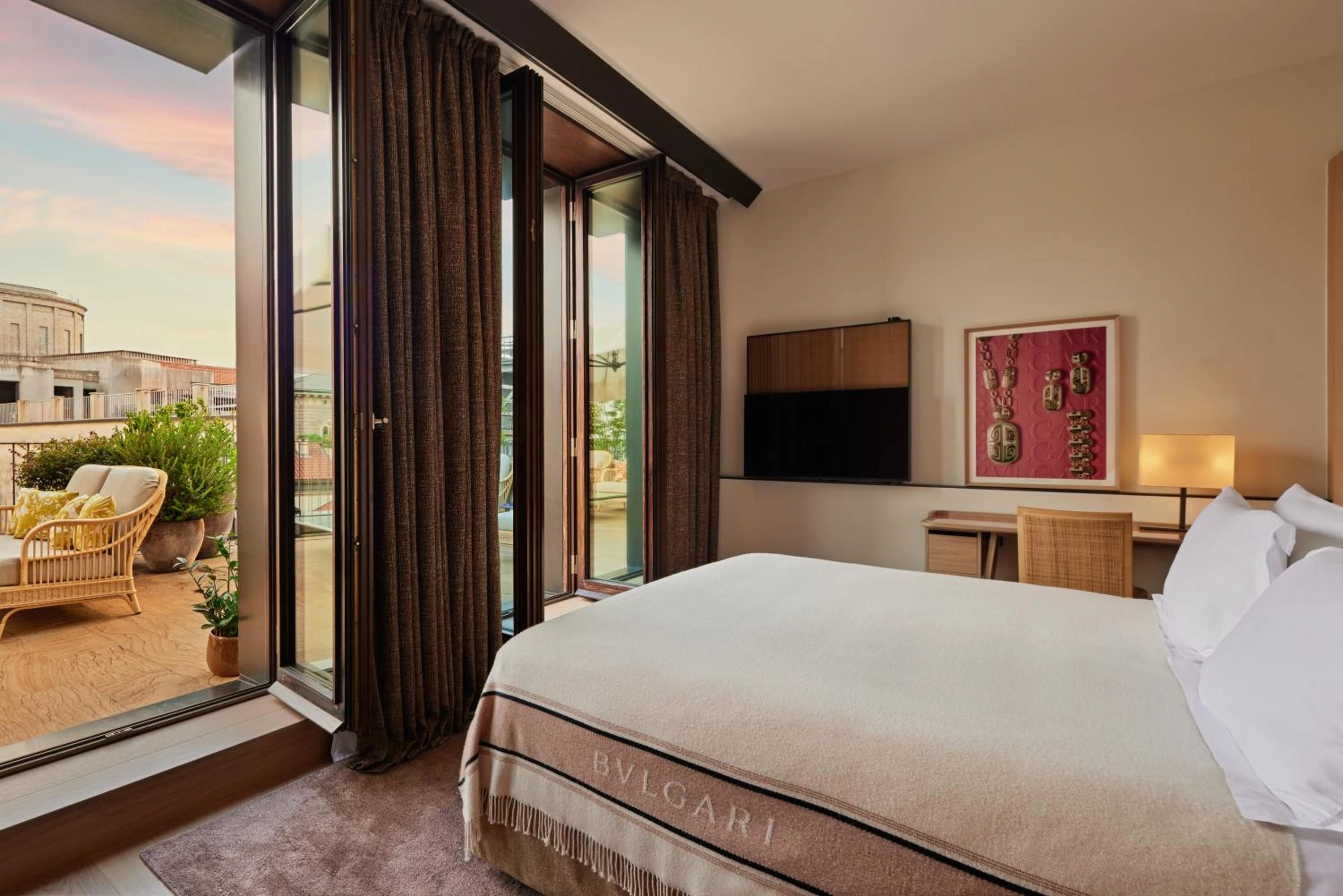
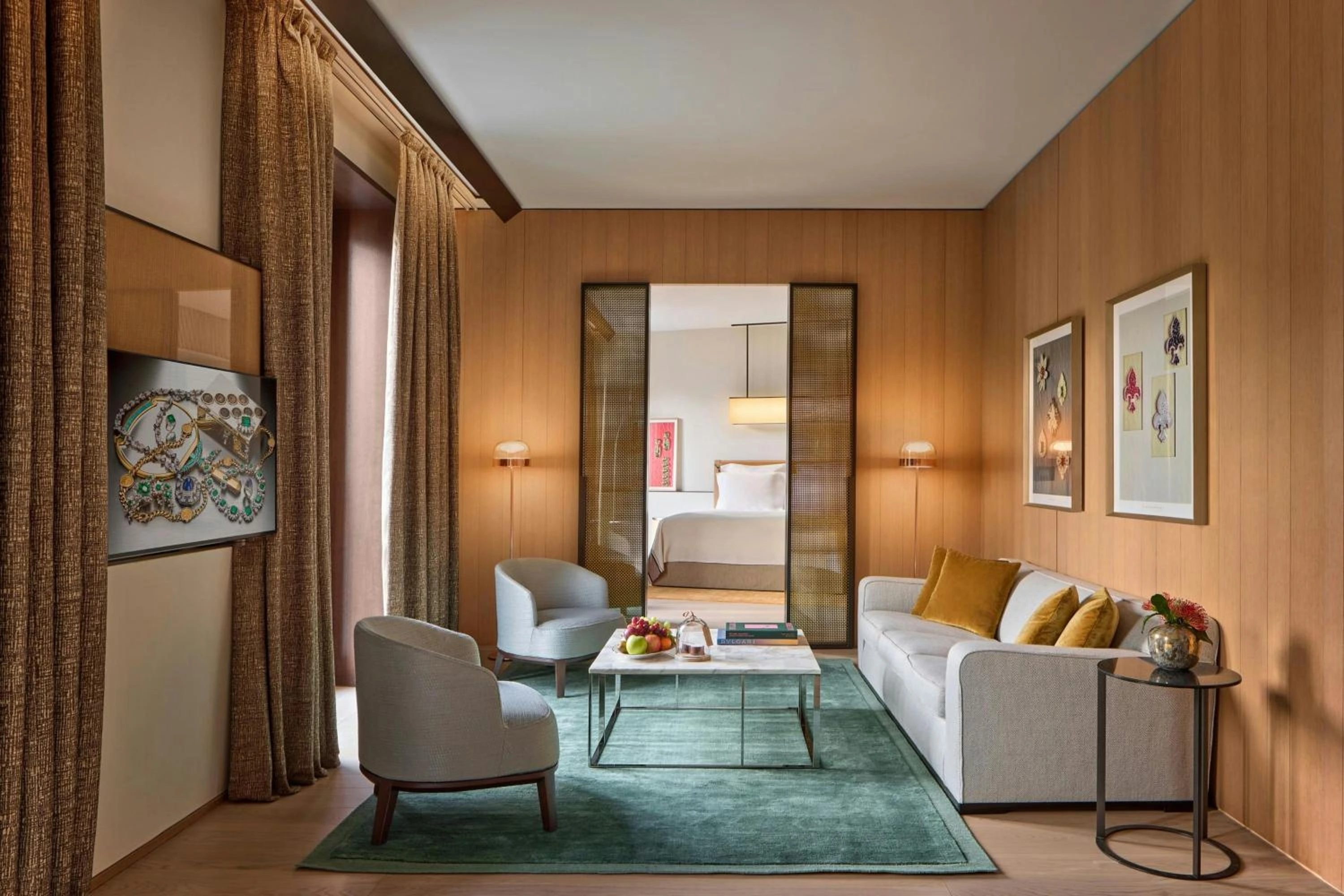
The Bvlgari Hotel Milano comprises five levels of suites, each expressing a gradation in space and in the relationship with light. The 65 m² Junior Suite provides a first immersion in the house's vocabulary: an open-plan space where the living area and bedroom articulate around a central axis of light, with partitions treated as dark wood panelling that absorbs sound and directs the eye outward.
The windows, deliberately tall and narrow, frame the landscape like framed paintings. Natural light enters in sequences, modulated by curtains in natural linen. The cream beige travertine marble floor contrasts with the dark lacquered furniture, creating an alternation of warmth and rigour that characterises Milanese minimalism in its most refined form.
The Superior Suite with Garden View: a dialogue with nature
The Superior Suite with Garden View of 70 m² introduces an additional dimension: the opening onto the hotel's private garden. From the bed, whose headboard is covered in full-grain leather sewn by hand, the view opens directly onto the foliage. This vegetal setting, dense and ordered, acts as a third wall, organic and changing with the seasons.
The bathroom, in Cipollino marble with veins of deep green, subtly echoes the chromatic codes of Bvlgari jewelry: that emerald green that the house has established as its absolute signature since its earliest collections. The freestanding bathtub, sculpted from a single block of stone, occupies the center of the room with the presence of a sculpture.

The Premium Suite with Garden View: 100 m² of inhabited silence
At the top of the hotel's residential hierarchy, the Premium Suite with Garden View of 100 m² offers a relationship to space that is exceptionally rare in central Milan. The living room, separated from the bedroom by a pivoting partition in solid walnut, has sufficient ceiling height for evening light to create distinct volumes depending on the hour.
The proportions here are deliberately generous, almost counterintuitive in a city that compresses its square meters. It is precisely this luxury of space that constitutes one of the most recognizable markers of the establishment's positioning. At an address where every detail is calculated, the air itself seems to be part of the architectural program.
If the relationship between interior architecture and brand identity interests you, the article Architect vs Decorator: Who Truly Structures the Space of Your Suite? provides valuable analytical insight into these design choices.
The private garden, natural extension of the suite experience
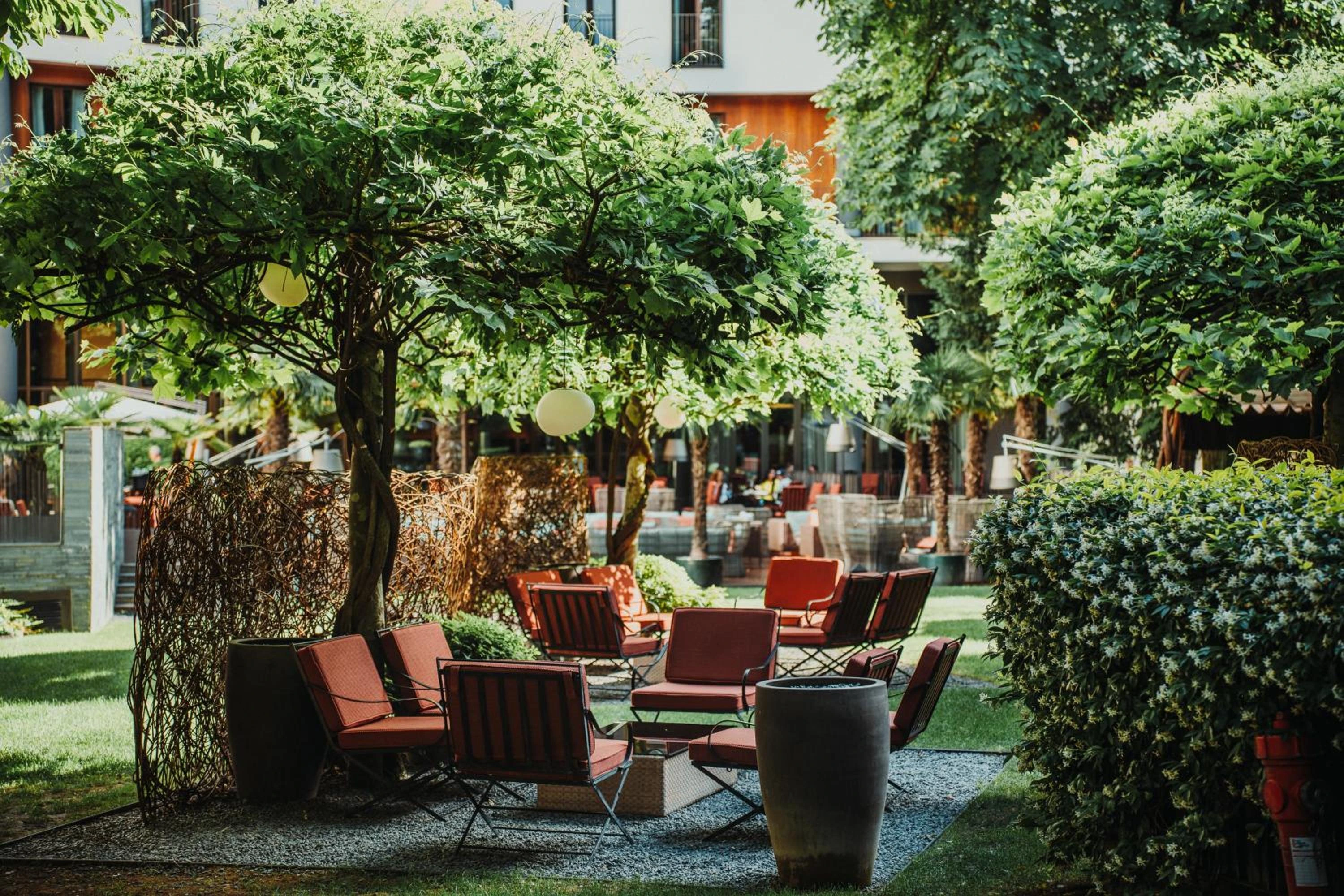
One of the most singular assets of the Bvlgari Hotel Milano in the Milanese urban context is its garden. Located at the rear of the building, in direct continuity with the adjacent botanical garden, this green space constitutes a precious anomaly in the heart of the Quadrilatero.
The garden is not a peripheral amenity: it is structurally integrated into the suite experience. The Deluxe Suites with Garden View of 80 m² have direct access to it or benefit from it as an immediate horizon. The vegetation, maintained with the precision of a bonsai, filters the light and creates an atmosphere of complete withdrawal from the surrounding urban fabric.
In summer, the garden becomes an open-air living room. In autumn, the yellowing leaves bring a chromatic patina that transforms each morning into a different experience. The continuity between the interior of the suites and this outdoor space is such that the boundary between inside and outside becomes porous, in the most precise sense of the architectural term.
This use of landscape as a material in its own right recalls approaches found in other exceptional European properties. Our article on minimalism and architectural serenity in the Balearic Islands documents other ways in which contemporary luxury architecture integrates vegetation into its formal design choices.
Goldsmith details: bespoke furniture and Bvlgari codes
Furniture conceived as a collection
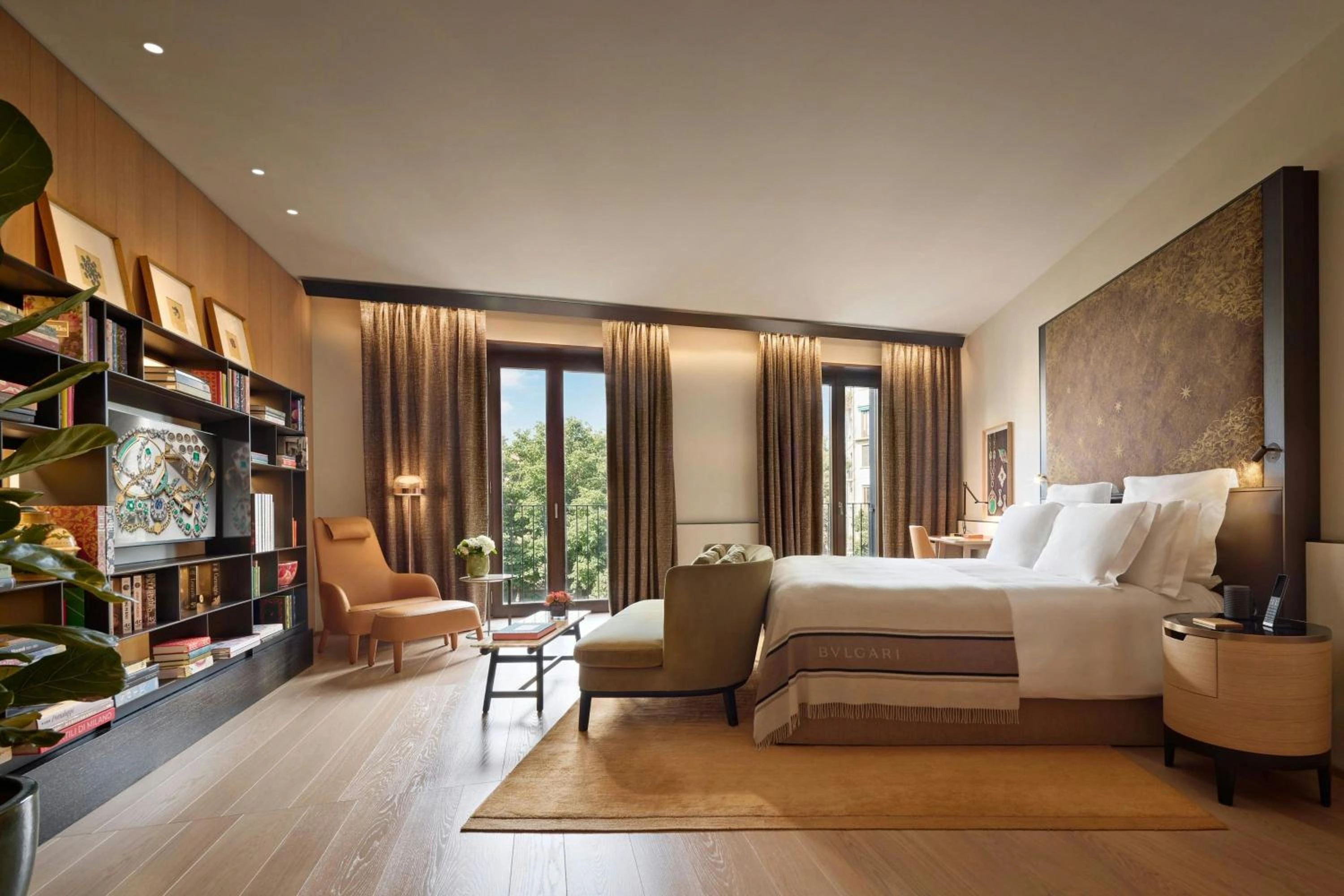
No piece of furniture at the Bvlgari Hotel Milano comes from a production line. Each piece was drawn specifically for the establishment, in close collaboration between the Citterio Patricia Viel teams and Italian craftsmen selected for their technical mastery. Bedside tables in brushed bronze, seats upholstered in saddler's leather, adjustable reading lights in satin metal: every object responds to a precise logic of use while contributing to the visual coherence of the whole.
Bvlgari chromatic codes return with discretion but consistency: deep green, rose gold, lacquered black. These hues never saturate the space; they punctuate, as in a musical score, moments of visual recognition.
The bathroom as a masterpiece
In each suite, the bathroom receives architectural treatment that gives it the status of a separate room. Marble is not simply applied as a coating: it is worked in mass, in dimensions that exceed the usual standards of luxury hospitality. Joints are reduced to their minimal expression to preserve the visual continuity of the stone.
The hygiene products, developed exclusively for Bvlgari hotels by the house, extend the sensory experience with fragrances elaborated internally. This level of vertical integration, from the building to cosmetics, is one of the characteristics that distinguishes the Bvlgari Hotels project from the majority of luxury establishments around the world.
The spa: mosaic, water and golden light
The hotel spa deserves special mention in any examination of the architectural identity of the place. The indoor pool, clad in glass mosaics in emerald green and gold tones, constitutes one of the most accomplished decorative achievements of the establishment. The lighting, designed to play on water reflections and glass facets, produces an atmosphere that oscillates between Roman thermal baths and the contemporary cabinet of curiosities.
This space illustrates with acuity the creative tension at the heart of the Bvlgari Hotel project: combining classical heritage and contemporary language without one overwhelming the other.
Why these suites embody understated Italian luxury
Understated luxury, in its most rigorous sense, is not defined by the absence of wealth but by the absence of display. The Bvlgari Hotel Milano embodies this definition with rare consistency. Nothing in its facade, sober and almost domestic, signals the intensity of what unfolds within.
The hotel's suites practice this same art of restraint. The richness of materials is apprehended through touch before it is read by sight. The quality of bed linens, the gentle resistance of woodwork under the hand, the exact weight of bronze door handles: so many sensations that accumulate to compose a total experience, without ever displaying it.
This approach aligns with what the finest examples of Italian luxury have always known how to do: inscribe value in the manufacturing gesture rather than in the outward sign. In this sense, the Bvlgari Hotel Milano is less a luxury hotel than a manifesto on what luxury should be.
To understand how other Italian establishments articulate architectural heritage and contemporary experience, our article Italy: when luxury combines with respect for the territory offers a complementary and enlightening overview.
For a comparative perspective on urban luxury in other European capitals, our selection of signature suites in Madrid with terrace documents another variation of the same exacting standard.
Key takeaways
The Bvlgari Hotel Milano was designed by Antonio Citterio Patricia Viel as a direct extension of the Bvlgari house's jewelry identity, with materials (Cipollino marble, teak, bronze) selected for their intrinsic quality.
The most sought-after suites are those with a direct view of the private garden, notably the Premium Suite with Garden View, 100 m², which offers an exceptional relationship to space in the city center.
Each piece of furniture is custom-designed; no piece comes from a standard collection, which gives the whole a collection coherence rather than an inventory quality.
The establishment practices a form of luxury founded on formal discretion: sober facade, interior dense in quality, progressive sensory experience rather than immediate.
LaSuite Selection
Discover the suites of the Bvlgari Hotel Milano and compose your stay according to your relationship with space and light. The Superior Suite Garden View and the Premium Suite with Garden View represent the two most emblematic entries into the Bvlgari experience in its fullness.
Frequently Asked Questions
What are the most iconic suites at Bvlgari Hotel Milano?
The suites with garden views capture the essence of the property's identity. The Superior Suite Garden View (70 m²) and the Premium Suite with Garden View (100 m²) offer direct visual access to the foliage of the private garden, in proportions rare for central Milan.
Who designed the interior architecture of Bvlgari Hotel Milano?
The entire project was conceived by the Milan-based firm Antonio Citterio Patricia Viel, commissioned to translate the aesthetic codes of the Bvlgari house into contemporary architectural language, with particular attention to natural materials and proportions.
What is the positioning of Bvlgari Hotel Milano in the Milan hotel landscape?
With fewer than fifty units, the property falls into the category of ultra-luxury hotels with minimal volume, prioritizing exclusivity and density of detail. It is located just steps from Via Montenapoleone, in the heart of the Quadrilatero della Moda.
What materials characterize the bathrooms of the Bvlgari Hotel Milano suites?
The bathrooms are finished in Cipollino marble, with veins of deep green evoking the chromatic codes of Bvlgari jewelry. The freestanding bathtubs, carved from solid stone, occupy a central position and bestow upon these spaces the status of a room in their own right.
Is the garden of Bvlgari Hotel Milano accessible from the suites?
Yes. The suites with garden views benefit from direct access or an immediate perspective onto the hotel's private garden, which itself flows into the adjacent botanical garden. This space represents a rare asset in the dense urban context of central Milan.
More from the Journal

The Suites at the Beverly Hills Hotel in Los Angeles
On Sunset Boulevard, the Beverly Hills Hotel has embodied California's benchmark for understated luxury for over a century. Behind its pink facade and banana tree gardens, the suite is not an enlarged room: it is an architecture of intimacy, designed for those who know the difference between comfort and experience.
BY Jules Peulet

Hotel Yona: When Architecture Redefines Alsatian Luxury
The Essence of the Hotel Yona Experience
Hotel Yona (formerly Le Parc Obernai) redefines the codes of luxury hospitality in the Grand Est through a mineral and avant-garde architectural transformation. While the spectacular Yonaguni Spa with 2,500 m² captures all eyes, the true secret of a successful stay lies in the choice of room. Choosing an upgrade to a Junior Suite at Yona means securing an intimate and privileged extension of the thermal area: a generous living space, a refined aesthetic combining solid wood with natural stone, and complete immersion in Quiet Luxury. This is the strategic recommendation of LaSuite.com and GREAT-ARTMAG, to transform a simple wellness experience into a genuine premium holistic retreat.
BY Jules Peulet

Suites at The Plaza New York: The timeless elegance of Manhattan's most iconic address
At the intersection of Fifth Avenue and Central Park, The Plaza has embodied since 1907 the purest expression of New York hospitality. Its signature suites, from the Pulitzer to the Grand Penthouse, tell a story of prestigious architecture where each space, each material and each view compose an intimate narrative. The Suite deciphers this art of hospitality that continues to define hotel excellence in Manhattan.
BY Jules Peulet