Where to stay in Bhutan: the key valleys and their character
Paro: the western gateway
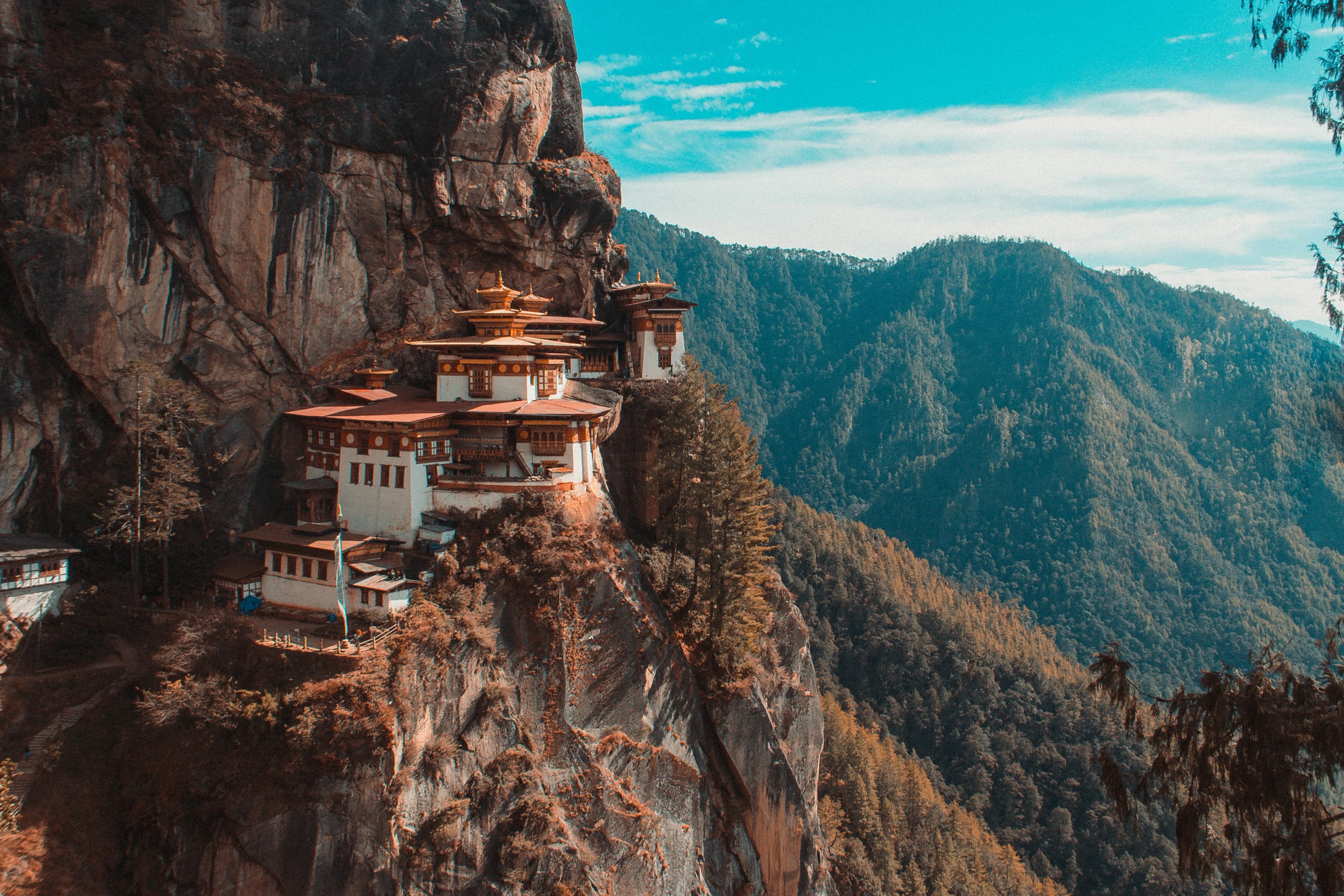
Paro is the entry point for most international visitors, as it is home to Bhutan's only international airport. The valley is wide and relatively flat by Himalayan standards, cultivated with wheat and rice fields, and anchored by the Paro Dzong, one of the country's most photographed fortress-monasteries. Several of Bhutan's most established luxury properties are located here, often built along the Paro Chhu river or set against forested hillsides. The proximity to Tiger's Nest Monastery (Paro Taktsang) makes it a natural base for travelers who want immediate access to the country's most iconic site without sacrificing comfort.
Thimphu: the capital at altitude
Thimphu sits at approximately 2,300 metres and functions as the country's administrative, cultural, and commercial centre. It is the only capital city in the world without traffic lights, a detail that speaks to the deliberate pace the city maintains. For suite travelers, Thimphu offers proximity to the National Museum, the Royal Textile Academy, and the weekend market. Properties in and around the capital tend toward a more contemporary interpretation of Bhutanese architecture, with a number of newer luxury hotels having invested in suite categories that balance local craft with modern spatial standards.
Punakha: the lower valley
Punakha, at around 1,200 metres, is significantly warmer than Paro or Thimphu, which makes it the preferred destination during winter months. The valley is exceptionally fertile, known for its rice cultivation and subtropical vegetation. The Punakha Dzong, built at the confluence of two rivers, is considered one of the most architecturally significant structures in the country. Luxury properties here tend to use the river and agricultural landscape as primary design references, with some incorporating traditional farmhouse architecture into their suite configurations.
For travelers moving toward central and eastern Bhutan, Wangdue Phodrang and Trongsa serve as logical staging points. Trongsa in particular holds historical significance as the ancestral seat of the Wangchuck dynasty. Properties in this corridor are fewer in number and often smaller in scale, offering a more immersive experience of rural Bhutan. Suite categories here prioritise views and quietude over urban access.
When to visit Bhutan for a luxury suite stay
Bhutan has two primary travel seasons, both determined by the Himalayan weather cycle. Spring (March to May) and autumn (September to November) are considered optimal. In spring, the rhododendron forests are in full colour and the air is clear enough for Himalayan ridge views. Autumn brings cooler temperatures, post-monsoon clarity, and the Thimphu Tshechu festival in September, one of the country's largest masked dance celebrations. Both seasons see strong demand for suite inventory, particularly at Paro properties, and advance booking is essential.
The monsoon season (June to August) brings significant rainfall and restricted trekking conditions, though some travelers specifically choose this period for the green intensity of the valleys and reduced visitor numbers. Winter (December to February) is cold at altitude but viable in Punakha, and coincides with the Punakha Drubchen festival in February, a significant ceremonial event.
Understanding Bhutan's luxury hospitality standards
Bhutan does not use the Palace designation found in France or the Ryokan framework of Japan. Instead, the country's high-end hospitality has developed around two distinct models. The first is the international group model: a small number of global operators (Aman, Six Senses, Como) have established properties in Bhutan, each adhering to their brand's suite standards while adapting spatial and material choices to the local context. These properties typically feature suite categories with private balconies, wood-burning fireplaces, and handwoven textiles produced within the country.
The second model is the independent Bhutanese luxury lodge, a category that has grown considerably since the early 2000s. These properties are often family-owned or operated in partnership with the government's tourism infrastructure, and they tend to place a stronger emphasis on cultural programming: cooking classes using local grain and chili, private access to monastery ceremonies, or guided agricultural experiences in working farmland adjacent to the property.
Across both models, the regulatory architecture of Bhutanese tourism (the Sustainable Development Fee, formerly the daily tourist tariff) means that the baseline traveler profile is already filtered. This creates a particular atmosphere in even the less exclusive properties: fewer visitors, more deliberate pacing, and a hospitality culture that does not orient itself around volume. For suite travelers, this structural context reinforces the quality of the stay.
How to choose the right luxury suite in Bhutan
Several factors are worth weighing before selecting a suite in Bhutan. Altitude and valley position matter considerably: a suite at 2,300 metres in Thimphu will feel different in January than a riverside suite in Punakha at half the elevation. Travelers with a strong interest in trekking or Tiger's Nest access should prioritise Paro. Those focused on cultural density and institutional visits may find Thimphu a more practical base. Punakha suits travelers who want warmth, river views, and a slower pace.
Architectural character is also a meaningful consideration. Traditional Bhutanese architecture uses whitewashed stone or rammed earth walls, timber-framed windows with painted detail, and sloping roofs. Properties that have maintained this vocabulary tend to integrate more coherently into the landscape. Some newer builds adopt a more hybrid approach, pairing local materials with contemporary interior layouts. Both can work at the suite level, but the choice reflects a traveler's preference for immersion versus contrast.
Finally, the question of programming: many of Bhutan's luxury properties include curated experiences as part of the suite rate, from private Dzong access at early hours to archery instruction and hot stone bath rituals. Understanding what is included and what requires separate arrangement is part of the pre-travel process, and one where a curated platform with current property knowledge adds measurable value. For broader context on traveling across the region, the Asia destination overview on La Suite provides additional perspective on how Bhutan sits within the wider Himalayan and Southeast Asian luxury landscape.
The case for curation in a restricted destination
Bhutan presents a specific challenge for the independent traveler: the country's tourism framework, its limited number of high-grade properties, and the significant cost of the trip itself all make the margin for error very low. A poor suite choice in Paris is recoverable. In Bhutan, where the investment in time, travel logistics, and government fees is substantial, the selection of accommodation is not a peripheral decision.
La Suite's curatorial approach applies the same criteria to Bhutan that it applies across Asia broadly: spatial quality, material integrity, service architecture, and the degree to which the suite experience amplifies rather than insulates from the destination. In a country where the landscape, culture, and regulatory framework already do the work of filtering, the right suite is the one that earns its place within that context. The curated selection by La Suite identifies the properties that meet that standard, without inflation and without approximation.