Where to stay in Rajasthan: understanding the distinct territories
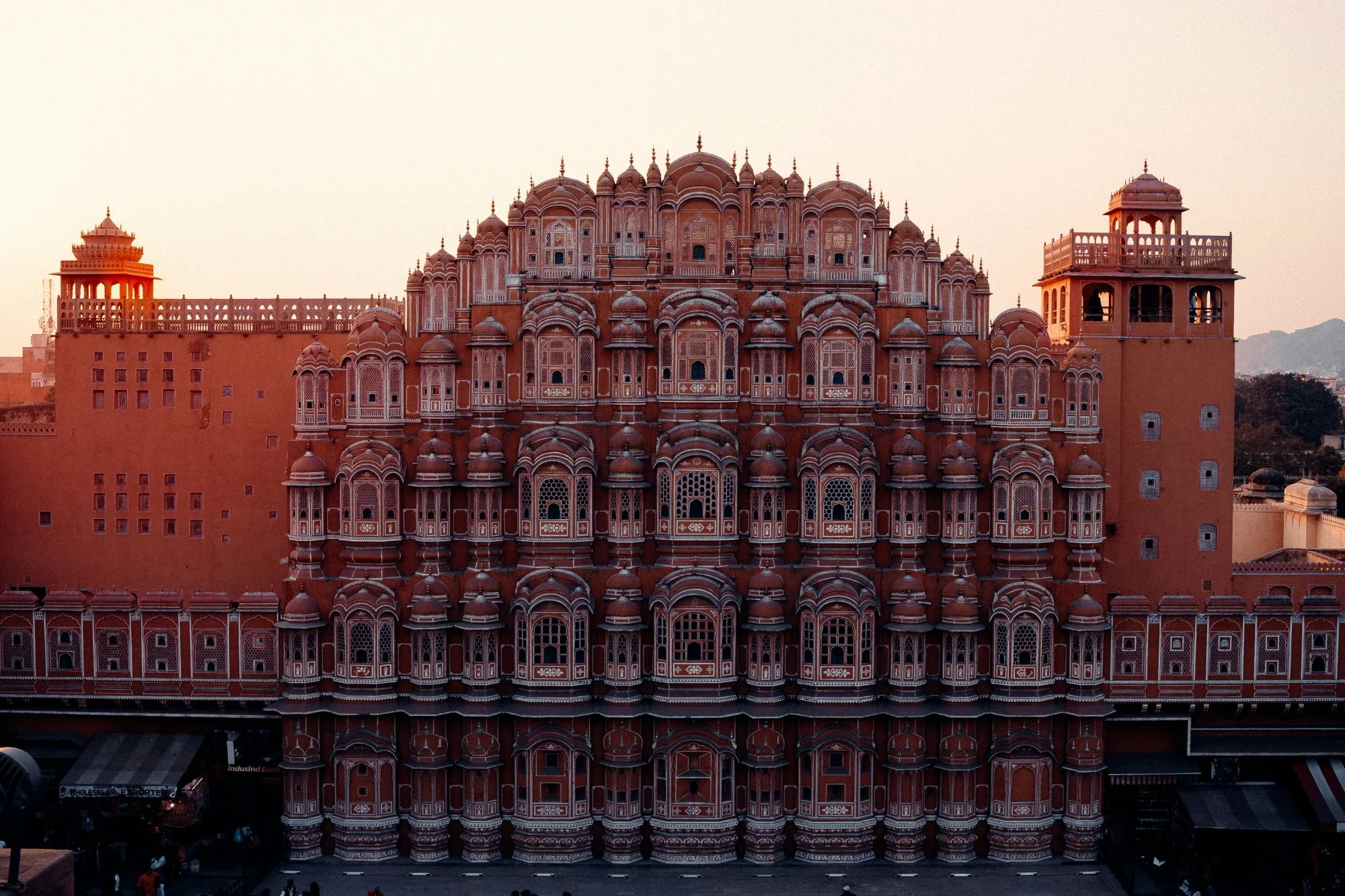
The eastern corridor, anchored by Jaipur, is where Mughal and Rajput influences converge most visibly. The walled city, the amber-coloured sandstone facades, and the density of palace-era architecture make this the region's most legible entry point for first-time visitors. Properties here tend toward conversion: former havelis and royal residences transformed into hotels with significant historical footprint.
Further west, Jodhpur rises around the massive Mehrangarh Fort. The city's blue-painted old quarter sits below the fort's walls, and the surrounding Thar Desert begins to assert itself. Stays here offer a rawer, more dramatic quality. The scale of the fort and the arid landscape give properties in this area a particular gravity.
Udaipur operates at a different register entirely. Built around a series of lakes, with the Aravalli Hills forming a natural enclosure, it is the most intimate of Rajasthan's major cities. The density of water, stone, and courtyard architecture creates a sensory environment distinct from the desert zones to the north and west.
Jaisalmer, close to the Pakistan border, is the desert's centre. The golden sandstone fort here is a living settlement, and the surrounding dunes attract travelers specifically for the silence and spatial extremity. Luxury in this context means privacy above all: camps and properties positioned far from the tourist circuit.
For those seeking isolation, the rural hinterland between these cities, including the areas around Ranthambore, Shekhawati, and the Aravalli foothills, offers estate properties, wildlife lodges, and restored fortresses with minimal footprint and maximum seclusion.
When to visit Rajasthan for a luxury suite stay
The climate of Rajasthan is among the most extreme in India, and timing has direct consequences for the quality of a stay.
October through March represents the primary season. Temperatures are manageable, ranging from cool evenings in December and January to warm, dry days through February and March. This is when the major cultural events occur, including the Jaipur Literature Festival in late January, one of Asia's largest literary gatherings, and the Pushkar Camel Fair in November, which draws international visitors alongside pilgrims. Suite availability at the finest properties tightens significantly during these months, and advance planning is essential.
April and May mark the pre-monsoon period. Temperatures regularly exceed 40 degrees Celsius across the desert zones. Some travelers specifically seek this period for its emptiness and reduced rates. Properties with strong indoor architecture, thick stone walls, and private pools are the appropriate choice for summer visits.
The monsoon arrives in July and lasts through September. Rajasthan receives less rainfall than most of India, but the season transforms the landscape, particularly around Udaipur and the Aravalli Hills. Select properties position the monsoon as their quietest and most atmospheric season, with lush surrounds and very few other guests.
Luxury standards in Rajasthan: what to expect from top-tier properties
Rajasthan operates with its own distinct taxonomy of luxury. Understanding these categories helps calibrate expectations before booking.
The Heritage Hotel category is formally recognized by the Government of India and covers properties classified as Grand Heritage, Heritage Classic, and Heritage Basic. Grand Heritage properties are former royal palaces, forts, and havelis of significant historical and architectural standing. These are not simply old buildings with good service; they are documents of Rajput and Mughal building culture, maintained (in the best cases) with rigorous attention to original materials, proportions, and craft.
Within these properties, suite configurations vary considerably. A suite in a converted palace may occupy a tower room, a zenana (women's quarters) pavilion, or a lakeside baradari. The spatial logic of these rooms follows historical precedent, not contemporary hotel norms. Ceiling heights, courtyard access, and decorative schemes are inherited rather than designed, which is precisely their value.
The Taj Hotels group's Palaces sub-brand, along with SUJÁN Hotels, Amanbagh, and several independent operators, represents the upper tier of the market. Standards at these properties are consistent with international ultra-luxury benchmarks: butler service, private dining, curated cultural programming, and suites that function as self-contained environments.
At the apex are the lake palace properties, most famously the Taj Lake Palace in Udaipur, which occupies an island in Lake Pichola. Suite access here is by boat, and the physical separation from the city is total. This model of deliberate inaccessibility recurs across Rajasthan's most serious luxury properties.
How to choose the best luxury suite in Rajasthan
Several considerations are specific to this destination and should inform the selection process.
Architecture versus amenity: The most historically significant properties do not always offer the most contemporary amenities. Stone walls, small windows designed for desert heat, and irregular floor plans are characteristic of genuine heritage buildings. Travelers who prioritize contemporary bathroom fixtures, large flat-surface beds, and seamless connectivity should assess each property carefully. The finest heritage operators have resolved this tension well; others have not.
Indoor-outdoor configuration: Rajasthan's climate means that the relationship between a suite and its outdoor space (terrace, courtyard, plunge pool) is critical for much of the year. Suites without meaningful private outdoor access are significantly less valuable in warm months.
Proximity to the main attraction versus seclusion: Some travelers want to be embedded in the city fabric; others want distance and privacy. Properties within fort complexes or city palaces offer immediacy but often also noise. Estate properties and wildlife lodges an hour or more from the nearest city offer the opposite.
Cultural programming: The strongest properties in Rajasthan offer structured access to craft traditions, culinary experiences, and historical interpretation that is not available independently. This programming, when it exists, substantially changes the nature of the stay.
Why a curated selection by La Suite matters in Rajasthan
The Rajasthan luxury hotel market is large, uneven, and in some areas actively misleading. The heritage hotel designation covers properties of radically different quality. Marketing language across the sector tends toward the ornate and the imprecise. Without reliable curation, it is easy to pay at the upper end of the market for a property that delivers only the aesthetics of heritage, not the substance.
La Suite applies consistent editorial criteria across the properties it lists. Each property is assessed for the quality of its suite inventory specifically, not simply for its brand reputation or its property rating. In a destination where the gap between a genuinely exceptional suite and a well-photographed average room is significant, this distinction matters.
For a region as architecturally and geographically complex as Rajasthan, having a filtered, reliable starting point compresses the research process considerably and reduces the risk of a misaligned booking.