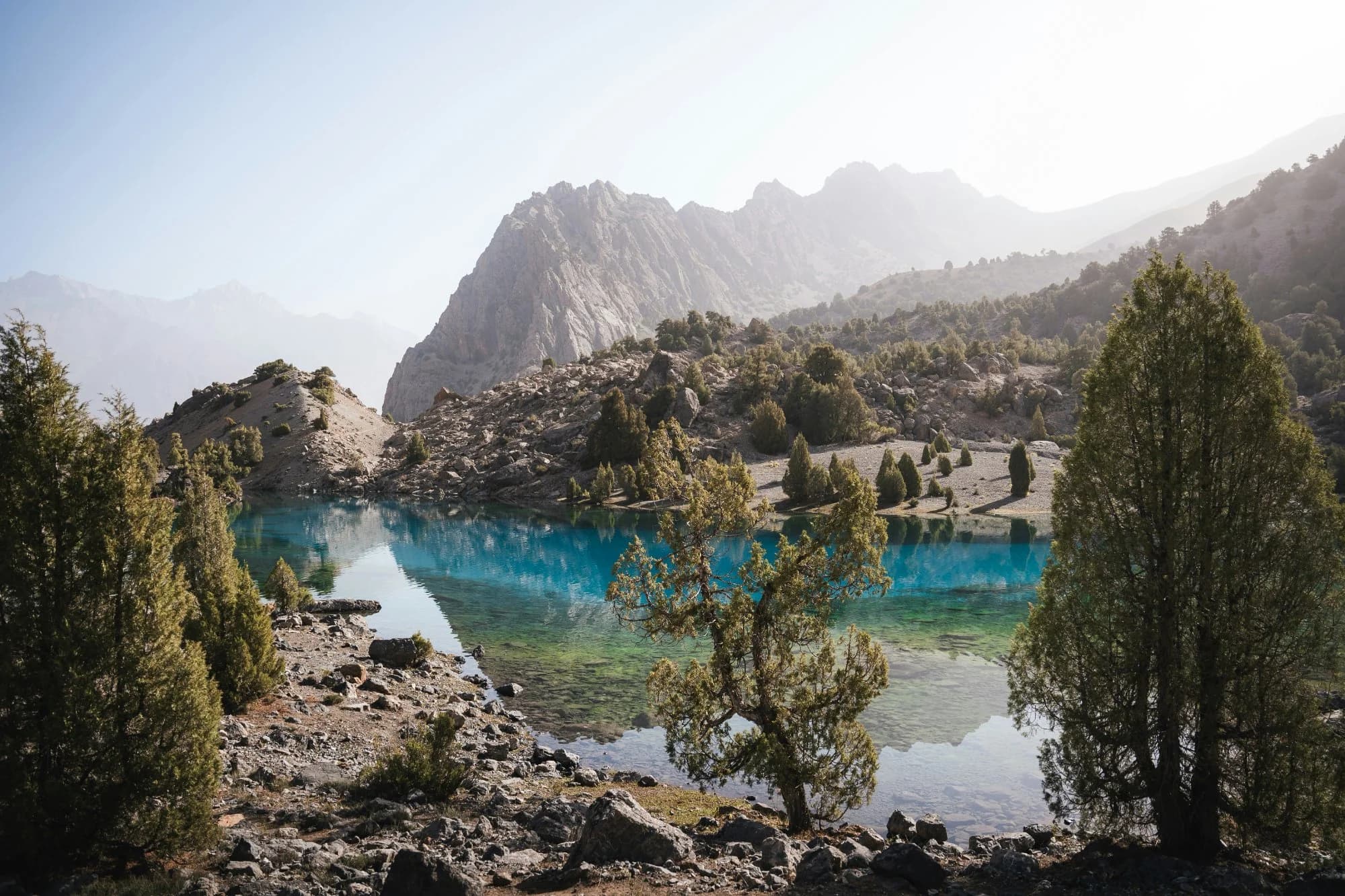
Where to stay in Tajikistan for a high-end suite experience
Dushanbe and the western lowlands
The capital, Dushanbe, is the country's administrative and commercial centre, situated in the Hissar Valley at around 800 metres above sea level. It is the primary entry point for international flights and the location of the country's most structurally complete hotels. The city's tree-lined boulevards, Soviet-era planning grid, and growing diplomatic quarter create a context that is neither purely Central Asian nor entirely contemporary. For suite travellers, Dushanbe offers the highest concentration of rooms that approach international luxury standards, with dedicated suite floors, reliable infrastructure, and proximity to the National Museum of Tajikistan and the Rudaki Opera and Ballet Theatre. The surrounding Hissar region contains a medieval fortress and ancient settlements that reward a half-day excursion.
The Wakhan Corridor and the Pamir Highway
Stretching eastward toward the Afghan and Chinese borders, the Wakhan Corridor is one of the most remote inhabited landscapes on the planet. The Pamir Highway (M41), one of the world's highest altitude road routes, connects Dushanbe to Murghab and beyond. This is expedition territory. Accommodation here tends toward purpose-built guesthouses and eco-lodges rather than conventional luxury hotels, but a small number of properties have begun investing in elevated design and service standards, prioritising location above a river valley or against a glacier-flanked ridge. Suite travellers willing to define luxury through position and solitude rather than thread counts will find this corridor genuinely irreplaceable.
Khujand and the Fergana Valley approach
In the north, Khujand, Tajikistan's second city, sits at the edge of the Fergana Valley, one of the historically densest and most agriculturally productive regions in Central Asia. The city's covered bazaar and ancient citadel mound situate it firmly in the Silk Road narrative. Business and diplomatic travel drives most of the demand for higher-tier rooms here, making it a more functional than experiential base for suite travellers, though the surrounding landscape of apricot orchards and terraced hillsides provides genuine visual compensation.
When to visit Tajikistan for the best suite availability and experience
Tajikistan's geography creates extreme seasonal variation. The window for comfortable high-altitude travel is narrow, and suite availability at the country's better properties follows these natural rhythms closely.
Late spring, specifically May and early June, brings blooming vegetation to the lower valleys and manageable temperatures in Dushanbe. This period represents a productive balance between accessibility and landscape quality. The Pamir and Wakhan regions become passable by road from approximately June onward, depending on snowmelt conditions in any given year.
July and August constitute the high season. Mountain passes are open, rivers run fast with glacial melt, and the light at altitude is exceptional in quality: sharp, direct, and long into the evening. Suite demand at the limited number of higher-end properties peaks during these months. Booking well in advance is not discretionary; it is structural, given the thin inventory of quality rooms across the country.
September offers a quieter window. Temperatures remain reasonable, the harvest season brings particular life to agricultural valleys, and the crowds that characterise August diminish perceptibly. For travellers who prefer a less compressed experience, early autumn is arguably the most rewarding period.
Winter isolates much of the country. High passes become impassable, and only Dushanbe maintains reliable year-round international access. Suite travellers with a specific interest in the Soviet architectural legacy or museum culture may find the capital functional in winter, but the Pamirs are not a realistic destination between November and April for most itineraries.
Local luxury standards: what to expect from top-tier suites in Tajikistan
Tajikistan does not yet operate within the established luxury classification systems that govern markets like France or the Gulf. There is no local equivalent of the French Palace designation or the UAE's formal five-star audit infrastructure. This creates both a challenge and an opportunity for the discerning traveller.
The country's top-tier properties, concentrated primarily in Dushanbe, have been built or renovated with international business and diplomatic travellers in mind. Suite configurations in these hotels typically include generous floor plans by regional standards, separate living areas, and improved bath specifications compared to standard rooms. The service culture draws on Tajik hospitality traditions, which emphasise attentiveness and generosity, though it operates within a staffing and training environment still maturing toward consistent global luxury benchmarks.
Outside the capital, the concept of a luxury suite shifts toward what might be called positional luxury: a room with a direct sight line over the Wakhan Valley, a terrace facing the Fan Mountains, or a structure built in traditional Pamiri architectural style, with its distinctive wooden central column (the chorkhona) reinterpreted for contemporary comfort. These properties reward travellers who can read beyond the amenity checklist.
Travellers should also note that connectivity, even in the capital's better hotels, does not yet match the infrastructure standards of comparable properties in Almaty or Tashkent. Due diligence on internet reliability, power stability, and arrival logistics is advisable before confirming a suite booking.
How to choose the best suite in Tajikistan: practical considerations
The suite selection process in Tajikistan requires a different frame of reference than most luxury destinations. The filtering criteria that apply in Paris or Singapore, where the density of excellent properties allows for nuanced comparison, give way to a more fundamental set of questions.
First, define what the suite must deliver functionally. If reliable high-speed connectivity is non-negotiable for a working trip, Dushanbe is the only viable base. If the goal is immersive landscape access and the journey itself is part of the experience, then the Pamir corridor's limited but earnest inventory of elevated guesthouses and small lodges deserves serious consideration.
Second, consider altitude physiology. Much of Tajikistan's most compelling territory sits above 3,500 metres. Acclimatisation is not a secondary concern but a genuine factor in how a stay is experienced. Properties that account for this, through pacing itineraries, altitude-appropriate menus, and knowledgeable staff, deliver a materially better experience than those that do not.
Third, assess the architectural and cultural integrity of the property. Tajikistan's Soviet and pre-Soviet built heritage is particular and largely intact in its secondary cities. A suite that references this context through material choices, craft detailing, or spatial organisation offers something that a generic international hotel box cannot replicate regardless of its amenity level.
Why curation matters for luxury suite travel in Tajikistan
The combination of thin inventory, extreme seasonal variation, uneven classification standards, and complex logistics makes Tajikistan one of the destinations where independent research carries the highest risk of miscalibration. A suite that photographs attractively may exist in a property where the infrastructure, service consistency, or positioning fails to justify the premium.
La Suite's curation process applies consistent editorial standards across all destinations, including those where the market is nascent. The properties that appear in our selection for Tajikistan have been evaluated against the same criteria as those in established luxury markets: spatial quality, service intent, positional value, and the coherence of the overall experience. In a destination where marketing outpaces delivery at many properties, this filtering function is not incidental. It is the primary value of working with a curated platform. The La Suite selection for Tajikistan is deliberately compact, reflecting honest market conditions rather than inflated inventory claims.