Understanding Darwin as a luxury destination
Areas and precincts worth considering
The Darwin waterfront precinct
The waterfront precinct represents the most concentrated zone of contemporary hospitality infrastructure in Darwin. Developed on reclaimed land adjacent to the central business district, it offers direct views across Frances Bay and the broader harbor. The architecture here tends toward the modern and climate-responsive, with deep overhangs, shaded terraces, and generous room volumes that allow air to circulate. This is the natural address for travelers seeking a luxury hotel suite with both urban convenience and direct engagement with Darwin's defining geographical feature: its relationship to the water.
The city centre and Esplanade
The Esplanade corridor, running along the clifftop above Darwin Harbor, offers an older and more established residential and hospitality character. Hotels positioned here benefit from elevated vantage points and a quieter, more contained atmosphere than the waterfront precinct below. The proximity to the Darwin CBD, the Museum and Art Gallery of the Northern Territory, and Bicentennial Park makes this area particularly practical for travelers combining business with cultural exploration.
Cullen Bay and Fannie Bay
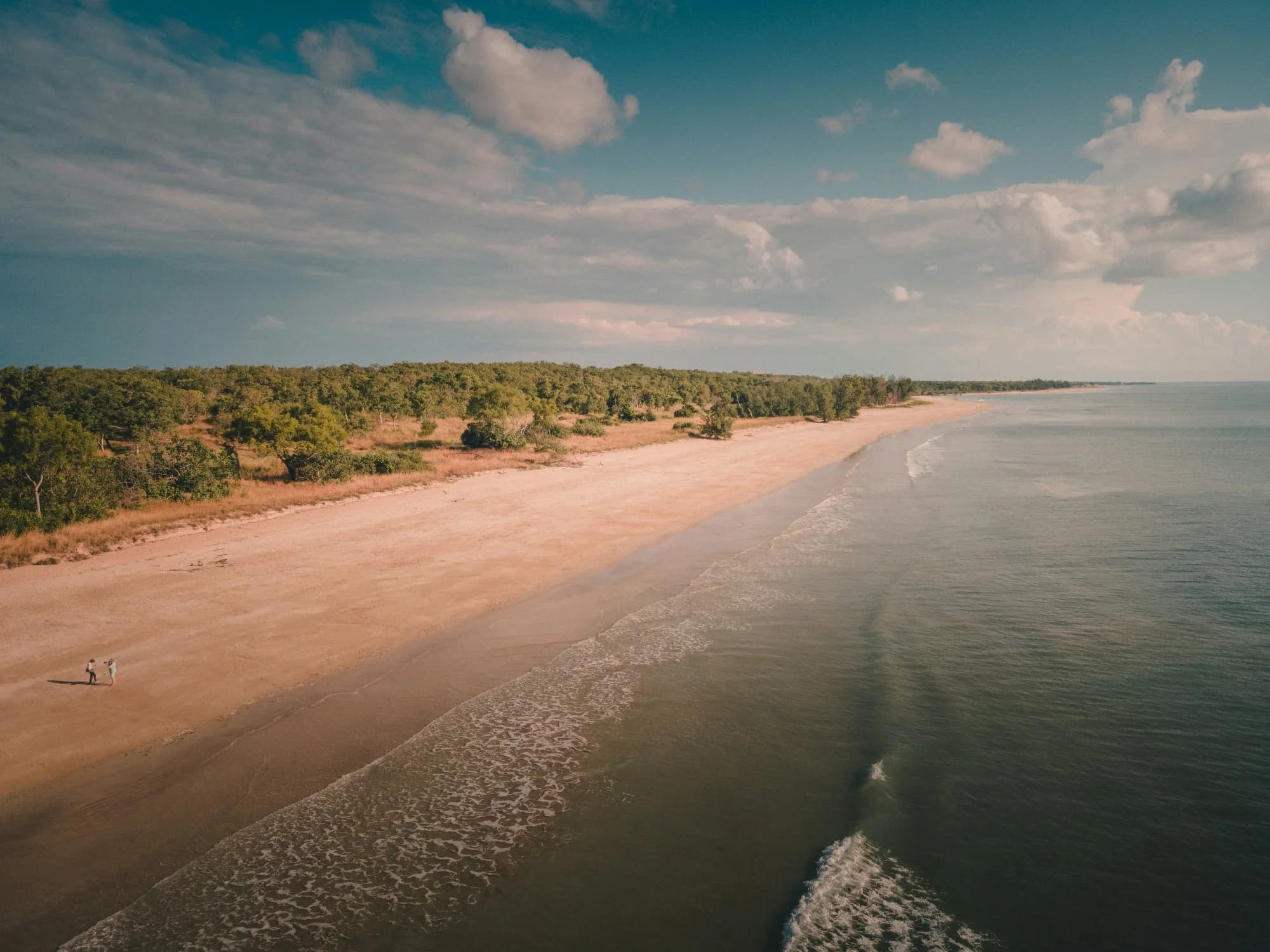
These inner suburbs to the west and northwest of the city centre offer a residential scale that contrasts with the more commercially developed waterfront. Cullen Bay Marina has a concentrated dining and marina scene, while Fannie Bay is home to the Museum and Art Gallery of the Northern Territory and East Point Reserve, a coastal parkland with direct Timor Sea exposure. Travelers seeking a quieter, more private atmosphere away from the main tourism precincts tend to favor this corridor.
When to visit Darwin
Darwin operates on a two-season tropical calendar. The dry season, running broadly from May through October, is the primary period for tourism. Temperatures remain consistently warm, humidity is manageable, and the landscape takes on a golden, dust-edged quality as the waterholes recede and wildlife concentrates around permanent water sources. This is when Kakadu and Litchfield are most accessible, and when Darwin's outdoor culture, particularly its sunset markets and harbor dining, functions at full capacity.
The wet season, from November through April, brings monsoonal rainfall, dramatic electrical storms, and a rapid greening of the entire landscape. Waterfalls that are dry or inaccessible in the dry season become spectacular. The heat and humidity are significant, and some roads into national parks become impassable. For travelers comfortable with tropical intensity, the wet season offers a different and arguably more visually extreme version of the Top End. Hotel rates tend to be lower, and the city is considerably quieter. The shoulder periods of April to May and October to November offer a reasonable compromise between conditions and availability.
Key events worth noting include the Darwin Festival in August, a two-week arts and culture program that draws interstate and international audiences, and the Arafura Games, a regional sporting event held periodically that can affect accommodation availability. The Darwin Cup Carnival in July and August is a horse racing season that carries genuine social significance in the city.
Local luxury standards in Darwin
Australia does not employ a formal national hotel classification system equivalent to France's Palace designation or Italy's five-star gran turismo category. In practice, the upper tier of Darwin's hotel market is defined by a small number of properties operating under international brand affiliations or as independent boutique offerings. Suite categories at the top end of Darwin's market typically include governor suites or penthouse-level rooms with panoramic harbor views, private balconies, and dedicated butler or concierge services.
Given Darwin's tropical climate, the highest-quality suites are designed with climate management as a primary architectural concern. Expect generous ceiling heights, cross-ventilation where possible, and outdoor private terrace space that is genuinely usable for much of the year. Pools are a standard feature at any property operating in the premium segment. The overall aesthetic in Darwin's better hotels tends toward a contemporary tropical vocabulary: natural materials, warm tones, and a deliberate connection to the outdoor environment rather than the insulated enclosure typical of city hotels in temperate climates.
How to choose the best suite in Darwin
The first and most important consideration is orientation. A suite with direct harbor or Timor Sea views commands a significantly different experience from an inland-facing room, particularly at sunrise and sunset when Darwin's light is at its most architecturally compelling. Ask specifically about the floor level and compass orientation before confirming a booking.
The second consideration is access to outdoor private space. In Darwin's climate, the ability to sit outside privately, whether on a terrace or a plunge pool deck, is not a luxury add-on but a functional requirement for anyone staying more than a single night. Suites that offer genuinely private outdoor areas, rather than exposed balconies overlooking other guests, represent a materially higher quality of stay.
The third consideration is proximity to the experiences that brought you to Darwin in the first place. If the primary agenda is exploring Kakadu or Litchfield, a suite positioned for easy early-morning departures by vehicle, with secure parking and storage for outdoor equipment, is more practical than one optimized purely for waterfront dining access. Conversely, if Darwin itself is the destination, proximity to the Esplanade, the museum, and the waterfront dining precinct has clear value.
The value of a curated selection
Darwin's luxury hotel market is relatively compact compared to Sydney, Melbourne, or the Whitsundays. The total number of properties operating at a genuinely premium suite level is limited, which means the selection process is less about filtering a large field and more about identifying the specific offering that aligns precisely with the purpose of your trip. La Suite approaches this with a structured editorial methodology, assessing each property against consistent criteria: suite design quality, service architecture, geographic positioning, and the coherence of the overall guest experience.
For a destination like Darwin, where the surrounding natural environment is as significant as the hotel itself, the curation process also accounts for how well a given property facilitates access to that environment. A curated selection by La Suite removes the noise of aggregator platforms and positions each property within its correct context, giving Darwin's limited but genuinely distinctive suite offerings the clarity they deserve.