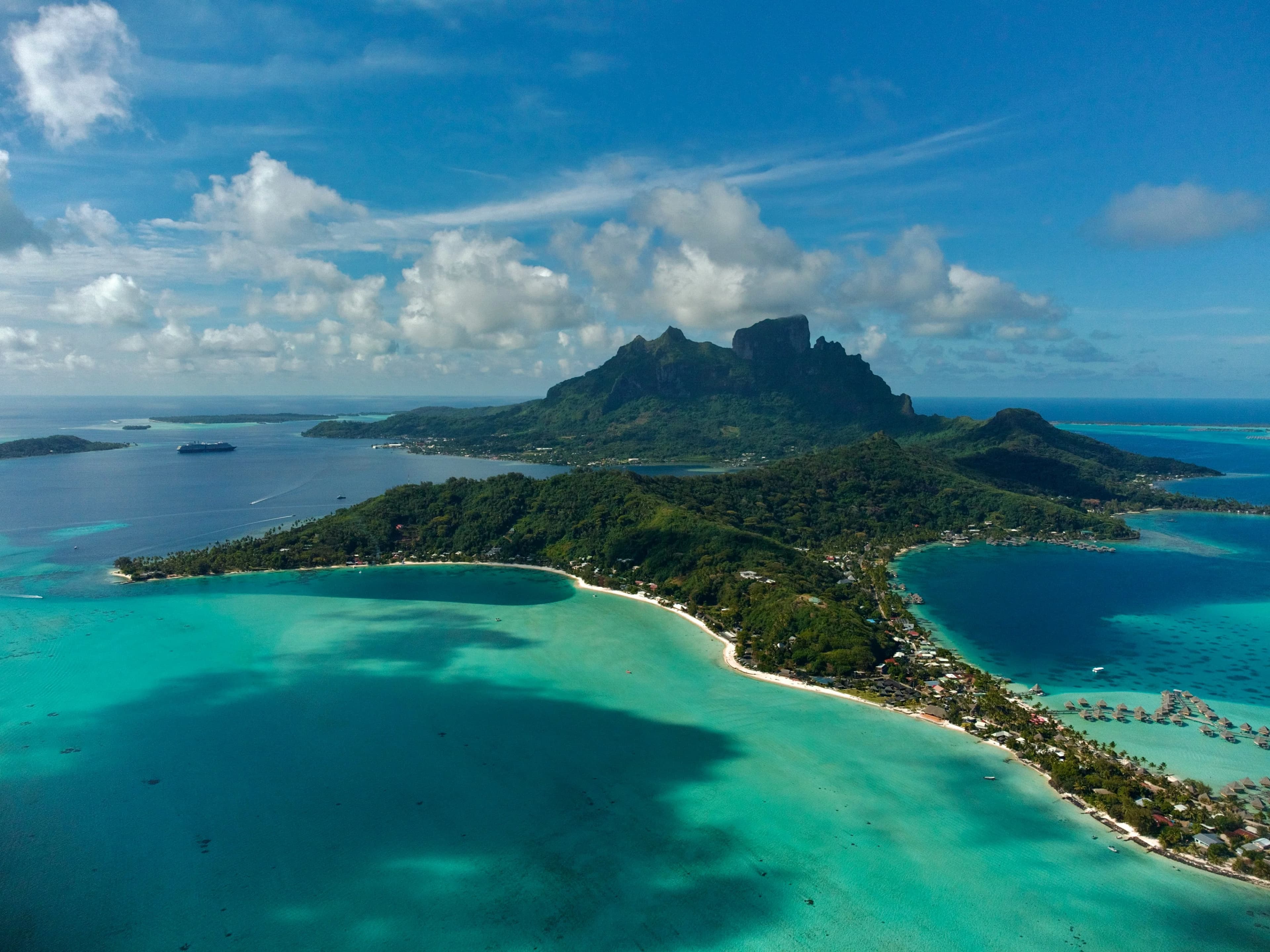
Understanding Bora-Bora as a luxury suite destination
The island has been recognised as a benchmark for a specific type of resort stay since the late twentieth century. Its overwater bungalow concept, which places guest accommodation directly above the lagoon on timber and concrete stilts, became one of the most replicated formats in high-end hospitality globally. In Bora-Bora, the original context remains intact: the water is clear, the reef is active, and the isolation is genuine.
Key areas and their distinct character
The motus and outer reef
The most architecturally ambitious resorts in Bora-Bora are located on the outer motus, the narrow coral strips that separate the lagoon from the open ocean. These properties offer complete separation from the main island, accessible only by boat transfer. The privacy is structural rather than curated: there is simply nowhere else to go. Luxury hotel suites on the motus tend to maximise lagoon exposure, with direct water access from private decks and unobstructed sightlines toward Mount Otemanu across the water. The trade-off is dependence on the resort for all dining, activity, and transport.
The main island shoreline
Some properties occupy the western and northern shores of the main island itself, offering a different geometry. Guests retain the option to walk or drive to the small commercial centre of Vaitape, access local restaurants, or hire a vehicle to circumnavigate the island on its single road. Suites here are often more architecturally varied, blending overwater formats with garden and hillside pavilions.
Motu Toopua and the inner lagoon
The inner lagoon area around Motu Toopua provides a middle ground: sheltered water, proximity to the main island, and views that frame the volcanic peak with particular clarity. Properties in this zone tend to attract guests who want the lagoon aesthetic without full resort isolation.
When to visit Bora-Bora for a suite stay
French Polynesia has two principal seasons. The dry season runs from May through October, with lower humidity, cooler temperatures averaging 26 to 27 degrees Celsius, and reduced rainfall. This is the period of highest demand for luxury hotel suites and the time when the lagoon visibility is typically at its clearest. Suite availability at the most sought-after properties during July and August requires advance planning of six months or more.
The wet season, from November through April, brings higher temperatures, occasional cyclone risk, and heavier rainfall. However, this period also offers lower rates at certain properties, and the landscape takes on a more saturated quality. Travelers prioritising value within the luxury segment, or those seeking quieter occupancy periods, often find November and early December particularly effective.
There are no large international cultural events on the island in the conventional sense. The Heiva festival, a celebration of Polynesian culture featuring dance and sports competitions, takes place across French Polynesia in July and is primarily experienced in Papeete on Tahiti rather than in Bora-Bora itself.
Local luxury standards: what to expect from top-tier suites here
French Polynesia does not operate a formal palace classification system comparable to France's official Palace designation. The luxury standard on the island is instead signalled by international brand affiliation, overwater suite positioning, and the ratio of staff to guests. Properties associated with major international luxury hotel groups set the benchmark for service structure, while independent resorts compete on design singularity and lagoon positioning.
A high-calibre luxury suite in Bora-Bora will typically offer direct lagoon access via a private ladder or steps from the deck, a glass floor panel or glass coffee table allowing views into the water below, an outdoor bathtub or rainfall shower with lagoon exposure, and a private deck with sun loungers and often a daybed. Interiors in the better suites reference Polynesian material culture: pandanus weaving, teak or ironwood joinery, and hand-carved details, without reducing these elements to superficial decoration.
Butler or dedicated host service is standard at the higher suite categories. Transfers by private speedboat, in-suite dining with full kitchen production, and curated marine excursions arranged directly through the property are expected elements of the experience at this level.
How to choose the right luxury suite in Bora-Bora
The primary decision axis in Bora-Bora is positioning: overwater versus beach versus hillside. Overwater suites provide the most direct lagoon relationship and the clearest visual connection to the water, but they require comfort with open water beneath and around the structure. Beach suites offer direct sand access, more stable footing, and often larger interior volumes. Hillside suites, less common, prioritise panoramic views over water access.
A secondary consideration is the orientation of the suite relative to Mount Otemanu. The peak is visible from certain lagoon positions and not from others, and the quality of the view changes significantly depending on the suite's aspect. Guests who regard that particular silhouette as central to the experience should confirm orientation before committing.
The scale of the property also matters. Bora-Bora's most prominent resorts range from intimate properties with fewer than thirty overwater units to larger complexes with several hundred rooms. At the suite level, the number of overwater suite units specifically, as opposed to standard bungalows, determines how exclusive the experience feels in practice.
Why a curated selection by La Suite serves this destination
Bora-Bora's reputation as the archetype of Pacific luxury means that a large number of properties market themselves at the premium level. The gap between what is presented in promotional materials and what a suite delivers in practice is wider here than in many other destinations, because the lagoon backdrop is available to every property regardless of interior quality or service standard.
La Suite's role in this context is to apply a consistent evaluative framework: examining the actual suite footprint, the quality of the lagoon positioning, the service architecture, and the material integrity of the interiors. The curated selection strips away properties that trade on the island's geography alone and surfaces those where every element of the stay is calibrated to match the setting. For travelers investing significantly in this experience, that distinction is not marginal. It is the difference between a stay that meets expectations and one that justifies them.