Best areas to stay in Guatemala for a luxury suite experience
Antigua Guatemala
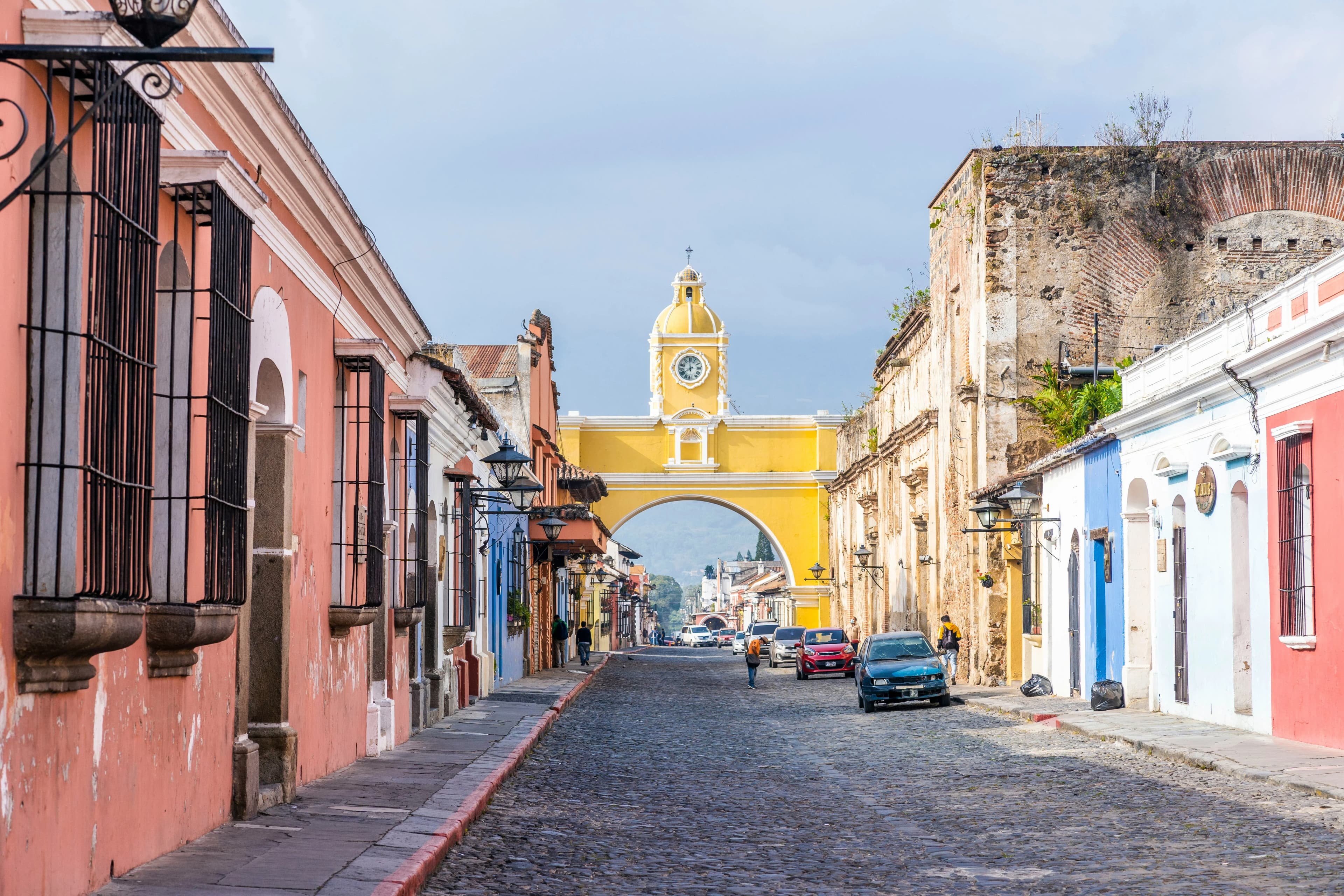
The former colonial capital remains the most architecturally coherent city in Central America. Its grid of cobblestone streets, pastel-walled convents, and baroque church facades provides a backdrop that few cities in the world can replicate. The best properties here occupy restored colonial mansions, known locally as casas coloniales, where internal courtyards, fountain gardens, and thick adobe walls create an experience of enclosed, contemplative luxury. This is a destination for travelers who read architecture as a primary text.
Lake Atitlán
Situated at over 1,500 metres above sea level, Lake Atitlán is framed by three volcanoes and a series of indigenous Maya villages that have maintained distinct weaving traditions and ceremonial calendars for centuries. The lake does not perform for visitors; it simply exists at its own scale. Luxury properties along its shores tend toward the discreet, prioritising terrace views, natural materials, and access to the water over grand lobby statements. This is the right environment for travelers who value stillness and visual clarity.
The Petén region
In the north, the lowland rainforest of Petén contains Tikal, one of the largest and best-preserved Maya cities in existence. Lodging in this region is intentionally limited and remote. High-end options position guests within the forest canopy, offering proximity to archaeological zones that most visitors never access at the right hours. Early morning entry to Tikal before tour groups arrive is an experience defined entirely by logistics, and the right property makes this possible.
The Pacific and Atlantic coasts
Guatemala's Pacific coast is warm, surf-oriented, and relatively underdeveloped for luxury travel compared to the interior. The Caribbean coast, anchored by the town of Livingston and the Rio Dulce corridor, offers a culturally distinct experience shaped by Garífuna heritage and riverine geography. Neither coast has yet produced a significant concentration of luxury hotel suites, which means the interior remains Guatemala's primary draw for suite-level travelers.
When to visit Guatemala for a luxury hotel suite stay
Guatemala operates on two primary seasons: the dry season, running roughly from November through April, and the wet season, from May through October. The dry season is the conventional choice for travel, with reliable conditions across all elevations and regions.
However, the wet season carries its own case for consideration. Afternoon rains are typically brief and concentrated, mornings remain clear, and the country's vegetation reaches its most saturated state. Crowds thin considerably, and properties that are fully booked in February may offer both availability and more considered pricing in July.
Semana Santa, the Holy Week preceding Easter, transforms Antigua into one of the most visually arresting events in the Americas. The city's streets are covered in alfombras, elaborate carpets of coloured sawdust, flowers, and pine needles, over which religious processions pass. Suite availability during Semana Santa must be secured months in advance; demand among international travelers is consistent and significant.
The Day of the Dead, observed on November 1st, produces a distinct ceremony in the highland town of Santiago Sacatepéquez, where enormous handmade kites are flown above the cemetery. This event attracts far fewer international visitors than Semana Santa and represents a more intimate cultural encounter.
Local luxury standards: what to expect from top-tier suites in Guatemala
Guatemala does not have a formal national classification system equivalent to France's Palace designation. The country's luxury hotel market is characterised by boutique scale, architectural distinctiveness, and a strong emphasis on artisanal detail rather than by international chain standards.
The most respected properties in Guatemala tend to be independently owned and managed. They are often housed in buildings of genuine historical significance, with restoration work that has preserved original structural elements including exposed stone, hand-painted tile work, and carved wooden ceiling beams. The suite experience in these properties is less about square footage and more about material authenticity.
Service culture in Guatemala's best properties reflects a combination of formal hospitality training and deep local knowledge. Staff at leading hotels frequently speak multiple languages and maintain relationships with Maya community leaders, archaeologists, and artisan producers that are not available through standard tour operators. Access facilitated through the right property constitutes a meaningful part of the luxury proposition here.
International luxury brands have a limited footprint in Guatemala compared to Mexico or Costa Rica. This is, for a certain type of traveler, precisely the point. The properties that meet the standard for suite-level travel here are defined by curation and context rather than by brand recognition.
How to choose the best luxury suite in Guatemala
The first structural question is elevation versus lowland. Antigua and Lake Atitlán sit at high altitude, which means temperate temperatures year-round and an absence of tropical humidity. Petén and the coastal zones are hot, humid, and ecologically distinct. These are fundamentally different physical environments, and the right choice depends on what the traveler is seeking sensorially.
The second question concerns architecture. Colonial properties in Antigua offer interiors defined by enclosed courtyards, thick walls, and a particular quality of natural light that comes from high windows and open roof terraces. Lakeside properties at Atitlán tend toward open-air design with direct visual engagement with the water and volcanoes. Both represent considered architectural positions; neither is inherently superior.
The third consideration is access. Guatemala rewards travelers who move with intention. A property that provides reliable, vetted ground transportation, relationships with site guides, and logistical support for early-morning archaeological visits is worth meaningfully more than one that simply offers a well-appointed room. In this destination, the operational intelligence of the property is as relevant as its physical attributes.
Finally, consider the scale of the property. Guatemala's finest suite experiences are almost exclusively found in hotels of fewer than thirty rooms. This is not a country where large resort infrastructure meets the cultural and architectural moment. Privacy, staff-to-guest ratios, and the ability to arrange bespoke itineraries all improve in direct proportion to the property's restraint in scale.
Why curated selection matters in Guatemala
Guatemala's luxury hotel market is not uniformly documented or easily navigated through conventional booking platforms. Properties of genuine quality are frequently under-represented in aggregate search results, while properties with significant marketing investment do not always correspond to the highest experiential standard.
La Suite approaches Guatemala with the same editorial rigour applied to Paris or Tokyo. The curated selection identifies properties where the suite offering, the service architecture, and the contextual intelligence of the team meet a consistent standard. For a destination where the difference between a well-located boutique hotel and a genuinely exceptional suite experience can define the entire trip, curation is not a convenience. It is the operative framework.