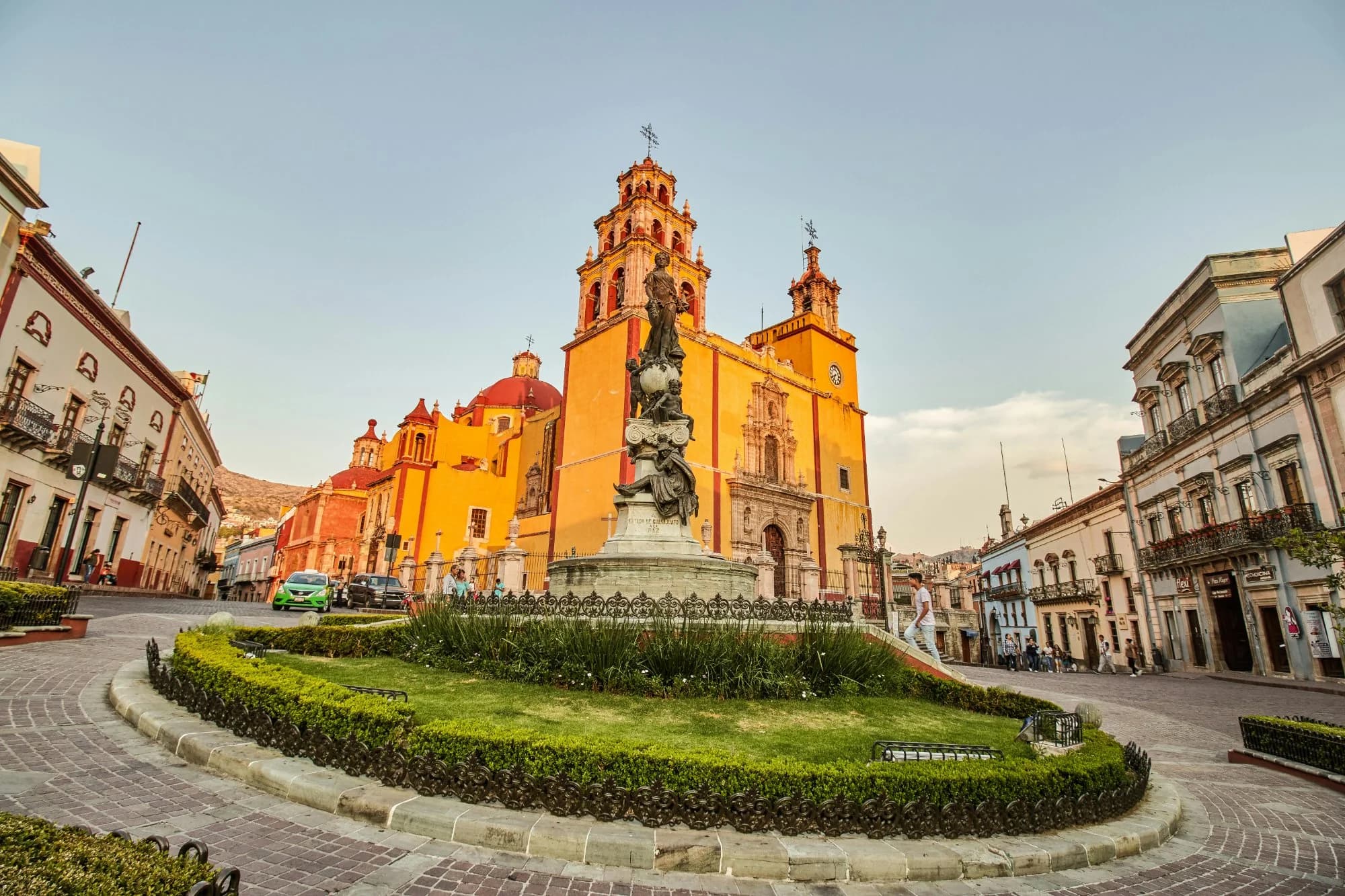
Where to stay in Guanajuato: areas and their distinct character
San Miguel de Allende, by contrast, operates on a more open, residential scale. The city has attracted a significant international community of artists, writers, and collectors since the mid-twentieth century, and that legacy is visible in the quality of its interiors, galleries, and culinary scene. The Zona Centro and the streets surrounding the Parroquia de San Miguel Arcangel form the highest-demand area for boutique and hacienda-style properties. Further from the centre, converted estates and rural retreats offer a quieter register, with views over the semi-arid landscape of the Bajio plateau.
The broader Bajio region also includes Dolores Hidalgo and smaller colonial towns, which function less as luxury destinations in their own right and more as day excursions from a base in either of the two main cities.
When to visit Guanajuato for a suite stay
The climate in Guanajuato state is temperate by Mexican standards. The altitude of both Guanajuato city (approximately 2,000 metres) and San Miguel de Allende (approximately 1,910 metres) moderates temperatures year-round, making the region comfortable in seasons that would be oppressive at sea level. The dry season, running from October through April, is generally considered the optimal window. Daytime temperatures sit between 20 and 27 degrees Celsius, evenings cool sharply, and natural light is clear and direct.
The rainy season (May to September) brings afternoon showers, typically brief and intense, that clear quickly. This period is considerably less crowded and offers a different visual register: the surrounding landscape turns deep green, and the colonial stonework darkens with moisture in ways that are photographically compelling. Suite rates in some properties reflect the lower demand.
Two periods deserve specific attention. The Festival Internacional Cervantino, held annually in October in Guanajuato city, is one of Latin America's most important performing arts festivals, drawing international theatre, dance, and music companies. Suite availability contracts sharply during this period and advance planning is essential. Semana Santa (Holy Week, March or April) is similarly high-demand in San Miguel de Allende, where the processions and ceremonial calendar draw large domestic and international audiences.
Understanding local luxury standards in Guanajuato
Mexico does not operate a formal designation equivalent to the French Palace label or the Italian Grand Hotel classification. Luxury in Guanajuato is therefore expressed primarily through the quality of the built environment, the depth of the restoration, and the intelligence of the programming rather than through a state-certified tier.
The most relevant typology for this region is the hacienda conversion. Guanajuato and the Bajio were among the wealthiest territories in colonial New Spain, and the haciendas built on silver and agricultural wealth were architecturally ambitious. The finest conversions preserve original chapel structures, central courtyards (patios), and period stonework while introducing contemporary service standards and spatial comfort. A well-restored hacienda suite in this region can offer ceiling heights, courtyard access, and architectural detail that no purpose-built hotel can replicate.
Boutique properties within the historic cores of Guanajuato city and San Miguel de Allende represent the second primary typology. These are typically colonial mansions (casas solariegas) adapted for hospitality use, with room counts rarely exceeding thirty or forty keys. The best among them are defined by restraint: locally sourced textiles, hand-painted Talavera ceramics, artisanal ironwork, and curated collections of Mexican contemporary art. The suite offer in these properties tends toward junior and master configurations, with rooftop terraces or private courtyard access as the defining spatial amenity.
How to choose the right suite in Guanajuato
The first decision is architectural orientation. The region's most characterful properties are historic conversions, and within that category, the specific position of a suite within the building matters considerably. A suite overlooking a private interior courtyard offers silence and enclosure; one with an exterior terrace facing the city offers panoramic orientation to the colonial skyline and the surrounding hills. Neither is objectively superior; the choice reflects the traveller's priorities.
The second consideration is scale. San Miguel de Allende supports a broader range of luxury properties than Guanajuato city, partly because of its larger international visitor base and partly because of the availability of suitable real estate for conversion. Travellers seeking a more intimate, architecturally intense experience will generally find the city of Guanajuato more rewarding; those prioritising service consistency, dining quality, and a curated arts environment will often prefer San Miguel.
Practical altitude considerations are worth noting for travellers unaccustomed to elevation. Both cities sit close to 2,000 metres, and mild altitude sensitivity (headache, fatigue) is not uncommon on arrival. A suite with generous natural ventilation and a considered bathroom configuration, rather than one optimised purely for visual drama, tends to perform better as a recovery and rest environment during the first day of acclimatisation.
Finally, noise is a contextual factor specific to colonial cities. Festival periods, weekend evening gatherings (callejoneadas in Guanajuato city), and church bells are intrinsic to the urban character but can affect sleep quality in street-facing rooms. Interior courtyard suites or properties with acoustic treatment on windows represent a more considered choice for light sleepers.
Why a curated selection matters in Guanajuato
The luxury suite market in Guanajuato is relatively small in absolute terms but highly variable in quality. The region's appeal to international travellers has generated a wide spectrum of properties that describe themselves in comparable terms: boutique, colonial, artisanal. The actual gap between a carefully restored hacienda with genuine architectural depth and a mid-range colonial-style hotel with decorative surface treatments is significant, and the difference is not always visible in standard booking interfaces.
La Suite applies consistent editorial criteria to identify properties where the suite offer represents a genuine upgrade in spatial quality, privacy, and experiential coherence. In a destination where the built environment is itself the primary attraction, the choice of where to stay is inseparable from the quality of the visit. The curated selection by La Suite is structured to make that choice precise.