Best areas to stay in San Luis Potosí for a luxury suite experience
The state capital and its historic centre
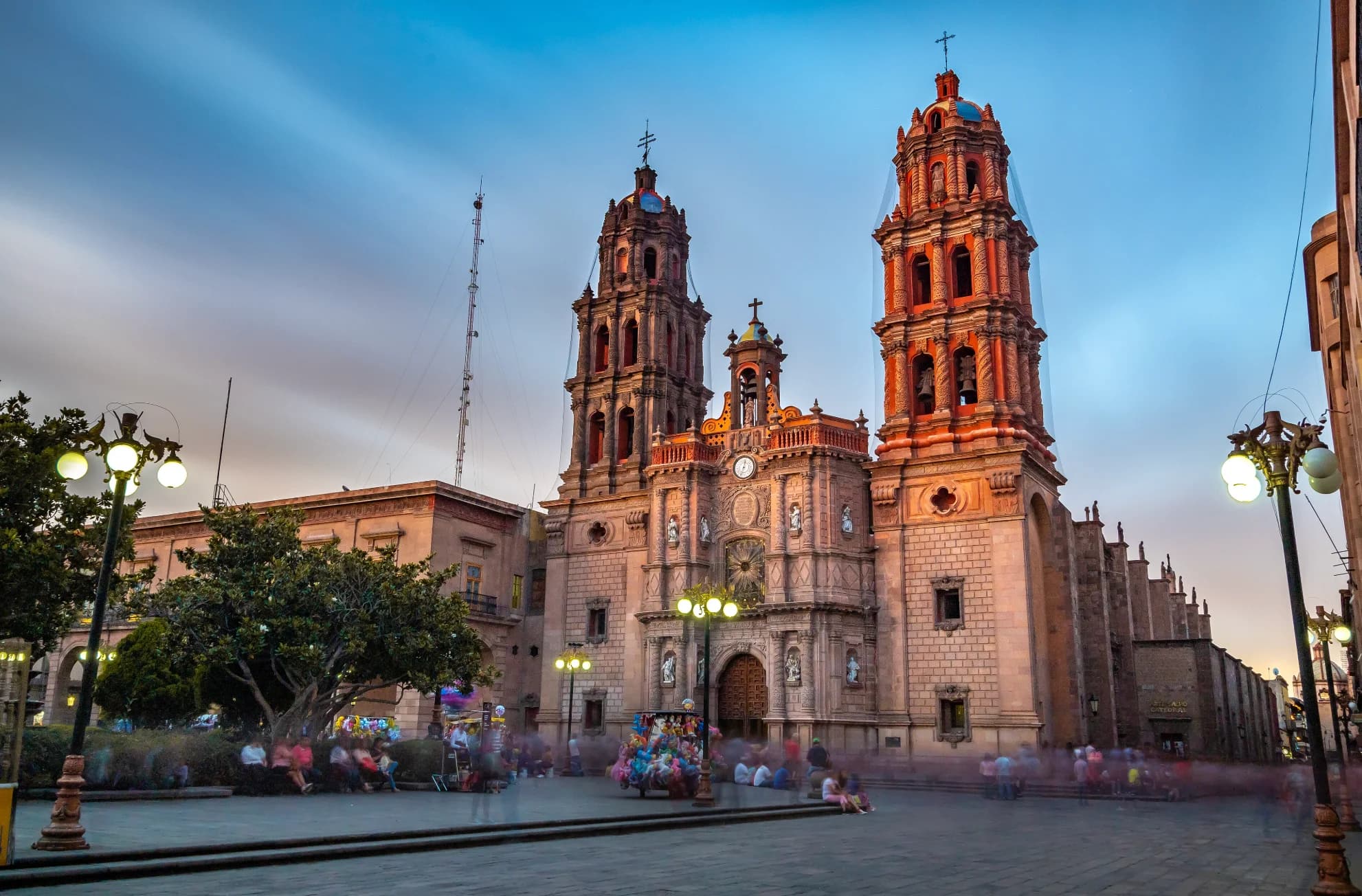
The city of San Luis Potosí itself is one of Mexico's most coherent colonial urban environments. Its centre, largely preserved from the 17th and 18th centuries, is organised around a series of interconnected plazas and Baroque-inflected churches. Staying in or immediately adjacent to the historic core places the traveler within walking distance of the Teatro de la Paz, the Templo del Carmen, and the regional museum housed in a former Franciscan convent. Luxury hotel properties in this context tend to occupy restored casona buildings, where original stone courtyards and vaulted ceilings define the spatial experience. For design-literate travelers, this architectural continuity is itself the amenity.
The Huasteca Potosina
The eastern lowlands of San Luis Potosí, known as the Huasteca Potosina, are a biologically dense region of rivers, waterfalls, and subtropical forest. Xilitla, Tamasopo, and the Tamul waterfall area represent an entirely different sensibility from the capital. High-end accommodation here is more limited in volume but notable in concept: properties tend towards ecological integration, private access to natural features, and architectural restraint. This is the correct choice for travelers whose definition of luxury is organised around privacy and landscape immersion rather than urban proximity.
Tierra Santa and the Real de Catorce plateau
The high desert of San Luis Potosí, including the storied mining town of Real de Catorce, functions at altitude and in near-total silence. Real de Catorce is accessible only through a single-lane tunnel carved into the Sierra de Catorce, which has made it a destination for travelers specifically seeking inaccessibility as a feature. Properties here are intimate, historically anchored, and operate in an atmosphere of concentrated quiet. The Wirikuta biosphere reserve, sacred to the Wixáritari (Huichol) people, lies in the surrounding desert and gives the region a cultural weight that distinguishes it within Mexico's broader luxury landscape.
When to visit San Luis Potosí
The state capital sits at roughly 1,850 metres above sea level, which moderates the climate considerably relative to coastal Mexico. Temperatures remain mild through most of the year, with the driest and most temperate conditions occurring between October and April. This period aligns with the highest demand for quality accommodation, and travelers planning extended stays in well-appointed suites should account for this when structuring their itinerary.
The Semana Santa (Holy Week) period draws significant domestic tourism to the capital and to pilgrimage sites across the state. The Festival Internacional de Danza Contemporánea and the broader cultural calendar concentrated in autumn and early winter make October through December a particularly textured time to visit for culturally oriented travelers. The Huasteca Potosina's river and waterfall circuits are best approached during the dry season, roughly November through May, when water levels are navigable and access roads are reliable.
Local luxury standards: what to expect from top-tier suites in San Luis Potosí
Mexico does not operate the same formal tiering system as France's Palace designation, but the country's luxury hotel sector has developed its own coherent markers of quality. The Secretaría de Turismo issues a Gran Turismo classification, which represents the highest tier in Mexico's official hotel rating system. Properties operating at this level in San Luis Potosí typically combine historical architectural fabric with contemporary service infrastructure.
In the state capital, the most distinguished properties are conversions of colonial-era buildings. A luxury suite in this context means something specific: original stone construction, interior courtyards functioning as private or semi-private open-air spaces, high ceilings, and proportions that no new-build structure replicates. Plumbing, climate control, and connectivity have been retrofitted, but the spatial logic of the building remains intact. This is a different value proposition from the purpose-built resort suite, and it is one that rewards travelers who understand the distinction.
In the Huasteca Potosina, luxury is expressed through access and exclusivity rather than square footage. A suite with direct river frontage, a private plunge pool fed by natural water, or a terrace positioned above a canyon represents the regional standard for exceptional accommodation.
How to choose the best luxury suite in San Luis Potosí
The decision-making framework for San Luis Potosí differs from resort-oriented destinations in Mexico. Several practical considerations apply specifically to this region.
First, establish the geographic anchor for the stay. The capital, the Huasteca, and the high desert require separate base camps. Attempting to cover all three from a single property is inefficient; the distances and road conditions between them make day-trip logic impractical for anything beyond one excursion.
Second, assess architectural preference with care. Colonial conversions are character-rich but variable in acoustic performance and natural light distribution depending on the room's position within the original building. A suite facing an interior courtyard will have a fundamentally different atmosphere from one with exterior street-facing windows. Requesting a floor plan or detailed photography before confirming is standard practice for this type of property.
Third, for the Huasteca Potosina specifically, verify the access conditions for each property. Several high-end lodges require a four-wheel-drive transfer or a boat segment to reach. This is not a deterrent but a variable that requires planning, particularly for travelers with large amounts of luggage.
Fourth, consider the service model. The most distinguished properties in San Luis Potosí tend to operate with smaller teams and more personalised service than large international hotel brands. This is a feature for travelers who value direct, attentive interaction, but it also means that certain standardised amenities common to global chain hotels may not apply.
Why curated selection by La Suite matters in this destination
San Luis Potosí is not a market saturated with verified luxury hotel inventory. The volume of properties is lower than in Los Cabos, the Riviera Maya, or Mexico City, which means that independent research returns inconsistent results. Traveler review platforms aggregate volume rather than filtering for the specific spatial, architectural, and service criteria that define a genuine luxury suite experience.
La Suite applies a consistent editorial standard across the entire selection: architectural quality, suite spatial integrity, verified service levels, and the coherence of the surrounding experience. For a destination like San Luis Potosí, where the finest properties are often boutique in scale and limited in online visibility, this curation function is not decorative. It resolves a real information asymmetry and delivers a shortlist that reflects the actual ceiling of what the region offers.