Where to stay on the Basque Coast: distinct areas for luxury travelers
Biarritz and its immediate surroundings
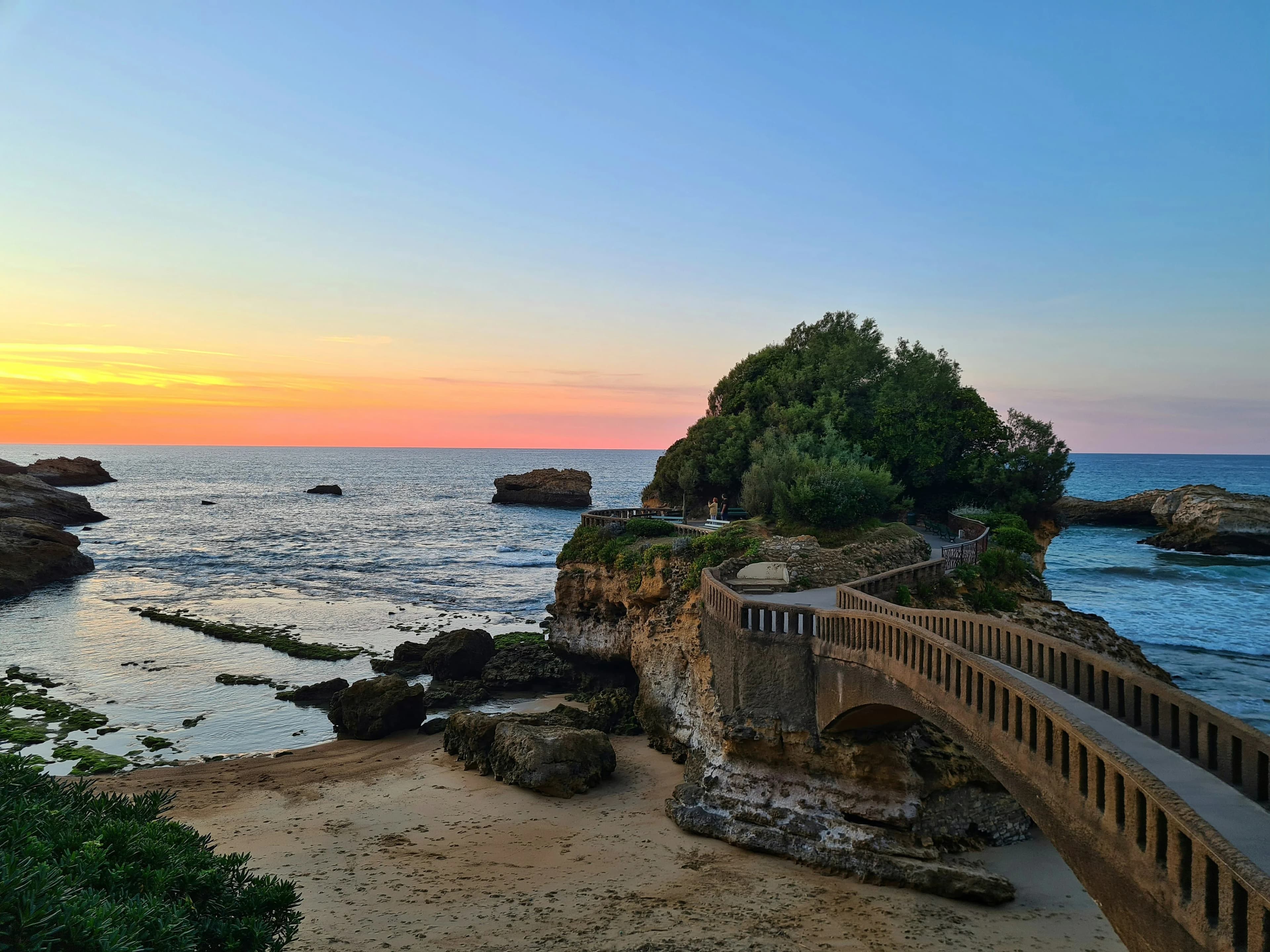
Biarritz remains the gravitational centre of Basque Coast luxury. Its identity was shaped by European royalty in the mid-nineteenth century, and its Grande Plage, casino architecture, and clifftop promenades retain that period confidence. Luxury hotels here tend toward the monumental: large Belle Époque or Art Deco volumes with sea-facing suites that frame the Atlantic as pure geometry. The town also has a serious surf culture that operates in parallel to the formal luxury infrastructure, giving it an unusual duality. Staying in a suite in or near Biarritz means access to excellent Basque restaurants, a functioning art scene, and one of the more cinematically beautiful coastlines in western France.
Saint-Jean-de-Luz and the southern Basque Coast
Saint-Jean-de-Luz sits closer to the Spanish border and has a more contained, domestic quality. Its harbour is still used by working fishing boats, and the town's central square and church carry genuine historical weight: Louis XIV married Marie-Thérèse of Austria here in 1660. The luxury offer in this area tends toward smaller properties, often in restored Labourdine houses with thick walls, deep-set windows, and interior courtyards. Suites here prioritise quiet and material authenticity over panoramic scale. Travelers who prefer restraint over spectacle tend to gravitate southward.
The Basque hinterland: Espelette, Cambo-les-Bains and the foothills
A short drive inland, the landscape shifts entirely. Red pepper strings dry on white facades in Espelette, and the Nive valley cuts through green hills toward the Spanish Basque Country. A small number of high-end properties in this zone offer suite experiences rooted in rural Basque architecture, farmhouse conversions and estate properties rather than coastal hotels. The light is different here, softer and more diffuse, and the food culture leans toward the earthy rather than the oceanic. For travelers who want the Basque Coast as a base but prefer silence and agricultural landscape over beach proximity, the hinterland is a serious alternative.
When to visit the Basque Coast for a luxury suite stay
The Basque Coast operates on a relatively generous seasonal calendar by French Atlantic standards. The Gulf Stream moderates temperatures, meaning the shoulder seasons are genuinely viable for high-quality stays.
July and August bring peak occupancy and the highest suite rates. The surf season is at its most social, festivals concentrate in these months, and the light on the Atlantic cliffs is at its most direct. Advance reservation becomes essential, particularly for sea-facing suites in the major properties.
June and September represent the most coherent months for discerning travelers: fewer crowds, full hotel services still running, and temperatures that allow both coastal and inland exploration without the compression of high summer. The Biarritz Surf Festival typically falls in late July, drawing an international crowd with a specific cultural profile.
October and early November offer a dramatically different experience. The Atlantic swells increase, the headlands take on a more austere character, and the region's gastronomic culture comes into sharper focus. Several properties reduce rates while maintaining full suite inventory. Winter in Biarritz is mild by northern European standards and has its own quiet authority.
Local luxury standards on the Basque Coast
France operates the Palace designation as its highest official hotel classification, sitting above the five-star category. Palace hotels must demonstrate exceptional architectural merit, service ratios, culinary distinction, and cultural contribution to their territory. The Basque Coast has properties that hold or approach this designation, and travelers should use it as a reliable quality filter when assessing the highest-tier options.
Beyond the Palace label, Basque Coast luxury has a regional inflection that distinguishes it from Parisian or Riviera hospitality. The dominant architectural language is Labourdine Basque: timber-framed facades, white walls, and shutters in oxblood red or forest green. The best suites in this region incorporate these materials and proportions rather than imposing a neutral international aesthetic. Exposed oak beams, terracotta tile, and linen in natural tones are indicators of a property that understands its context.
Local gastronomy is integral to the luxury experience here. The Basque Country holds a disproportionate concentration of Michelin-starred restaurants relative to its size, and the txoko culture of private gastronomic societies reflects a deep regional investment in food as social ritual. A well-positioned suite will have access to this culinary infrastructure within a short radius.
How to choose the right suite on the Basque Coast
Several practical considerations apply specifically to this destination.
Orientation matters considerably. Atlantic-facing suites offer the most dramatic light and sea views, but also the most exposure to wind. Properties set slightly back from the cliff edge often offer more livable terraces and quieter interiors. Travelers who prioritise outdoor space over direct sea views should look carefully at terrace dimensions and shelter.
Architecture type shapes the entire sensory experience of a stay. A Belle Époque grand hotel in Biarritz will deliver scale, ceiling height, and period detailing. A converted Labourdine farmhouse inland will deliver silence, material warmth, and a completely different spatial rhythm. Neither is objectively superior: the choice depends on what the traveler is seeking from the stay.
Pool availability is less universal here than on the Mediterranean. Many clifftop and beachfront properties rely on the Atlantic itself. Travelers for whom a private or semi-private pool is a requirement should filter explicitly on this criterion.
Connectivity to Spain is a practical asset that is often underused. San Sebastián (Donostia) is under an hour by road, and its gastronomic profile is among the most concentrated in Europe. A suite on the Basque Coast functions as a base for cross-border exploration in a way that few other French destinations can match.
Why curated selection by La Suite matters for the Basque Coast
The Basque Coast is small enough that the total number of genuinely exceptional suite properties is limited. The challenge is not volume but precision: identifying which properties deliver spatial quality, material authenticity, and service calibration at the level that justifies the category.
La Suite applies consistent editorial criteria across this coastline, assessing suites on architectural coherence, Atlantic or landscape orientation, local material use, and the culinary and cultural infrastructure immediately accessible to guests. The result is a curated selection that removes the noise of aggregator platforms and presents only the properties where the suite experience is the primary design intention, not an afterthought.
For a destination this specific and this characterful, curation is not a convenience. It is the most direct route to a stay that reflects the actual quality of the Basque Coast rather than a generic version of French coastal hospitality.