Where to stay in Normandy for a luxury suite experience
The Côte Fleurie and the Pays d'Auge
The stretch of coastline running from Honfleur to Cabourg, known as the Côte Fleurie, has been associated with Parisian and Anglo leisure culture since the nineteenth century. Deauville and Trouville established the grammar of French seaside resort life here: the casino, the racecourse, the planche à voile, the timber-framed villa. Properties in this corridor tend to be architecturally distinctive, drawing on the regional Norman style of colombage half-timbering and slate roofing. A luxury hotel suite in this area typically offers direct access to the beach promenade or views across the estuary toward Honfleur. Inland, the Pays d'Auge is orchard and pasture country, the source of Calvados, Camembert, and Livarot. Manor house conversions and smaller château hotels here offer a more agrarian, contemplative form of luxury.
The Seine estuary and the historic port towns
Honfleur, at the mouth of the Seine, remains one of the most architecturally coherent port towns in northern France. Its Vieux Bassin, lined with narrow slate-fronted houses, has attracted painters and writers since the Impressionists worked the light of its harbour. The area around Rouen, further inland along the Seine, offers proximity to one of the great Gothic cathedrals of Europe and a well-preserved medieval urban fabric. Suite accommodation in this corridor tends to occupy historic buildings that have been converted with care rather than large resort-format hotels.
The Cotentin peninsula and the Mont-Saint-Michel bay
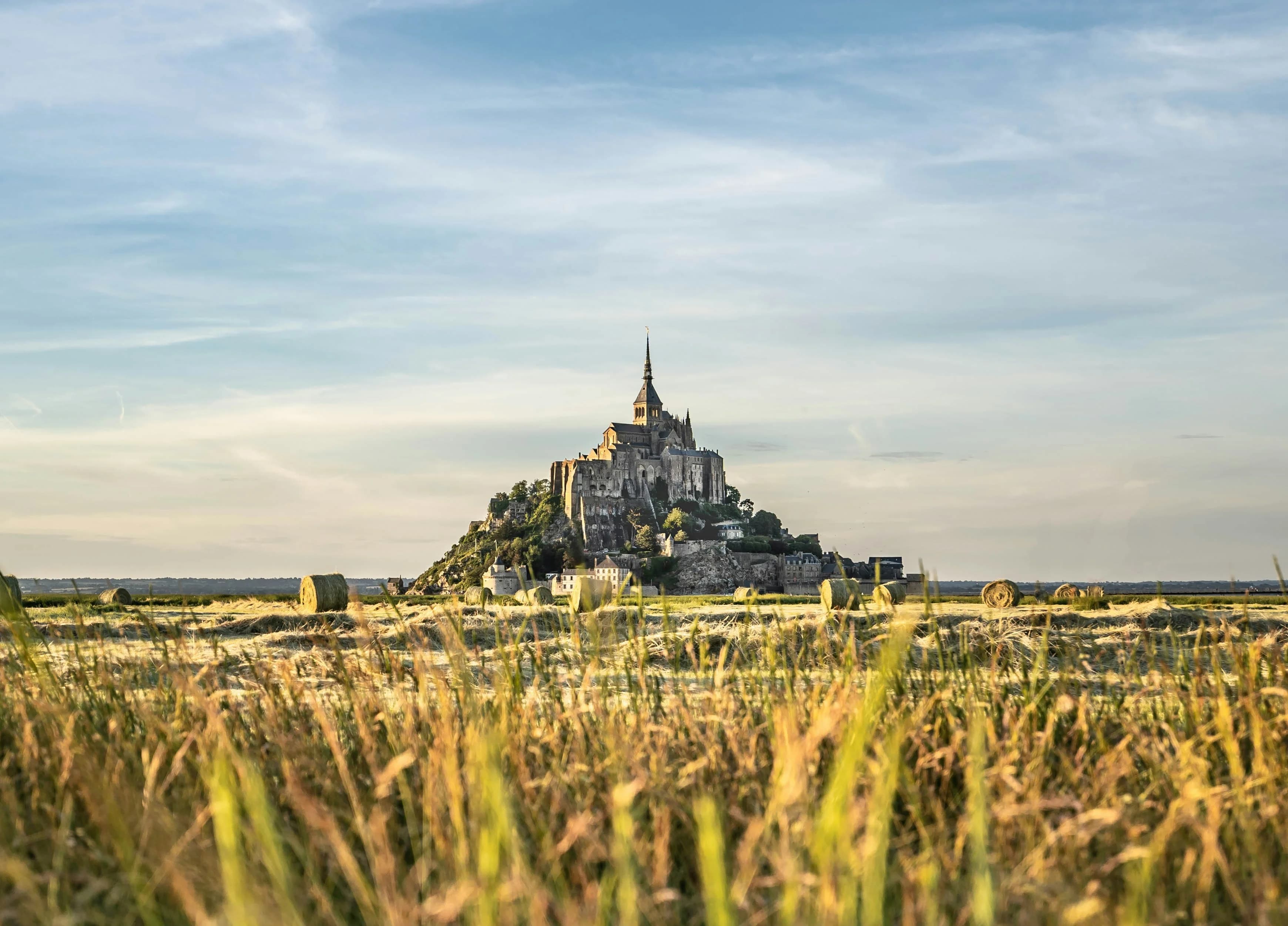
The western reaches of Normandy carry a different atmosphere: more austere, more Atlantic, more geologically dramatic. The bay of Mont-Saint-Michel, shared with Brittany, is one of the most visited sites in France, but the surrounding territory of salt marshes, polders, and fishing villages rewards slower, more considered travel. Suite properties here tend to be smaller in scale, prioritising access to the natural landscape over resort amenities.
When to visit Normandy for a luxury hotel stay
Normandy operates differently from the Mediterranean calendar. Its peak season is shorter and more concentrated, running from late May through early September, when the coastal resorts are fully operational and the agricultural landscape is at its most productive. The Deauville racing season, which runs across the summer months and culminates in the Grand Prix de Deauville in late August, draws a consistent audience of French and international visitors with significant purchasing power.
Spring and early autumn are particularly well-suited to cultural and architectural travel. The light in Normandy, famously studied by the Impressionists, is at its most complex in these shoulder seasons: softer, more diffuse, and more variable than the sharp contrasts of high summer. Many luxury properties offer better availability and more considered service during this period. Winter travel is possible and underrated for those seeking complete seclusion, particularly in manor house and château properties where the surrounding landscape takes on an austerity that suits the architecture.
The D-Day commemorations in early June, centred on the landing beaches of the Calvados coast, bring a specific category of visitor and can affect availability across the region. Travelers should plan accordingly if their itinerary includes this period.
Local luxury standards: what defines a high-end suite in Normandy
France operates a formal classification system for its most prestigious hotel properties, the Palace designation, administered by Atout France. This label, awarded to a small number of establishments nationally, denotes a standard of service, architecture, and cultural identity that goes beyond the five-star rating. Normandy has historically had fewer Palace-designated properties than Paris or the Riviera, but the region compensates with a strong tradition of château-hotel and manor house conversion that produces a form of luxury specific to its agricultural and aristocratic heritage.
A luxury suite in Normandy will often reflect the building's original function: beamed ceilings, stone fireplaces, parquet floors, and windows that frame the orchard or the coast rather than an urban skyline. The service register tends toward the discreet and the personal rather than the formally ceremonial. Local materials and produce are central to the gastronomic identity of these properties: Norman cream, cider, and seafood from the Channel define the culinary offer in ways that are impossible to replicate outside the region.
For travelers accustomed to the standardised luxury of international hotel groups, the best Normandy suites offer something architecturally and sensory specific to this territory. The question is not simply how large the suite is, but how fully it is embedded in the Norman landscape and material culture.
How to choose the best luxury suite in Normandy
Several considerations are specific to Normandy and should inform the selection process.
First, the distinction between coastal and inland properties is more significant here than in many French regions. Coastal suites offer the Channel light, proximity to the beach culture of the Côte Fleurie, and the maritime atmosphere of towns like Honfleur or Barfleur. Inland suites, particularly in the Pays d'Auge or the bocage of the Orne, offer a quieter, more immersive experience of the agricultural landscape. The two experiences are complementary but not interchangeable.
Second, the architecture of the building matters considerably. Norman vernacular architecture, with its distinctive use of colombage, local stone, and slate, produces interiors that are spatially idiosyncratic. Rooms and suites in converted manor houses or châteaux are rarely standardised. Travelers should review floor plans and precise room descriptions rather than relying on category names.
Third, access to specific experiences should be factored into the choice. Proximity to the D-Day sites requires a coastal property in the Calvados department. Access to the Mont-Saint-Michel requires positioning in the Manche or on the border with Brittany. Gastronomic travel centred on the Pays d'Auge appellations and the cider routes rewards an inland base. These logistical considerations are not incidental to the suite selection: they are central to it.
Why curated selection matters in Normandy
Normandy does not have a saturated luxury hotel market. The number of genuinely exceptional suite properties is limited, and they vary considerably in character, architecture, and service register. In a region where the difference between a converted manor house with real historical integrity and a generic countryside hotel with period furniture can be difficult to assess from a standard booking interface, curation adds measurable value.
La Suite approaches the Normandy selection with the same criteria applied across the full portfolio: architectural distinctiveness, suite quality, service calibration, and territorial immersion. The goal is not to list every property in the region but to identify the ones that deliver an experience genuinely specific to Normandy. For travelers making a considered decision about where to invest their time and attention, the curated selection by La Suite removes the noise and focuses the choice.