Understanding Uzès as a luxury destination
The town clusters around the Duché d'Uzès, a ducal palace still occupied by the same family after nineteen generations. The Place aux Herbes, shaded by plane trees and ringed with arcaded facades, functions as both civic center and social ritual. On Saturday mornings, it becomes one of the most authentic markets in the Languedoc region, drawing producers of local honey, tapenade, and seasonal vegetables. Staying in a luxury hotel suite within walking distance of this square places you inside the life of the town, not adjacent to it.
The areas around Uzès worth knowing
The historic center
The medieval core is compact and largely pedestrian. Properties here tend to occupy converted private mansions, known locally as hôtels particuliers, with interior courtyards, original stone floors, and proportions that smaller renovations cannot replicate. A luxury suite in the old town typically means high ceilings, deep walls that regulate temperature naturally, and proximity to the cathedral of Saint-Théodorit and its distinctive Fenestrelle tower. This is the correct choice for travelers who prioritize cultural immersion and architectural coherence.
The garrigues and countryside
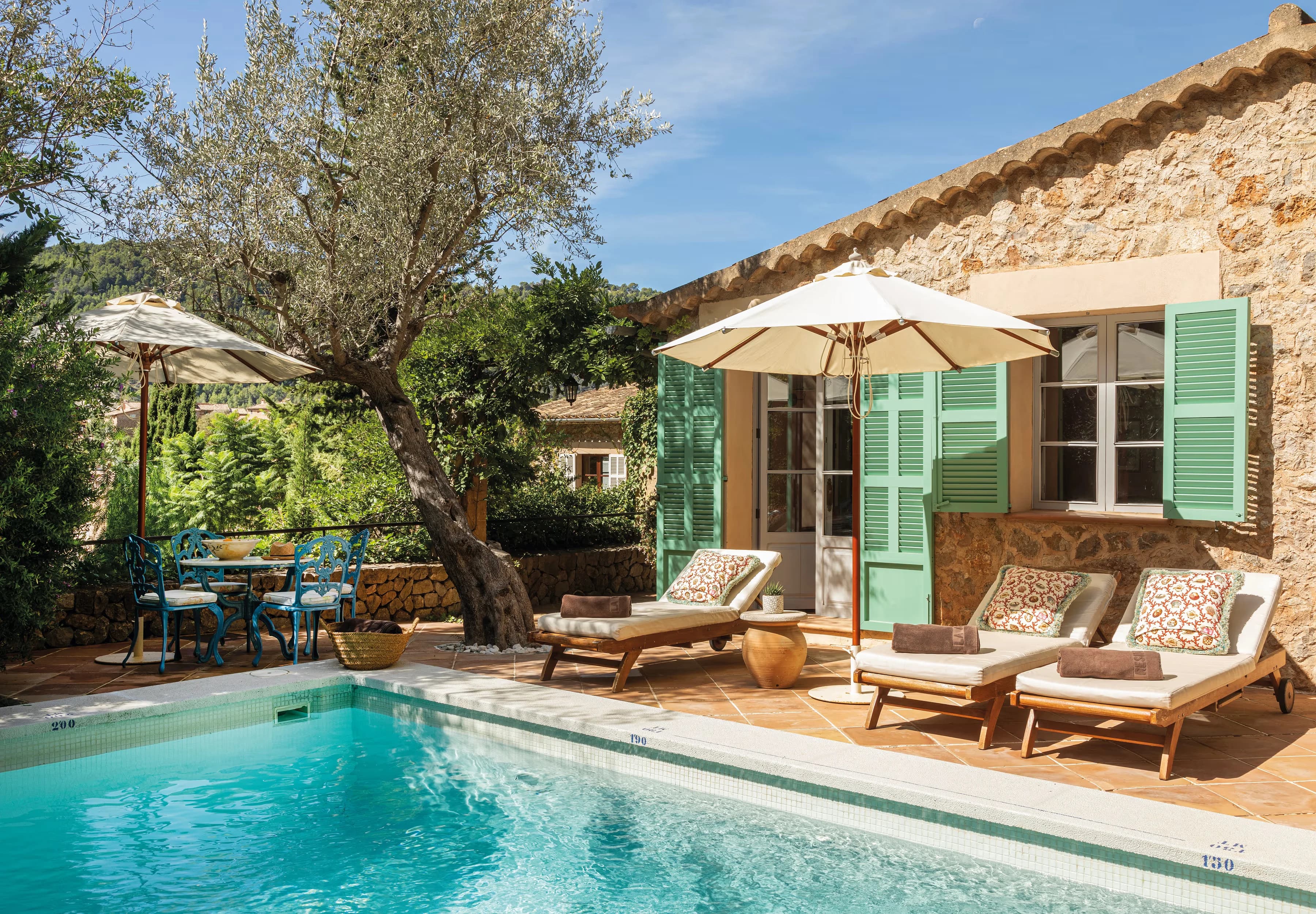
Beyond the town walls, the scrubland and low hills of the garrigue open into a landscape of vineyards, olive groves, and isolated mas. These traditional farmhouses, often centuries old, have in recent decades been converted into private properties and, in some cases, boutique hotels with suite accommodations. The sensory vocabulary here is entirely different: the resin of wild herbs underfoot, the sound of cicadas in late July, the absence of artificial light at night. Guests who prioritize privacy and natural quiet will find this environment more conducive to rest than the town center itself.
The Pont du Gard corridor
A short drive west of Uzès, the Roman aqueduct at Pont du Gard defines the landscape as much as any natural feature. Properties in this corridor offer proximity to one of the most perfectly preserved Roman structures in Europe, alongside access to the Gardon river for swimming and kayaking in season. The presence of UNESCO heritage in the immediate vicinity adds a layer of context that elevates the experience of staying nearby.
When to visit Uzès for a luxury stay
The Gard enjoys more than 300 days of sun per year on average, but the quality of each season differs markedly. Spring, from late March through May, brings mild temperatures, the truffle season in its final weeks, and the town before the arrival of summer visitors. This is the preferred window for travelers who want full access to restaurants, markets, and cultural sites without the compression of August.
July and August are the peak months. The Nuits Musicales d'Uzès, a classical music festival held in the Duché courtyard, draws an audience attuned to both music and setting. Accommodation fills well in advance. Securing a luxury hotel suite in Uzès for this period requires planning several months ahead, particularly for properties with courtyard access or terrace views.
September and October represent a secondary peak, favored by many repeat visitors. The light changes quality after the solstice, growing more horizontal and golden. The crowds thin, temperatures remain warm without excess, and the olive harvest begins in the surrounding countryside. For those whose schedule allows flexibility, this window delivers the highest ratio of access to atmosphere.
Winter in Uzès is quiet. The truffle market at Uzès runs on Saturdays from late November through February, drawing serious buyers and chefs from across the region. For travelers whose interest is gastronomic rather than recreational, winter offers an unfiltered encounter with the town and its producers.
Local luxury standards in Uzès and the Gard
France operates a formal classification system for its finest hotels, with the Palace designation reserved for properties meeting a demanding set of criteria established by Atout France, the national tourism authority. Uzès itself does not currently host a Palace-designated property, but the surrounding region of Occitanie and Provence contains several. The relevant standard in a town of this scale is more often the five-star boutique property, where individual attention, historical architecture, and regional cuisine converge.
What distinguishes a top-tier luxury suite in this part of France is less about surface amenity and more about material quality: the thread count of linen sourced from local mills, the presence of original architectural detail that no renovation budget can replicate, the kitchen that sources truffles from the same family it has worked with for a decade. The luxury here is contextual, embedded in place.
Service standards in the best Uzès properties tend toward the discreet. There is no performance of hospitality. Staff know the producers at the Saturday market by name, can arrange a private truffle hunt in the garrigue in season, and understand that the guest who chooses this destination has made a considered choice that does not require validation.
How to choose the right luxury suite in Uzès
The primary decision is architectural: historic stone construction within the town center, or a rural mas in the surrounding garrigue. Each offers a different relationship to the destination. The former keeps you in direct contact with the social and cultural fabric of the town. The latter offers physical separation, more space, and direct access to the Provençal landscape.
For couples or solo travelers, a luxury suite in the old town with a private terrace overlooking the rooftops typically satisfies both the cultural and aesthetic ambitions of a visit. For families or small groups, a converted mas with a pool and independent access to each suite or room provides more practical comfort.
Consider also the timing of your arrival in relation to the market calendar and the truffle season. A property whose staff can integrate these experiences into your stay, rather than simply directing you toward the tourist office, represents a meaningful operational difference.
Why curated selection matters in Uzès
Uzès has a limited inventory of genuinely high-quality accommodations. The distance between a property that understands this destination and one that merely occupies a stone building in it is considerable. La Suite curates only those properties whose suite offerings reflect the intelligence and restraint that the town itself demands. The selection process eliminates the properties that trade on location alone, focusing instead on those where the room, the service, and the setting form a coherent whole. For a traveler whose time is finite and whose standards are not, this distinction is the entire point of using a curated platform.