Where to stay in Zante for a high-end suite experience
The western cliffs and the Navagio area
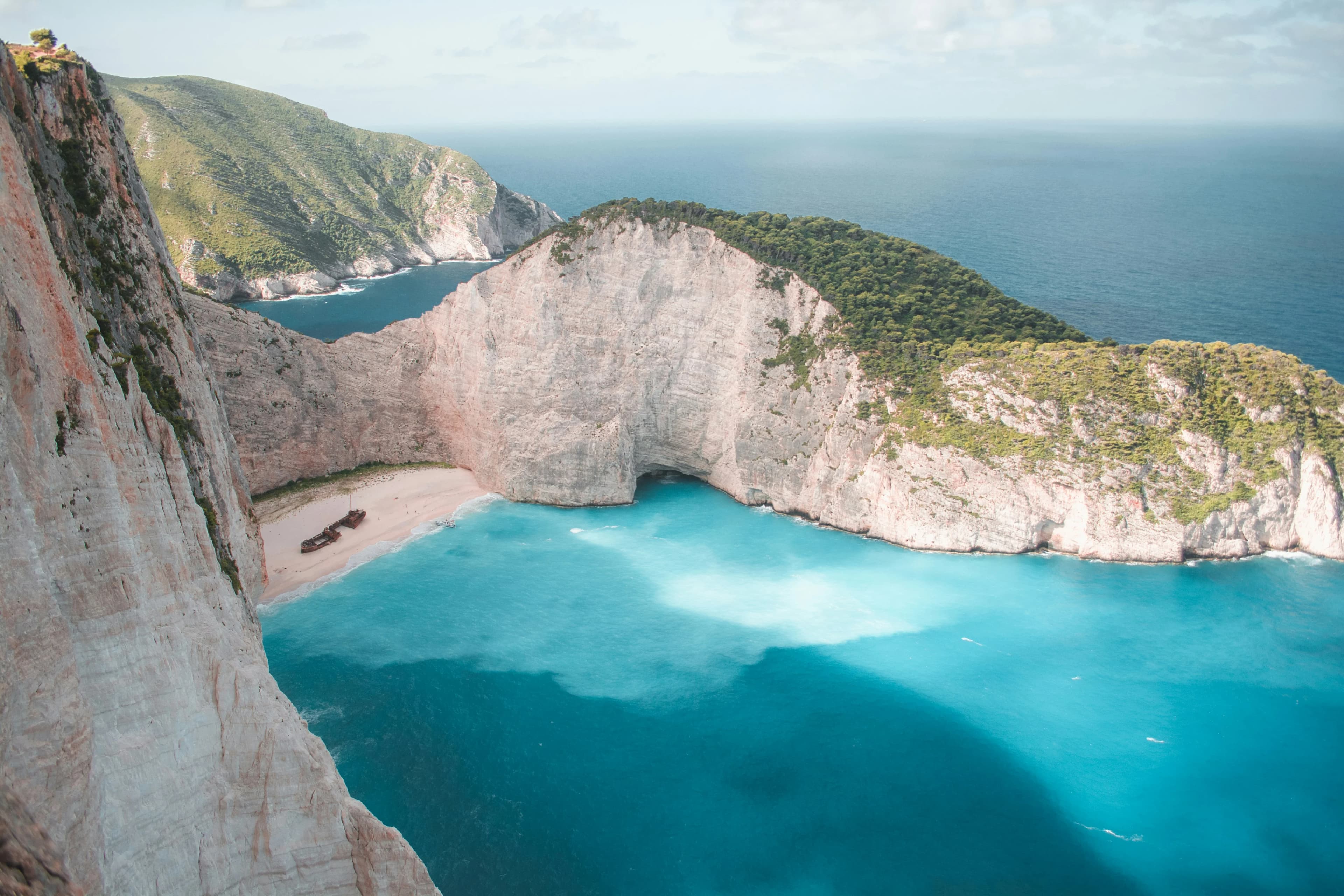
The northwestern corridor, anchored by the Anafonitria region and the viewpoints above Shipwreck Beach (Navagio), is the island's most architecturally dramatic zone. Properties here tend to be smaller in scale, carved into or built against the limestone terrain. Suites in this corridor prioritize the visual relationship with the sea over surface amenities. The light at dusk on these cliffs is particularly precise, moving from white to a deep amber with few transitional shades. Access to the beach below requires a boat, which reinforces the sense of controlled remoteness that high-end travelers frequently seek.
Laganas Bay and the southern coast
The southern bay is broader and more exposed, with a long sandy arc that doubles as a protected nesting area for the loggerhead sea turtle (Caretta caretta). This ecological designation limits certain types of development, which has paradoxically preserved a quieter shoreline character than one might expect from a beach of this scale. Luxury hotel properties here tend to operate within environmental constraints, which shapes both their architecture and their programming. Guests who value ecological context alongside comfort find this part of the island coherent with those priorities.
Zakynthos Town and the northeastern coast
The island's capital, rebuilt after the 1953 earthquake in a considered Venetian-influenced style, offers a more urban frame of reference. The northeastern coast between the town and Alykes provides flatter terrain, calmer water, and a more accessible format for families or travelers who want proximity to services without full resort immersion. Suite-level accommodation in this zone tends toward larger properties with complete facilities.
When to visit Zante for a luxury suite stay
The Ionian climate gives Zante a longer usable season than many Aegean destinations. The island receives more rainfall than the Cyclades, which accounts for its notably green interior even in midsummer, a quality that distinguishes it visually from the drier Greek island aesthetic.
Late May through June represents the clearest window for a first visit. Temperatures are stable, the sea has warmed sufficiently for extended swimming, and occupancy at suite-level properties has not yet reached its peak compression. September into mid-October performs similarly well, with the addition of a harvested agricultural landscape and calmer sea conditions. The island's olive groves and currant vineyards, both historically significant to the local economy, are most readable in this period.
July and August bring full capacity across the island. Suite availability narrows considerably, and advance planning of several months is a practical necessity rather than a recommendation. Those visiting in peak season should prioritize properties with private pool access and sufficient buffer from shared amenities to maintain the quality of experience that defines a suite stay.
Understanding luxury standards in the Greek island context
Greece does not operate a formal national palace classification equivalent to the French system. Hotel grading uses a star system administered by the Greek National Tourism Organisation (GNTO), with five stars representing the ceiling of official classification. Within that ceiling, however, the range of actual quality is considerable.
On an island like Zante, the most relevant distinction is between large resort complexes with suite categories and smaller boutique properties where every room is effectively a suite-level offering. The former tend to compete on amenity breadth: multiple pools, spa infrastructure, beach service, restaurants with international programming. The latter compete on specificity: a particular view corridor, handmade furnishings sourced locally, a terrace configuration that is genuinely private.
For the traveler who defines luxury through precision rather than volume, the smaller category tends to deliver more consistently. Greek island hospitality at its most refined operates on a personal scale. Owners are frequently present. Staff ratios are higher relative to room count. The quality of local produce that arrives at breakfast, from Zakynthian honey to local cheese, reflects a supply chain that larger properties cannot always replicate.
How to choose the right suite in Zante
Several practical considerations shape the choice of suite on this island beyond the standard checklist of thread counts and terrace dimensions.
First, orientation matters more in Zante than in many destinations. The island's most compelling light arrives from the west, over the Ionian Sea. A suite with a western exposure will offer sunset views of uncommon quality. An eastern-facing suite will receive the morning sun earlier but lose the evening spectacle. This is worth clarifying at the point of selection, as room-naming conventions across Greek properties are not always consistent in how they communicate orientation.
Second, the access road condition to many clifftop or hillside properties should be factored into the stay logic. Some of the most compelling small hotels in Zante are reached via unpaved or narrow mountain roads. For travelers arriving with luggage or traveling with older family members, this is a concrete consideration rather than an aesthetic one.
Third, the distinction between a suite with a private pool and one with shared pool access has a material effect on the experience, particularly in July and August. Private plunge pools, even small ones, redefine the temporal rhythm of a day in high heat.
Fourth, meal programming deserves attention. Some smaller properties operate on a breakfast-only basis. Given that Zante's restaurant infrastructure outside the main town is uneven in quality, guests staying in more remote locations benefit from understanding what culinary resources the property itself provides.
Why a curated selection by La Suite matters in Zante
Zante's accommodation offer has expanded significantly over the past decade, and the range of properties now carrying suite designations is broad. Not all of them are equivalent. The gap between a room labeled as a suite in a large beach resort and a genuinely considered suite in a clifftop property with architectural integrity is significant, and it is not reliably communicated by star ratings or marketing language alone.
La Suite applies a consistent editorial standard across every property it lists. On an island where the physical environment is as specific as Zante's, that standard accounts for factors that generic booking platforms do not weight: the quality of the view from the primary terrace, the degree of acoustic privacy, the architectural relationship between the interior and the exterior, and the coherence of the overall guest experience at the suite level. For travelers who arrive in Zante with a clear sense of what they want from the stay, a curated selection removes the friction of navigating a market where the signal-to-noise ratio is not always favorable.