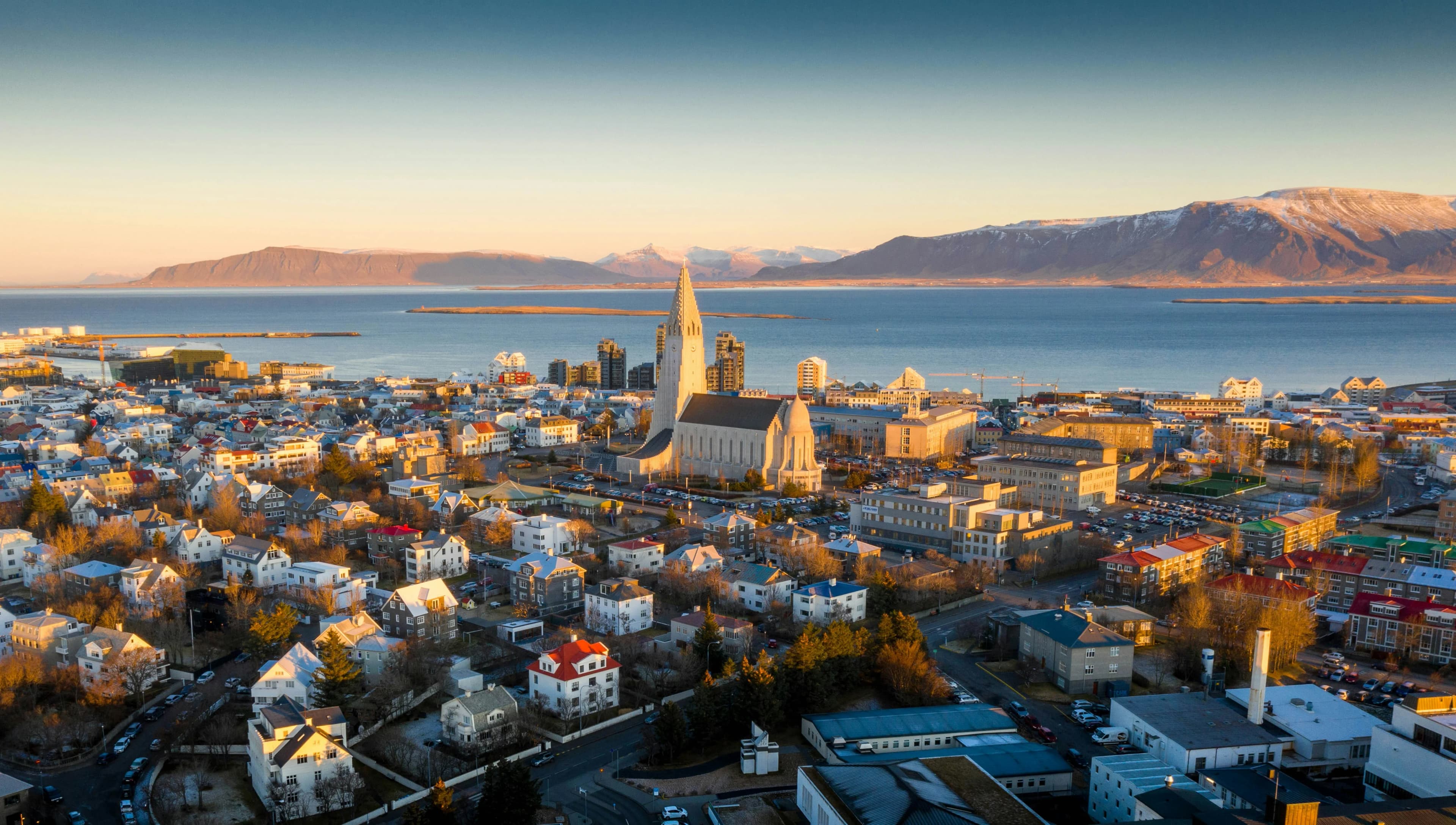
Where to stay in Reykjavik for a luxury suite experience
The city centre, clustered around Tjörnin lake and the commercial corridor of Laugavegur, places guests within walking distance of the National Museum, the Hallgrímskirkja church, and the concentrated gallery and restaurant culture that defines the city's creative identity. Suites positioned in or adjacent to this core benefit from immediate access to the city's cultural institutions without sacrificing quiet. Reykjavik is not a loud city. Even its centre operates at a register closer to a well-edited residential neighbourhood than a conventional capital.
The harbour district, around the Harpa Concert Hall, represents the city's most architecturally assertive quarter. The Henning Larsen-designed glass facade of Harpa has become a reference point for Reykjavik's commitment to considered design at civic scale. Properties near the harbour offer direct sightlines over the bay, with Esja mountain forming a permanent backdrop across the water. For suites with an orientation toward the natural environment rather than the urban fabric, this district rewards attention.
When to visit Reykjavik for a suite stay
The question of timing in Reykjavik is not incidental. The city operates under two almost opposite atmospheric conditions depending on the season, and neither is a compromise.
Winter, from November through February, is the primary season for Aurora Borealis activity. The northern lights require darkness, and Reykjavik in December provides as few as four hours of daylight. Suites with north-facing glazing or rooftop access become genuinely functional tools for observation during this period. The city is quieter, hotel rates are often more negotiable, and the thermal bathing culture, centred on geothermal pools and the nearby Blue Lagoon, reaches its most atmospheric in cold weather.
Summer, from late May through July, inverts the equation entirely. The midnight sun produces a quality of light that has no equivalent elsewhere in Europe. Photographic, artistic, and simply experiential reasons draw a different traveler profile during this period. The Reykjavik Arts Festival takes place in May and June, and the city's music scene, historically significant as the origin point for artists like Björk and Sigur Rós, becomes more active. Suite availability in high summer requires earlier planning, and rates reflect the demand.
The shoulder months of March, April, September, and October offer a workable balance: some Aurora probability, manageable visitor volumes, and access to Icelandic interior landscapes before winter access restrictions apply.
Understanding luxury hotel standards in Reykjavik
Iceland does not operate within the French Palace classification system or the Italian Relais and Châteaux framework. The local luxury hospitality market is smaller and newer than its European counterparts, having developed substantially in the decade following the 2008 financial crisis, when international tourism to Iceland accelerated sharply.
What distinguishes a genuinely high-standard suite in Reykjavik is typically a combination of three factors: spatial generosity, design integrity, and a direct sensory relationship with the Icelandic environment. The latter is non-negotiable for properties that aspire to the upper tier. Geothermal heat is standard across Iceland, and in premium suites it often extends to private hot tubs or infinity pools fed by natural thermal water. This is not an amenity in the conventional sense. It is an expression of the country's defining geological character.
Materials matter in this context. The best Reykjavik suites tend toward volcanic stone, untreated timber, and textiles drawn from Icelandic wool traditions. The aesthetic is Nordic in discipline but specific to Iceland in its material palette. Properties that import a generic international luxury language without engaging with local materiality tend to miss the point of the destination entirely.
Service in the finest Reykjavik properties is characteristically direct and technically precise, reflecting Icelandic cultural values around competence and restraint. Warmth is present but rarely demonstrative. For travelers who find conventional luxury hotel service overly theatrical, this register is often a relief.
How to choose the right luxury suite in Reykjavik
Given that La Suite currently lists one property meeting its curation standards in Reykjavik, the decision framework is less about comparing multiple options and more about confirming alignment between the suite's specific character and your travel objectives.
The key considerations are orientation and season. A suite designed for Aurora viewing requires north-facing exposure and ideally some form of private outdoor space or panoramic glazing. A suite chosen for the midnight sun experience benefits from west or southwest orientation to capture the extended golden hour that characterises Icelandic summer evenings.
Floor position within a property carries particular weight in Reykjavik, where the city's low-rise urban profile means that even modest elevation can produce unobstructed views across the bay toward Esja or out to the Reykjanes Peninsula. This is a city where height translates directly into experiential value.
Private thermal bathing access is worth treating as a primary filter rather than an optional feature. The geothermal tradition is central to Icelandic daily life, and a suite that provides private hot tub access integrates that culture into the stay in a way that shared hotel facilities cannot replicate.
For travelers extending beyond the city into the Golden Circle, the South Coast, or the Snæfellsnes Peninsula, logistical convenience relative to the city's main road network is a practical factor worth verifying before confirming a booking.
Why curated selection matters in Reykjavik
The Reykjavik hotel market has expanded rapidly since 2010, and the volume of properties now positioned in the upper price range does not correspond uniformly to genuine quality at the suite level. Marketing in this sector frequently conflates standard rooms with high price points, and the distinction between a well-appointed room and a true luxury suite, defined by space, privacy, specific amenity, and design coherence, is not always transparent from hotel websites alone.
La Suite applies a consistent set of criteria across every property it lists, regardless of geography. In a market as geographically remote and comparatively young as Reykjavik's luxury hospitality sector, that filter is particularly useful. The single property currently featured in the La Suite Reykjavik selection has been assessed against those standards and found to meet them without qualification.
For travelers whose time in Iceland is limited and for whom a suboptimal suite experience represents a meaningful cost, the curated selection by La Suite removes the research burden and replaces it with a single, confident recommendation.