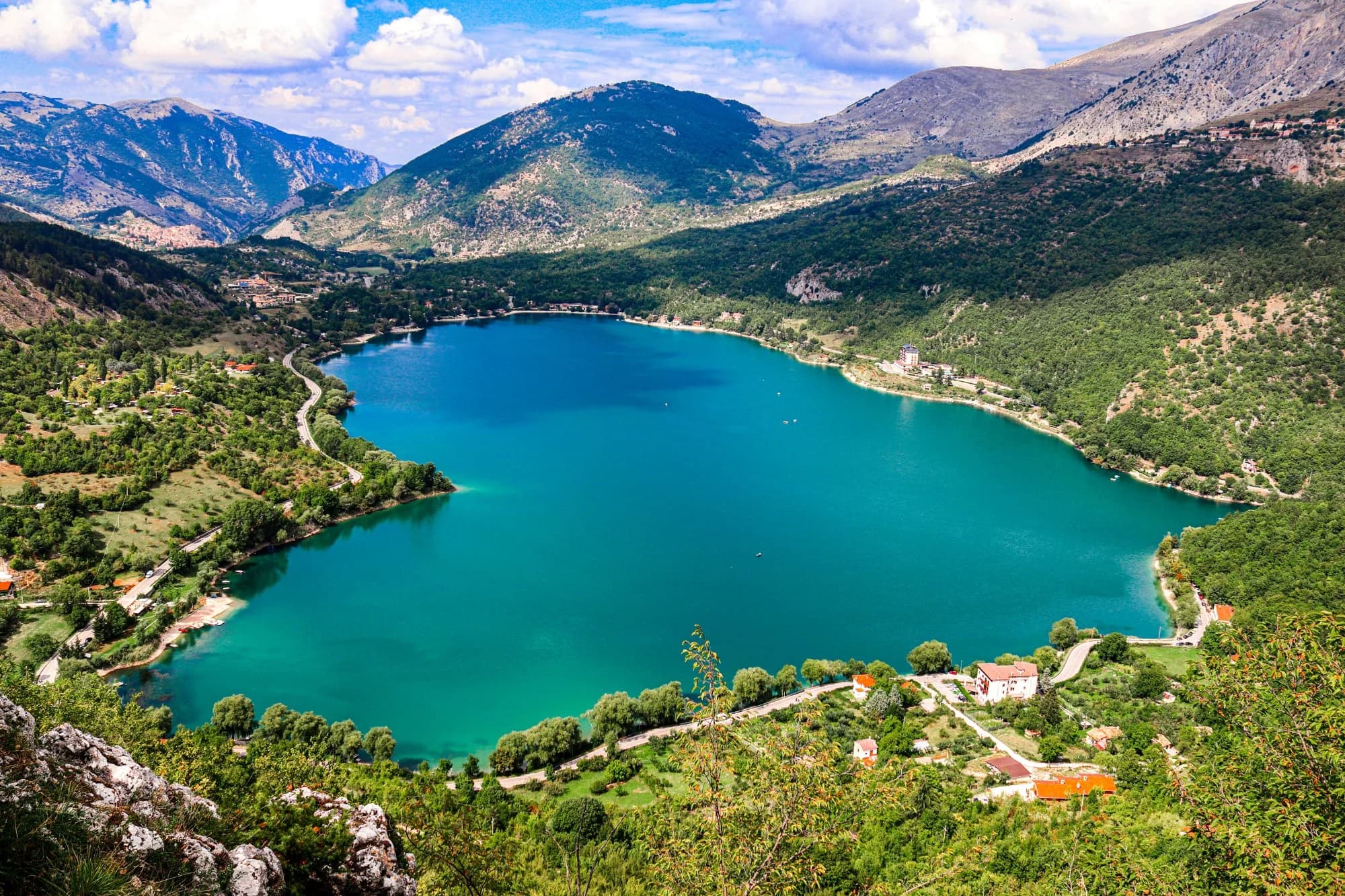
Where to stay in Abruzzo: distinct territories for luxury travellers
The Gran Sasso and Majella highlands
The Gran Sasso d'Italia massif, whose highest peak, the Corno Grande, reaches 2,912 metres, defines the interior of the region. This is continental Italy at its most severe and most beautiful. Properties at altitude or at the foot of the massif tend toward converted stone structures: former masserie, medieval tower houses, and fortified farmsteads that have been adapted into intimate retreats. The experience here is one of altitude, silence, and a cuisine anchored in sheep farming, saffron cultivation (Navelli plain), and slow-fermented charcuterie. A luxury suite in this zone typically means thick stone walls, wood-burning heat, and direct access to trails inside the Gran Sasso and Monti della Laga National Park.
The Adriatic coast and the Trabocchi Coast
The so-called Costa dei Trabocchi, running from Ortona southward to Vasto, is named for the wooden fishing structures that extend over the sea on stilts. This coastline has seen careful infrastructure investment in recent years, including a dedicated cycling and walking path built along a former railway line. Coastal stays offer a different register from the interior: the pace slows toward the water, the cuisine shifts to Adriatic fish, and the light has the particular warmth of the central Italian coast. Luxury hotels along this stretch tend to be smaller in scale, with suites oriented toward sea views and immediate access to the shore.
The inland hill towns and the Peligna Valley
Towns such as Sulmona, Scanno, and Pescocostanzo represent the cultural weight of Abruzzo's interior. Sulmona, birthplace of Ovid, is known for its confetti (sugar-coated almonds) and its well-preserved medieval centre. The Peligna Valley, in which Sulmona sits, offers a landscape of planted fields surrounded by limestone karst ridges. Boutique properties in this zone often occupy former palazzi or ecclesiastical structures, and their luxury proposition centres on cultural immersion and architectural integrity.
When to visit Abruzzo for a high-end suite stay
Abruzzo does not operate on a single seasonal logic. The region's geographic diversity means that optimal timing depends entirely on the type of experience sought.
For the mountain interior, late spring (May to June) and early autumn (September to October) offer the most temperate conditions for walking, cycling, and exploring national park territory. Summer at altitude remains cooler than the coast, making July and August genuinely viable for inland stays, while the coast reaches its peak warmth. Winter transforms the Gran Sasso and the Majella into functioning ski territory: Roccaraso and Campo Felice are the principal ski areas, and properties in their proximity see strong demand from December through February.
The region has no single dominant luxury event calendar in the way that Venice or Florence does, which is, for many travellers, precisely the point. Visits can be timed around Sulmona's Giostra Cavalleresca (a medieval jousting festival held in summer), the Sagra della Ventricina in the Vastese area, or the olive harvest across the hill towns in October and November. None of these require advance booking at the scale of major Italian cultural events, which means suite availability remains more fluid than in Tuscany or the Amalfi Coast.
Understanding luxury standards in Abruzzo
Abruzzo does not carry the same density of internationally branded luxury hotels found in Rome, Milan, or the Amalfi Coast. This is not a deficit. It reflects a hospitality culture that has developed along different lines: smaller, owner-operated, and often rooted in agricultural or architectural heritage.
The most relevant local category is the dimora storica, a historic residence converted into accommodation. These properties are classified under Italian heritage law and their conversion is subject to preservation constraints that, in practice, often produce interiors of considerable character. A suite in a dimora storica in Abruzzo is more likely to feature original frescoes, vaulted ceilings, or hand-cut stone floors than the standardised luxury finishes of an international chain.
The agriturismo category also operates at a higher register in Abruzzo than its basic classification might suggest. Several properties in the region combine working farms (producing olive oil, saffron, pecorino, and wine from the Montepulciano d'Abruzzo and Trebbiano d'Abruzzo appellations) with accommodation that meets a genuine luxury standard in terms of space, materials, and service.
What to expect from a top-tier suite in Abruzzo: generous floor plans by Italian boutique standards, a strong relationship between interior and landscape (terraces, gardens, or direct park access), and a food proposition that draws directly from local producers. Spa facilities exist but are less ubiquitous than in Tuscany or South Tyrol.
How to choose the right luxury suite in Abruzzo
The first decision is geographic: mountain interior or coastline. These are not interchangeable experiences, and the properties suited to each are architecturally and experientially distinct. A suite in a restored stone tower above the Majella plateau has nothing in common with a sea-facing room on the Trabocchi Coast, beyond the regional classification.
The second consideration is access. Abruzzo is served by Pescara airport (Aeroporto Internazionale d'Abruzzo), which handles connections from several European cities, particularly via Ryanair. Rome's airports (Fiumicino and Ciampino) are approximately two hours by road. The interior of the region requires a car: public transport connections to the smaller hill towns and national park areas are infrequent. Any traveller intending to use a mountain property as a base for exploration should plan accordingly.
Third: season alignment. A coastal property visited in November will not deliver the experience its architecture promises. Equally, a mountain retreat booked in August without ski infrastructure should be evaluated on its hiking and cultural access rather than winter sport proximity.
Finally, consider the service model. Several of the most compelling properties in Abruzzo operate with small teams, sometimes family-run, and deliver a highly personal but not formally hotelier style of hospitality. For travellers accustomed to the operational scale of a Palace hotel in Rome or a five-star resort on Lake Como, this requires a calibration of expectations, not a lowering of them.
Why curation matters in a region like Abruzzo
The challenge in Abruzzo is not a shortage of interesting properties. It is the absence of a legible signal to distinguish genuinely exceptional suites from the merely adequate. The region lacks the editorial infrastructure that surrounds more established luxury destinations in Italy: fewer international press features, fewer brand-name operators, and a hospitality landscape that is, in aggregate, harder to read from a distance.
La Suite approaches Abruzzo with the same rigorous criteria applied to properties in Positano or Marrakech: spatial quality, material integrity, service proposition, and the degree to which the suite experience is coherent with its landscape context. The curated selection on La Suite represents properties where the suite itself, not just the location, justifies the stay. In a region where the gap between an interesting address and a genuinely elevated experience can be wide, that distinction is the entire point of curation.