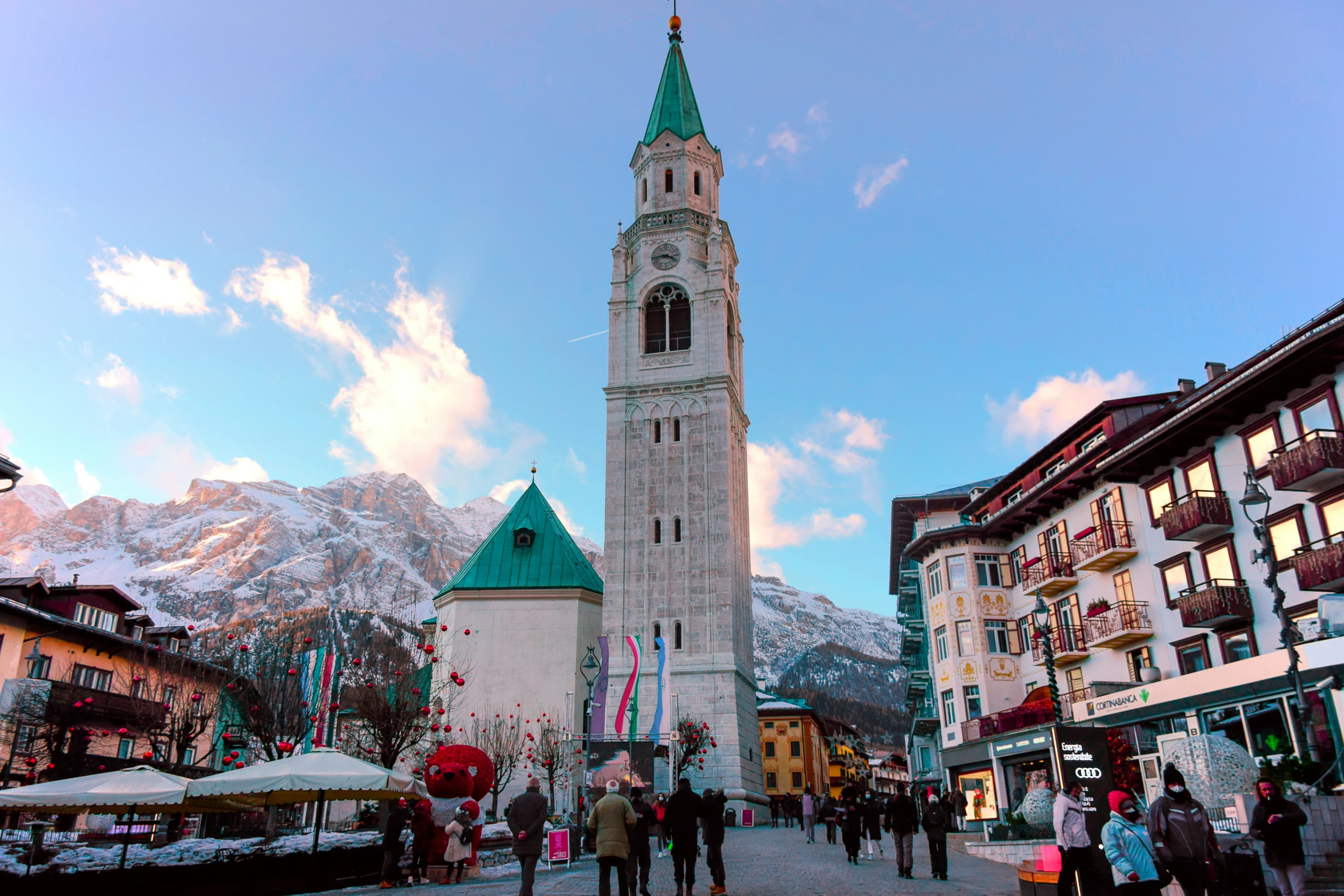
Understanding Cortina d'Ampezzo as a luxury destination
The distinct areas of Cortina and their luxury character
The town centre and Corso Italia
The pedestrian axis of Corso Italia is where Cortina's social life concentrates. Boutiques from Fendi, Moncler, and Tod's occupy historic facades alongside independent purveyors of local craft and alpine provisions. Properties positioned within walking distance of this corridor offer immediate access to the town's cultural and retail texture, without requiring a vehicle. For travellers who prefer proximity to the social centre, the town core provides the most immediate immersion in Cortina's particular version of Italian alpine life.
The slopes and elevated positions
Several properties sit at higher elevations or in direct proximity to the main ski areas: Socrepes, Faloria, and Tofana. These locations offer a different relationship to the landscape, one defined by direct mountain access and a quieter residential character. A luxury suite positioned at altitude, with unobstructed views of the Dolomite rock formations, provides a different quality of morning light and a different register of silence. For travellers whose primary motivation is the mountain itself, these positions warrant serious consideration.
The surrounding valley and peripheral estates
Beyond the immediate town perimeter, the Ampezzo Valley contains historic properties and converted estates that offer more spatial privacy. These locations require transport to reach central amenities but compensate with acreage, architectural distinction, and a degree of isolation that the town centre cannot provide. For longer stays or family groups, this peripheral positioning often proves the most considered choice.
When to visit Cortina d'Ampezzo
Winter season
The primary season runs from December through March. Peak demand concentrates around Christmas, New Year, and the February half-term periods, when suite availability at leading properties tightens considerably. The Ski World Cup races, which Cortina has hosted regularly on the Olympia delle Tofane course, draw a specific sporting and social audience. January, outside the major holiday windows, offers the best combination of snow reliability and relative availability. Advance planning of three to six months is standard practice for serious travellers targeting specific properties during this period.
Summer season
Cortina's summer season, from late June through August, is increasingly significant. Hiking, cycling on the Dolomite passes, and the cultural programming of the Cortina Film Festival in late August attract a different but equally considered audience. Summer suite demand has risen materially in recent years as the town's appeal beyond skiing has become more widely recognised. The light quality in the Dolomites during summer, particularly in the early morning and late afternoon, is a distinct sensory consideration that serious travellers account for when planning itineraries.
Shoulder seasons
April through May and October through November represent genuine shoulder periods, when many properties close for renovation or transition. Travellers who do visit during these windows often find exceptional availability and a more private engagement with the landscape, though the full range of amenities and services may not be operational.
Local luxury standards and what to expect from top suites in Cortina
Italian hotel classification does not use the Palace designation employed in France. Instead, leading Italian properties operate within the five-star superior category, with a subset of properties recognised under the Leading Hotels of the World or Preferred Hotels frameworks. In Cortina specifically, the reference properties have historically combined alpine architectural tradition, characterised by dark timber, pitched roofs, and locally sourced stone, with interior programmes that draw on Italian design expertise. The better suites in Cortina are not generically alpine: they carry specific material decisions, often involving local craftwork, bespoke textile commissions, and spatial planning that accounts for the particular quality of Dolomite light at different times of day.
Guests should expect suite categories to reflect the view orientation as much as the floor area. A suite positioned toward the Tofana massif commands different value from one oriented toward the valley floor. Thermal facilities in leading Cortina properties tend to be architecturally integrated rather than appended, reflecting the serious attention paid to the spa and wellness dimension in Italian mountain hospitality. Gastronomic programming at top-tier Cortina hotels increasingly reflects the Veneto and Ladin culinary traditions, with an emphasis on local dairy, cured meats, and foraged ingredients.
How to choose the right luxury suite in Cortina d'Ampezzo
Historical versus contemporary architecture
Cortina's most established properties occupy buildings with architectural histories that predate the postwar period. These structures offer a material authenticity that newer constructions cannot replicate. However, several more recently developed properties have introduced contemporary spatial programmes that provide larger floor areas and more current technical infrastructure. The choice between these registers depends substantially on what the traveller values: historical texture and craft continuity, or spatial generosity and modern technical performance.
Ski-in, ski-out access versus town proximity
True ski-in, ski-out positioning is limited in Cortina by the town's geography. Properties that claim direct slope access warrant careful verification. The practical implications for a suite stay are significant: properties with genuine slope access provide a fundamentally different daily rhythm from those that require even a short transfer to reach the ski area. For guests who will ski daily, this distinction is worth investigating in detail before confirming a reservation.
Suite size and configuration
Cortina attracts a high proportion of family and group travellers alongside couples and solo guests. Suite configurations vary significantly: some properties offer junior suites of 45 to 60 square metres, while others provide residential-scale apartments with multiple bedrooms, private terraces, and separate living areas. Matching the configuration to the travel group's actual spatial needs, rather than simply selecting the highest category available, is a practical discipline that the most experienced travellers apply consistently.
Why a curated selection by La Suite changes the decision
The Cortina market is not large in absolute terms: the town's total accommodation capacity is finite, and the number of properties that genuinely meet the standards relevant to this audience is limited. This makes curation more consequential, not less. A curated selection by La Suite applies consistent editorial criteria to every property presented, filtering for material quality, suite spatial standards, service infrastructure, and the specific contextual relevance of each property to the Cortina experience. The result is a shortlist that reflects considered judgment rather than inventory volume. For travellers making a significant investment of time and expenditure in a Cortina stay, beginning with a curated selection removes the primary friction of an unfiltered search.