Where to stay in Marche: distinct areas and their luxury profiles
The Apennine interior and hill towns
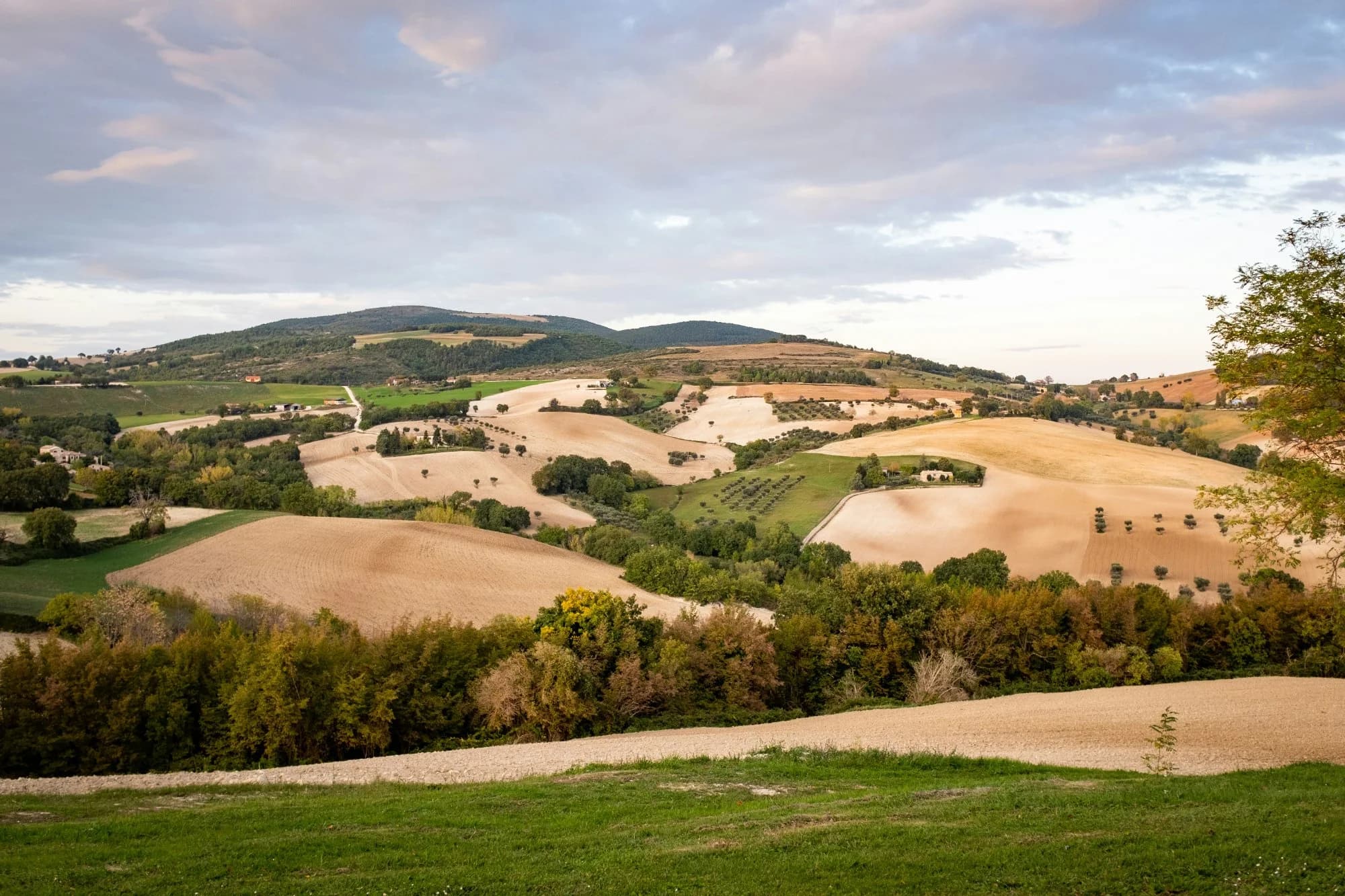
The western spine of Marche is defined by the Apennines and the sequence of fortified hill towns that follow the ridgelines. Towns such as Urbino, Macerata, and Camerino carry significant Renaissance and medieval heritage. Urbino in particular is a UNESCO World Heritage Site and the birthplace of Raphael, with a ducal palace that remains one of the most coherent examples of fifteenth-century court architecture in Italy. Properties in this interior zone tend to occupy converted noble residences, former convents, or agricultural estates. The pace is slower, the landscape is agrarian, and the light in the late afternoon takes on a quality that painters have returned to document for centuries. For travelers who prioritise cultural immersion and solitude over coastal access, the interior offers the most distinctive expression of the Marche character.
The Adriatic coastal strip
The eastern edge of Marche is a long Adriatic coastline running from Gabicce Mare in the north to San Benedetto del Tronto in the south. The northern stretch, around the Conero promontory, is the most architecturally and scenically significant. The Conero Riviera is one of the few stretches of the Italian Adriatic coast where the hills reach directly to the sea, producing dramatic limestone cliffs and small protected coves. Portonovo, at the base of Monte Conero, remains a point of reference for those who want coastal access without the infrastructure of a resort town. Luxury hotel suites in this zone often combine sea views with proximity to the natural park, giving guests a rare combination of physical wildness and considered comfort.
The central foothills and wine country
Between the coast and the mountains, the rolling foothills support a significant wine and agricultural economy. The Verdicchio dei Castelli di Jesi and Verdicchio di Matelica appellations produce white wines of genuine complexity, while the Rosso Conero and Rosso Piceno appellations are the principal reds. Converted farmhouses and agriturismi at this level of the market offer suites that are embedded in working landscapes, where the view from the terrace is as likely to be a vineyard as a formal garden. This middle zone appeals most directly to travelers who want to eat and drink seriously within the property's own orbit.
When to visit Marche for a luxury suite stay
The optimal window for a suite stay in Marche runs from late April through June and from early September through October. These shoulder periods offer mild temperatures, lower occupancy, and the clearest light. July and August bring heat and a concentration of Italian domestic tourism, particularly along the coast, which can work against the sense of privacy that motivates most guests booking at this level. The Sferisterio Opera Festival in Macerata, held in July and August, is a significant cultural event that draws an international audience and fills the better properties in the province; if attendance is the purpose, advance booking is essential. The truffle season, running from October into early winter, adds a specific gastronomic dimension to stays in the interior, particularly around Acqualagna, which is one of Italy's principal truffle markets.
Luxury standards in Marche: what to expect from top-tier properties
Italy does not have a nationally codified prestige designation equivalent to the French Palace label, but the market operates with its own understood hierarchy. At the top of the Marche market, properties are typically five-star hotels or high-end relais, a category that in Italian hospitality signals a small, architecturally significant property with a high ratio of staff to guests and a strong culinary identity. Many of the finest properties in the region have been developed from historic structures: noble villas, monasteries, and agricultural complexes that have been restored with attention to original materials and proportions. Guests should expect stone floors, vaulted ceilings, and a deliberate restraint in the use of contemporary design interventions. The best suites in Marche are not large by the standards of an urban grand hotel, but they are spatially coherent, and the relationship between interior and exterior, through loggia, terrace, or garden, is generally handled with care. Service at this level is personal rather than formal, reflecting the family or small-group ownership structures that characterise many of the leading properties.
How to choose the right luxury suite in Marche
Several practical considerations shape the decision. The first is the tension between coastal and inland positioning. A suite above the Conero cliffs and a suite in a converted palazzo in Urbino are radically different experiences, and they do not compete with each other so much as address different intentions. The second consideration is accessibility: Marche is served by Ancona Falconara Airport for international connections, and the A14 motorway runs along the entire coastal length of the region. Properties in the deep interior may require a rental car and an appetite for mountain roads. The third consideration is the suite's architectural character: historic conversions often offer more individual spatial interest than purpose-built resort accommodation, but they may come with the constraints of protected heritage structures, including limited air conditioning capacity or restricted accessibility. Finally, the culinary program of the property matters in Marche more than in many Italian regions, because the local larder is exceptionally strong. Brodetto, vincisgrassi, and the region's exceptional seafood deserve a kitchen and a chef who treat them with seriousness.
Why a curated selection by La Suite matters in Marche
Marche does not have the density of internationally recognised luxury hotel brands that operate in Tuscany or the Amalfi Coast. The finest properties here are often independently owned and lightly marketed, which means they do not surface easily through conventional search or booking platforms. The gap between a five-star listing and a property that genuinely delivers at the suite level is wider in Marche than in more established luxury destinations, and navigating that gap without prior knowledge of the region is time-consuming. La Suite applies a consistent editorial standard to each property it lists, evaluating the suite inventory, the architectural quality, the service proposition, and the surrounding landscape context. For a region as understated and geographically varied as Marche, that curatorial filter is not a convenience but a genuine determinant of whether the stay meets the expectations that bring a discerning traveler here in the first place.