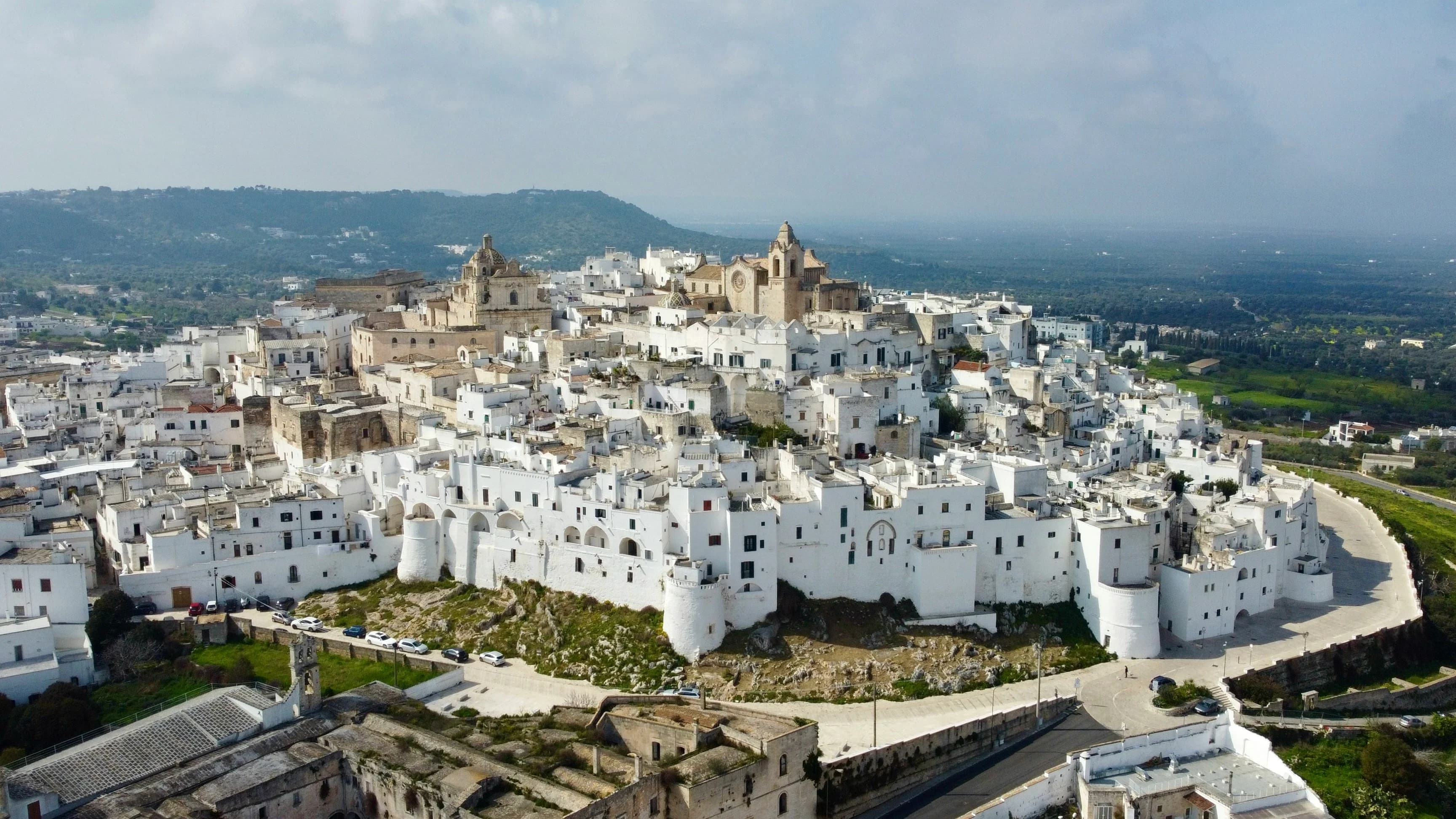
Where to stay in and around Ostuni
The surrounding countryside, known as the Valle d'Itria, presents a contrasting typology. Converted masserie (historic fortified farmhouses) operate across the olive groves between Ostuni, Fasano, and Cisternino. These properties sit within private landholdings, often measured in hundreds of hectares, and offer a degree of seclusion that the hilltop cannot. Swimming pools carved from local stone, private dining in former agricultural buildings, and uninterrupted views across the oldest olive trees in Europe define the experience here.
The Adriatic coastline lies roughly fifteen kilometres east of Ostuni's ridge. The coast near Rosa Marina and Torre Canne offers a different register entirely: sea access, lower density, and a quieter pace that suits guests travelling in summer without wanting the social concentration of more famous Puglian resorts.
When to visit Ostuni for a luxury suite stay
The Puglia region operates on a compressed luxury season that runs from late April through to early October. Within that window, June and September represent the clearest choices for guests seeking suite availability alongside tolerable temperatures. July and August bring the full weight of the Italian summer, with temperatures frequently exceeding 35 degrees Celsius and peak-season pricing across all property categories. Properties fill early during this period, and the most sought-after masseria suites are typically reserved months in advance.
Late spring, particularly May, offers arguably the most balanced conditions: the almond and cherry blossoms have passed, the wheat fields are still green, and the coastal towns have not yet reached their summer density. October extends the season gracefully, with the olive harvest underway across the countryside and daytime temperatures remaining in the low twenties. The cultural calendar during this period includes local food festivals and the DOC wine harvest events that are native to the Salento and Valle d'Itria appellations.
Winter in Ostuni is quiet, atmospheric, and largely unknown to international visitors. The historic centre empties considerably, and some countryside properties close for the season. Guests who travel between November and March will find a city operating on local rhythms, with fewer services oriented toward tourism but an authenticity that summer cannot replicate.
Understanding local luxury standards in Puglia
Italy does not apply the French Palace designation to its hotels, but it operates a five-star superior classification that functions as the highest formal tier. In Puglia specifically, the most meaningful distinction is not a star rating but a property typology: the masseria. Originally agricultural complexes built for defence and production across the Puglian plains, many have been converted over the past thirty years into precision hospitality properties. The best examples retain original stone construction, vaulted ceilings, trullo outbuildings, and centuries-old olive groves while integrating contemporary interiors, spa facilities, and refined food and beverage programmes.
A luxury hotel suite within a genuine masseria context typically occupies a former agricultural outbuilding or a wing of the main fortified structure. Ceilings are low and arched, walls are thick enough to maintain natural climate regulation, and light enters at angles that shift dramatically through the day. This is architecture with a material logic: designed for survival in an extreme southern Italian climate, now repurposed for a form of comfort that is both historical and sensory.
Guests should distinguish between properties that have undergone authentic restoration, preserving original construction techniques and local materials, and those that use the masseria label as a marketing category while delivering a more standardised product. The difference is perceptible immediately: in the thickness of the walls, the source of the stone, and the relationship between interior space and the surrounding landscape.
How to choose the best luxury suite in Ostuni
The first consideration is typology. Guests choosing between a suite within the historic centre and one within a countryside masseria are making a fundamentally different decision about how the trip will feel. The city offers walkability, proximity to restaurants and the daily life of the centro storico, and a density of architectural detail that suits culturally motivated travellers. The countryside offers space, privacy, and a direct relationship with the Puglian agricultural landscape that shaped the region's identity.
The second consideration is seasonal alignment. A suite designed around an outdoor terrace, a private pool, or a garden dining area delivers its full value only during the warmer months. Guests travelling in spring or autumn should confirm what amenities remain operational during shoulder season, as some masserie run reduced services outside peak summer.
The third consideration is scale. Ostuni and its surrounding territory are home to properties that range from four-suite boutique conversions to larger estate resorts with twenty or more rooms. Smaller properties tend to offer a higher ratio of staff attention to guests and a more considered food programme tied to local producers. Larger estates offer greater facility depth: multiple pools, full spa infrastructure, and flexibility for group or family travel.
Architectural preference matters here in a way it does not in more homogeneous luxury markets. Puglia's building heritage is specific and regional. The trullo (a conical dry-stone construction native to the Valle d'Itria), the arched vaulting of the masseria, and the carved limestone facades of Ostuni's Baroque churches represent a visual and material vocabulary unlike any other in Italy. Guests with a high tolerance for historical texture will find that the finest suites here integrate that vocabulary into the experience rather than neutralising it with generic contemporary design.
Why a curated selection by La Suite matters in this destination
The Puglia market presents a specific curation challenge. The category of converted masseria has expanded rapidly over the past decade, and the quality spread is wide. Properties that perform well on general booking platforms are not necessarily those that deliver at the suite level. Photography, category labelling, and pricing can be misleading in a market where a genuine luxury hotel suite in a historically significant property sits alongside a more modest conversion using similar visual language.
La Suite applies a consistent standard of editorial and experiential verification to every property it lists. For Ostuni and the surrounding Itria Valley territory, that means identifying the properties where the suite product, the architectural context, the food programme, and the staff-to-guest ratio meet the expectations of a guest who chooses suites deliberately. The curated selection by La Suite removes the friction of that research and presents only the properties that hold to that standard.