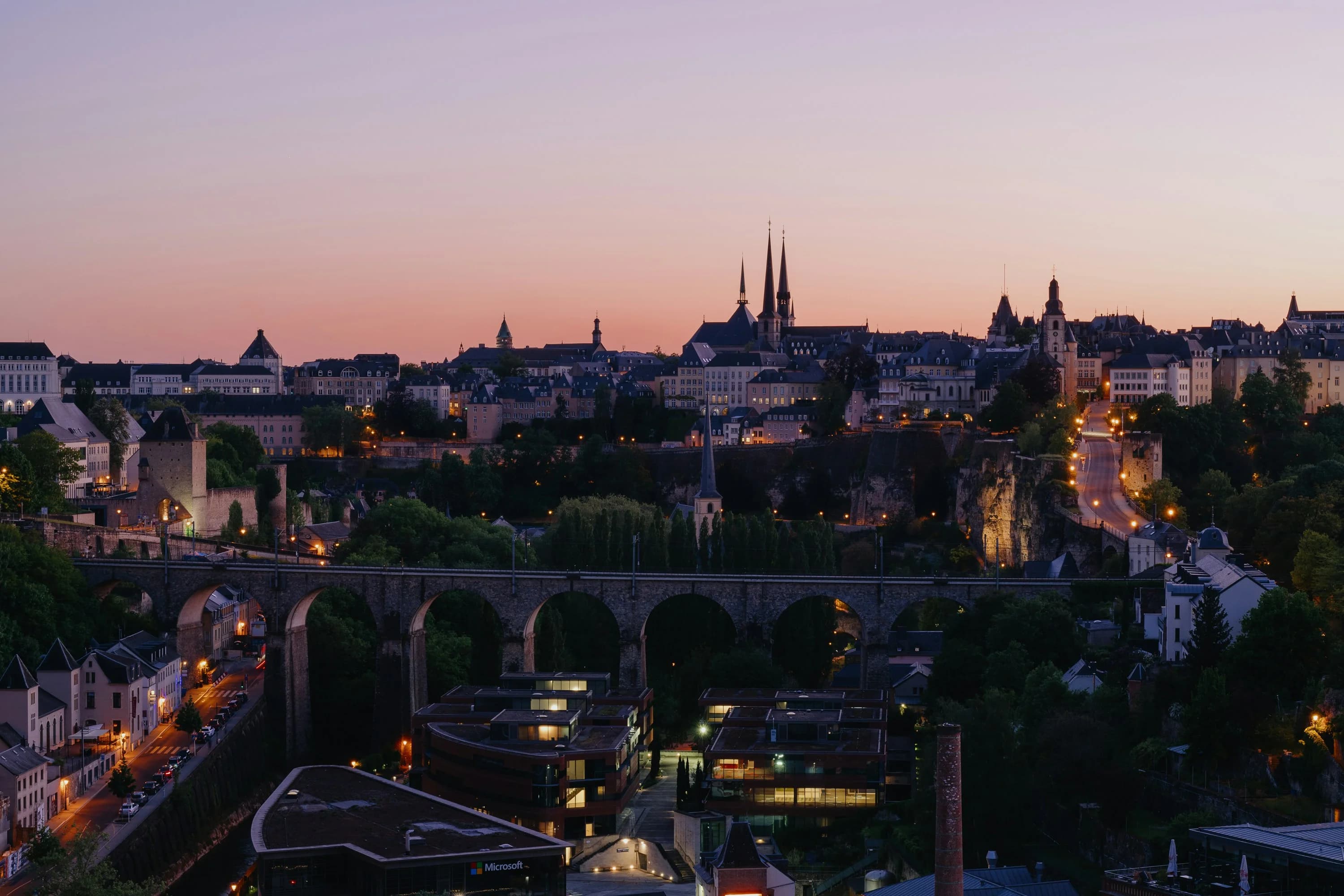
Where to stay in Luxembourg for a suite experience
The Grund district, carved into the valley of the Alzette river, provides a quieter residential atmosphere. Properties in or near this area suit travelers who prefer the texture of a historic streetscape over the efficiency of a central business address. Further north, the Ardennes region, which Luxembourg shares partly with Belgium, offers a different register altogether: forested, slow, and oriented toward countryside estates and converted manor properties. For travelers extending their stay beyond the capital, this area represents a genuine change of pace and architecture.
The Moselle valley to the east, Luxembourg's wine-producing corridor, offers smaller boutique properties set against vineyard landscapes. While accommodation density is lower here, the quality of individual properties can be high, and the sensory contrast with the capital is marked.
When to visit Luxembourg for luxury travel
Luxembourg's climate follows a temperate continental pattern, with mild summers and cold winters. The most comfortable window for leisure travel runs from late April through October, when the gorge walks, outdoor terraces, and river valleys are fully accessible. June and September represent the clearest balance between agreeable weather and manageable visitor numbers.
The Luxembourg Philharmonie season runs from September through June, drawing an audience with significant crossover with the cultural traveler profile. The European institutions in Kirchberg operate on a calendar that concentrates business travel in the spring and autumn sessions, which can create pressure on suite availability at the city's upper-tier properties during those periods. Travelers with scheduling flexibility should note that July and August, while quieter professionally, represent the local holiday period, when some independent restaurants and smaller properties reduce their operating hours.
The Christmas period transforms the capital's historic squares into some of Northern Europe's more architecturally coherent seasonal markets. For travelers who time visits around cultural atmosphere rather than warmth, December carries its own specific appeal.
Luxury accommodation standards in Luxembourg
Luxembourg does not operate a specific prestige classification equivalent to France's Palace designation, but the country's small size and high-income residential base have supported a consistent standard at the upper end of the hotel market. Properties positioning themselves at the five-star level in Luxembourg City typically offer suites with significant square footage relative to European urban norms, reflecting both the influence of the business-diplomatic clientele and the country's general cost structure.
The architectural range available in luxury hotel suites across Luxembourg spans nineteenth-century bourgeois townhouses converted into boutique properties, purpose-built contemporary towers adjacent to the European Quarter, and restored country estates in the rural cantons. Each typology carries a different spatial logic: the converted townhouse delivers intimacy and historical texture; the contemporary tower offers unobstructed views over the gorges; the country estate provides the privacy and grounds that urban properties cannot replicate.
Service standards at the upper tier in Luxembourg tend toward the discreet and professionally precise. The city's role as a European financial and institutional center has calibrated local hospitality culture toward efficiency and confidentiality rather than theatrical gestures. Travelers who prioritize understated, competent service over performative luxury will find the local standard well-matched to their expectations.
How to choose the right luxury suite in Luxembourg
The first variable to consider is the purpose of the visit. Luxembourg City functions simultaneously as a cultural capital, a business hub, and a gateway to the surrounding countryside. A suite in the Ville Haute or near the Place d'Armes serves a different itinerary than one positioned in Kirchberg or on the city's periphery. Identifying the balance between convenience and atmosphere is the primary architectural decision.
Suite orientation is a practical consideration unique to the capital's topography. Properties built into or overlooking the Pétrusse and Alzette gorges can offer extraordinary vertical views that flatly urban properties cannot provide. Confirming whether a suite faces the gorge, the old town roofline, or an internal courtyard will materially affect the daily experience of the space.
For travelers visiting during the European institutions' session periods, suite availability at the city's most sought-after properties can tighten considerably. Advance planning of four to six weeks is advisable for peak institutional calendar dates. For country estate properties in the Ardennes or Moselle, availability tends to be more fluid, though peak summer weekends attract domestic leisure demand from Belgium, France, and Germany.
Travelers with specific requirements around privacy, connectivity, or extended-stay configuration should review suite specifications in detail before confirming. Luxembourg's top properties generally accommodate detailed pre-arrival requests, consistent with the expectation of the client base they serve.
Why curated selection matters in Luxembourg
Luxembourg's luxury accommodation market is concentrated and precise, but it is not transparent. The gap between a property's marketing presentation and its actual suite quality can be significant, particularly among smaller boutique conversions where investment has been uneven across room categories. A curated selection by La Suite cuts through this noise by applying consistent editorial criteria: spatial quality, design coherence, service reliability, and the specific character of the suite experience rather than the property's aggregate star rating.
For a destination as compact and high-stakes as Luxembourg, where the number of genuinely exceptional suite options is finite, the value of curation is not about volume but about precision. La Suite identifies the properties and suite categories that deliver at the level this audience expects, removing the effort and risk from a decision that is, ultimately, about how well a space supports the reason for the trip.