Where to stay in North Macedonia: distinct areas and their luxury character
Ohrid and the lake region
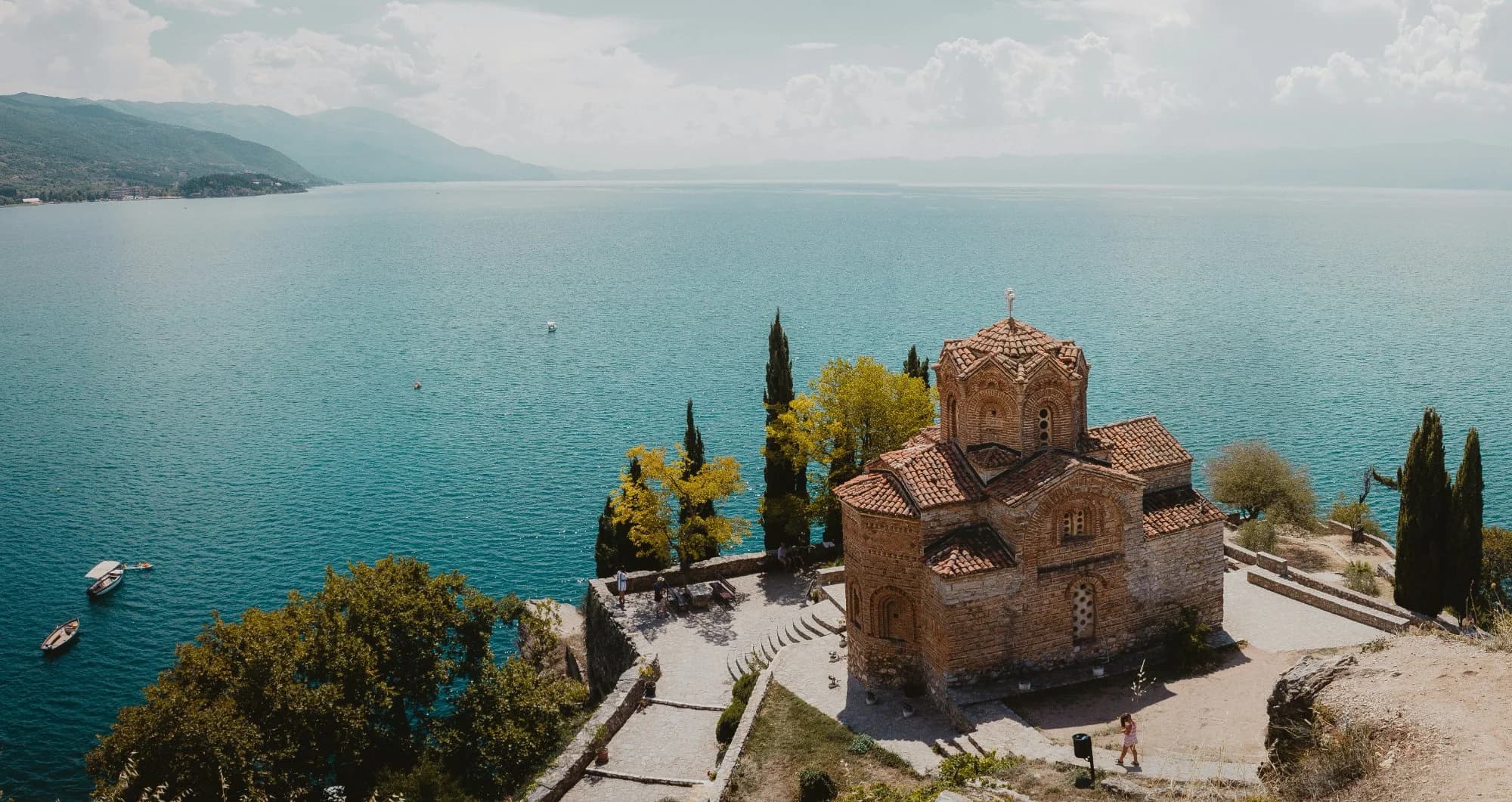
The southwestern corridor around Lake Ohrid is consistently the most refined area for suite travel in the country. The lake itself is classified as a UNESCO World Heritage Site for both its natural and cultural significance, and the town of Ohrid carries an architectural density that rewards slow movement: medieval churches, a late-antique theatre, and a fortified hilltop overlay a working waterfront. Suites here typically command lake-facing orientations, and the quality of natural light, particularly in the early morning and at dusk, is among the most photographically precise in the Balkans. The pace is measured, the scale is human, and the hospitality tradition draws on a centuries-old culture of hosting.
Skopje and the capital corridor
Skopje presents a more complex proposition. The city rebuilt substantially after the 1963 earthquake and again under the Skopje 2014 urban project, which introduced neoclassical facades and monumental statuary across the central zone. The result is architecturally polarising, but for travellers interested in the cultural mechanics of post-socialist nation-building, it is genuinely instructive. The Old Bazaar district, one of the largest preserved Ottoman bazaars in the Balkans, operates as a counterweight: narrow lanes, artisan workshops, and historical mosques provide texture that the newer districts lack. Suites in Skopje tend to occupy the upper floors of contemporary hotels positioned near or within the central zone.
Mavrovo and the mountain interior
The western mountain region, centred around Mavrovo National Park, offers a quieter register. The park contains one of North Macedonia's most photographed subjects, the partially submerged Church of St. Nicholas visible above the lake surface when water levels drop. Winter brings skiing at the Zare Lazarevski resort; summer offers hiking in underpopulated terrain. Suite availability in this zone is limited, but the properties that exist here provide isolation of a quality that the lake and capital regions cannot replicate.
When to visit North Macedonia for a suite-level stay
The country operates on a continental climate with Mediterranean influence in the south and southwest. The Ohrid region is warmest and most accessible from late April through September. July and August bring the highest visitor concentrations, particularly around the Ohrid Summer Festival, an established cultural programme of classical music, theatre, and folklore running from mid-July to mid-August. Suite availability during this window requires forward planning, as the festival draws significant regional and international audiences.
Spring (April to early June) and early autumn (September to October) represent the most balanced periods: temperatures are moderate, lake and mountain landscapes are at their most textured, and the competition for the best-positioned suites is considerably lower. Winter visits to Skopje and the mountain zones are viable and carry a particular atmosphere, though the lake region slows markedly outside the summer season.
Local luxury standards: what to expect from top-tier suites in North Macedonia
North Macedonia does not operate a formal national hotel classification system equivalent to France's Palace designation or the UK's AA system. The five-star category is the primary marker of premium positioning, but the range within that category is wide. The most credible properties tend to be smaller, independently operated, or affiliated with regional boutique groups rather than major international chains, though that landscape is shifting.
In the Ohrid region, the most considered properties foreground their lake orientation, the quality of their stonework (local limestone and wood are predominant materials), and the integration of traditional Macedonian architecture, characterised by the cantilevered upper floors of the old-town house typology known locally as the Ohrid-style house. Suites in these contexts often feature private terraces, lake views, and materials sourced from regional craft traditions.
In Skopje, the luxury offer is more urban and contemporary in character, with international brand standards beginning to establish a foothold. Service quality in the capital has risen consistently over the past decade, and the restaurant culture adjacent to the best hotels has developed in parallel.
Spa and wellness infrastructure remains less developed than in comparable Balkan destinations such as Slovenia or Croatia, but thermal bathing traditions exist in the country and several properties have invested in dedicated wellness facilities.
How to choose the best suite in North Macedonia
The orientation of the suite is the single most important variable in the Ohrid region. A lake-facing room at the correct altitude above the old town will produce a fundamentally different experience from an equivalent room positioned toward the hillside or town interior. Verify orientation before confirming any reservation.
Assess the architectural context of the property. Ohrid's most coherent luxury stays sit within or immediately adjacent to the UNESCO-protected old town. Properties located further along the lake shore or in the resort extensions built during the Yugoslav period offer a different, more generic experience. The distinction matters.
For Skopje stays, proximity to the Old Bazaar is a more reliable quality signal than proximity to the neoclassical central zone. The bazaar district provides pedestrian access to the city's most authentic food, craft, and cultural infrastructure.
Consider the length of stay carefully. North Macedonia is not a destination that reveals itself quickly. A minimum of three nights in the Ohrid region, combined with a night or two in Skopje, allows for a more complete reading of the country's character. Travellers passing through on a single night rarely leave with an accurate impression.
Why a curated selection by La Suite matters for North Macedonia
North Macedonia is a destination where the gap between a well-chosen suite and a poorly chosen one is significant. The country's hotel market includes properties that carry four- or five-star designations but deliver inconsistently against international luxury benchmarks. The difference is not always legible from standard booking platforms.
La Suite's curatorial process applies consistent criteria: architectural coherence, suite-specific quality (not just room-level standards), service reliability, and the degree to which a property enhances rather than merely accommodates the destination. In a market like North Macedonia, where the category is still maturing, that filter is particularly valuable. The curated selection by La Suite removes the uncertainty of discovery and replaces it with considered editorial authority.