Where to stay in Basque Country: areas and their character
San Sebastian and the Gipuzkoa coast
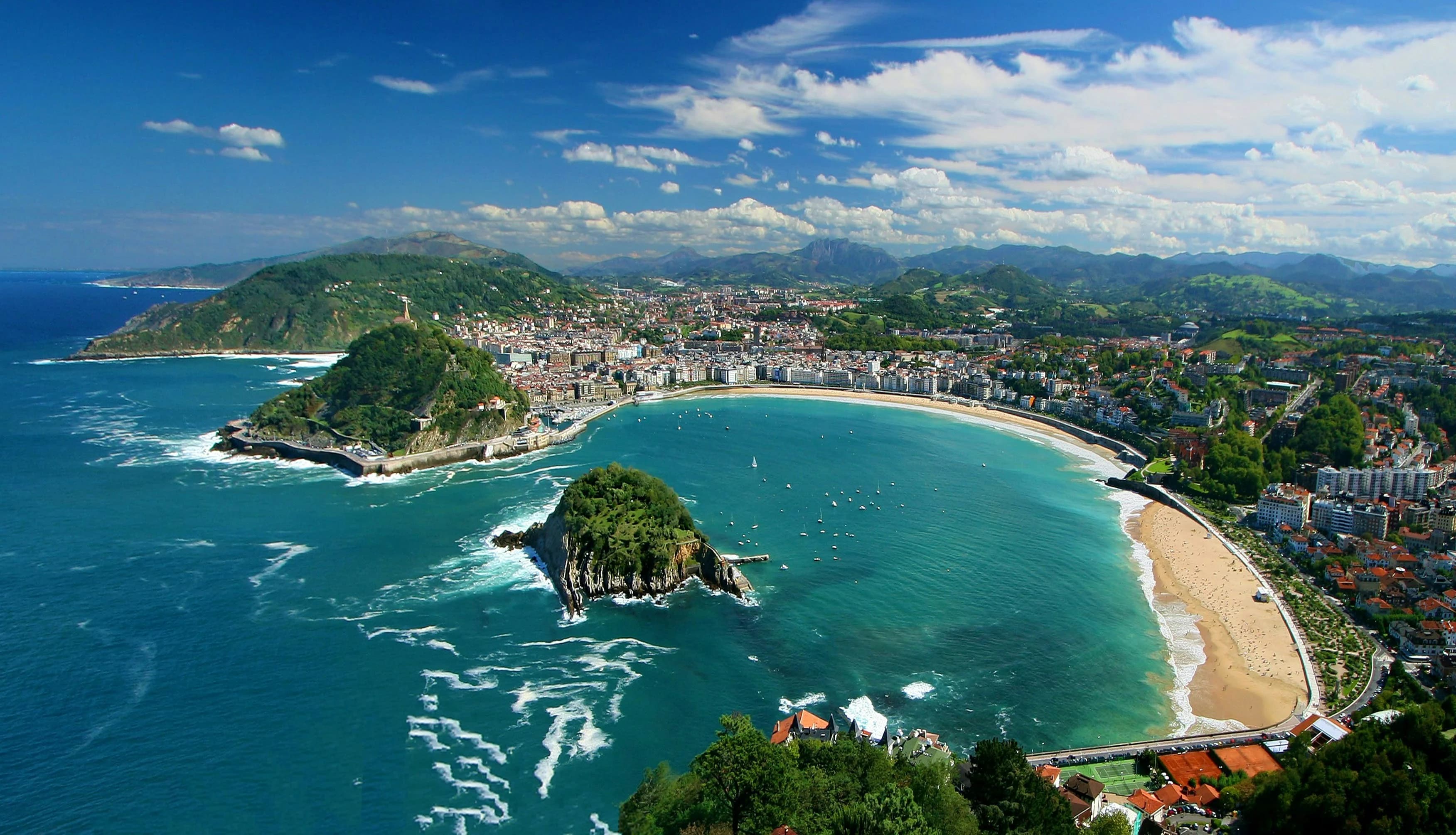
San Sebastian, known locally as Donostia, is a compact city of unusual architectural coherence. Its Belle Époque seafront, framed by Monte Igueldo and Monte Urgull, contains one of the highest concentrations of Michelin-starred restaurants per capita in the world. The surrounding Gipuzkoa province offers quieter coastal villages and green interior valleys. Luxury hotel suites here tend to occupy either grand historic buildings on La Concha bay or design-led properties in the Parte Vieja and Gros neighbourhoods. The scale is intimate. Proximity to the water and to the gastronomic circuit defines the logic of a stay.
Bilbao and the Bizkaia hinterland
Bilbao functions on a different register entirely. Its transformation since the 1990s, anchored by the Guggenheim Museum Bilbao designed by Frank Gehry, has made it a reference point for urban regeneration through cultural investment. The Casco Viejo retains its mercantile past, while the Abandoibarra waterfront district projects an explicitly contemporary identity. Luxury hotels in Bilbao tend toward architectural ambition rather than resort-style retreat. The Bizkaia coast, with its dramatic sea cliffs and fishing villages, offers a counterweight for those who want proximity to the city without remaining inside it.
Vitoria-Gasteiz and Alava
The Basque capital, Vitoria-Gasteiz, operates at a quieter register. Regularly cited among Europe's most liveable cities, it is known for its medieval old town, its European Green Capital designation, and its proximity to the Rioja Alavesa wine region. Staying here suits travelers whose priority is the interior landscape: the Cantabrian mountain foothills, the vineyards of Laguardia, and a pace of life that differs substantially from the coastal towns.
French Basque Country: Biarritz, Bayonne, Saint-Jean-de-Luz
Across the border, the Pays Basque adds a further dimension. Biarritz carries the memory of its nineteenth-century imperial resort status, with a grand hotel tradition that still shapes its hospitality landscape. Saint-Jean-de-Luz is more contained, its harbour town scale lending itself to a different kind of visit. Bayonne serves as the cultural and gastronomic capital of the French side, with its chocolate-making tradition and annual festival calendar.
When to visit Basque Country for a suite stay
The Basque Country does not follow the standard Mediterranean seasonal logic. Its Atlantic climate means rainfall is distributed throughout the year, and the green landscape that results is part of its identity. That said, certain periods favour a suite-based stay more clearly than others.
Late spring, from May through June, offers mild temperatures, lower occupancy than peak summer, and access to the full cultural calendar before it becomes crowded. July and August bring the Semana Grande festivals in both Bilbao and San Sebastian, significant cultural events with fireworks competitions, concerts, and a dense social atmosphere. Accommodation demand during these weeks is high, and advance planning is essential. September is widely regarded as the optimal month: the light is clear, the sea remains swimmable, the gastronomic circuit resumes after summer, and hotel occupancy begins to ease. The San Sebastian International Film Festival takes place in September, drawing an internationally minded audience. October and November suit those interested in the wine harvest in Rioja Alavesa and a more contemplative version of the destination.
Local luxury standards: what defines a top-tier suite here
The Basque Country does not have a nationally specific prestige label equivalent to the French Palace designation, though several properties within the region hold that French classification on the northern side of the border. On the Spanish side, the leading reference point is the Gran Lujo category within the Spanish hotel classification system, though the more meaningful signals come from international recognition: Relais and Chateaux membership, Leading Hotels of the World affiliation, and inclusion in curated editorial selections.
What distinguishes the finest suites in this region is less about surface area and more about specificity of place. The best addresses offer views of the Bay of Biscay from rooms where the light changes visibly through the day, or access to the pintxos culture of the old town without sacrificing acoustic privacy. In rural properties, the emphasis shifts toward the sensory qualities of the landscape: the smell of the Cantabrian forest, the sound of rivers, proximity to thermal springs. The gastronomic dimension is structural. Several of the region's leading luxury hotels either house or maintain direct relationships with restaurants of serious culinary standing.
How to choose the best luxury suite in Basque Country
The primary axis of choice in the Basque Country is coastal versus interior. Both offer distinct experiences, and the answer depends on what the traveler is actually trying to do. Those who want to eat at the region's most significant restaurants, walk the Concha promenade, and access contemporary art institutions will gravitate toward San Sebastian or Bilbao. Those seeking physical landscape, wine country, and a more withdrawn pace will find the interior valleys and the Alava plateau more coherent with their intentions.
A secondary consideration is architectural register. The Basque Country contains both nineteenth-century grand hotel tradition, particularly in Biarritz and San Sebastian, and a strong vein of contemporary architecture. The Guggenheim effect extended beyond the museum itself, and the region's investment in design is visible in its hotel stock. Travelers who are sensitive to these distinctions should verify whether a property's architectural claim is substantiated before committing.
Practical considerations specific to this region include: the relatively compact distances between major destinations, which make multi-base itineraries feasible; the fact that crossing between the Spanish and French Basque territories requires only a short drive; and the gastronomic calendar, which runs on a rhythm of its own and rewards advance research into reservations alongside accommodation.
Why curated selection matters in Basque Country
The Basque Country's hospitality market is not uniformly transparent. A number of properties present themselves with the vocabulary of luxury without the substance. The gap between a well-marketed four-star hotel and a genuinely considered suite experience is significant here, as it is in most culturally dense European destinations.
La Suite approaches this territory with the same editorial discipline applied across its full curation. The relevant questions are specific: does the suite offer a real relationship to its location, or simply a good view from a distance? Is the service calibrated to the expectations of travelers who choose space and privacy deliberately? Does the gastronomic access, whether in-house or through the property's network, reflect the genuine standing of Basque cuisine rather than a superficial claim to it? The curated selection by La Suite filters for these qualities, allowing travelers to focus on the experience rather than the research required to arrive at it.