Where to stay in Castile-La Mancha: the region's distinct territories
Toledo and its surroundings
Toledo, the former imperial capital perched above the Tagus river, functions as the cultural gravitational centre of the region. The city's medieval urban fabric, stratified with Visigothic, Moorish, Jewish, and Christian architecture, demands a considered base. Properties positioned on the hills facing Toledo, or within restored historic structures inside the city walls, offer views and spatial access that standard accommodation cannot replicate. Suite travellers here are oriented toward architecture, museum collections (El Greco's work is inseparable from this place), and the particular quality of light that falls on Toledo's stone in the late afternoon.
Cuenca and the Serranía
Cuenca is one of the most architecturally singular cities in Spain: a UNESCO World Heritage Site defined by its hanging houses, suspended over gorges carved by the Júcar and Huécar rivers. The surrounding Serranía de Cuenca is a landscape of pine forest, limestone formations, and near-total silence. Luxury properties in and around Cuenca tend toward converted historic buildings and rural estates oriented toward the landscape. This is the right territory for travellers seeking a suite that operates as a retreat in the architectural and sensory sense.
La Mancha's wine country
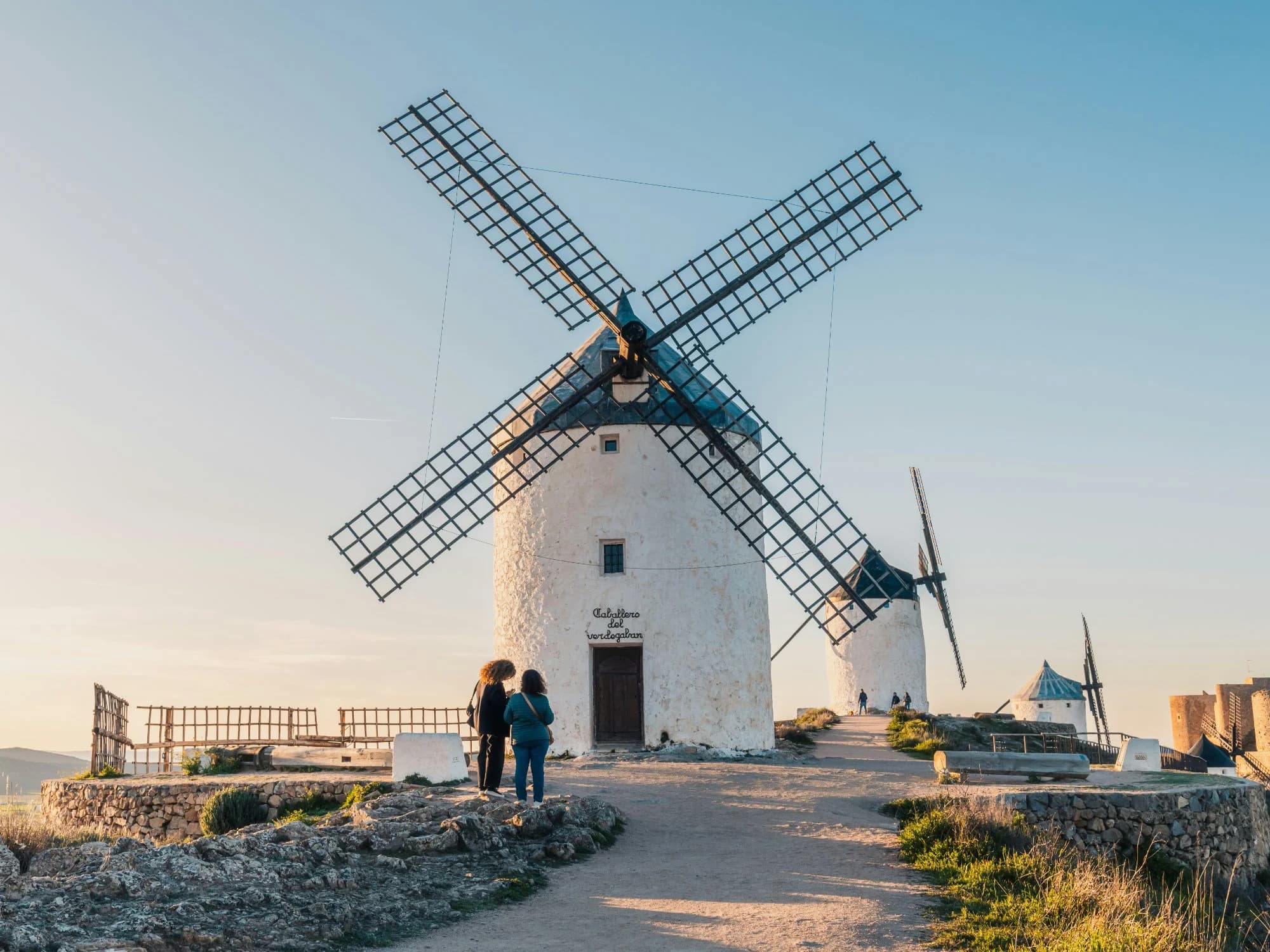
The flat, open plains of La Mancha proper, running through the provinces of Ciudad Real, Albacete, and southern Toledo, form Europe's largest wine-producing region by area. The Denominación de Origen La Mancha covers an enormous expanse of Airén and Cencibel (Tempranillo) vineyards. Luxury stays here align with wine tourism: rural estates, converted farmhouses with serious cellars, and properties that organise access to the production process at a level beyond the standard tour. The silence of the meseta at night, under a sky with minimal light pollution, is a defining sensory quality of this territory.
Albacete and the southeastern corridor
Albacete province connects Castile-La Mancha to the Mediterranean southeast and contains the Lagunas de Ruidera, a chain of natural lakes set into the plateau that provides a counterpoint to the region's predominantly arid character. Properties near this natural area offer a different register of luxury, one oriented toward water, nature, and physical seclusion.
When to visit Castile-La Mancha for a suite stay
The region's continental climate is extreme by European standards. Summers on the meseta are hot and dry, with temperatures in July and August regularly exceeding 35 degrees Celsius. Winters are cold and frequently severe, particularly at altitude. These conditions directly affect the quality and character of a luxury stay.
Spring (April to June) and autumn (September to November) represent the optimal windows. In spring, the plateau blooms with wildflowers and the vineyards begin their growth cycle. Temperatures are moderate, the light is clear, and the cultural calendar is active. Semana Santa (Holy Week) in Toledo is one of the most architecturally and ceremonially significant observances in Spain, drawing visitors who understand its cultural weight. In autumn, the grape harvest across La Mancha wine country runs from September into October, and the landscape takes on a particular warmth of colour. This is also when truffle season begins in the Serranía de Cuenca, a detail of interest to travellers who calibrate their itineraries around gastronomy.
Winter visits to Toledo or Cuenca carry their own logic: fewer visitors, lower rates at top properties, and a certain severity in the light and landscape that has its own aesthetic register. Summer, while challenging climatically, suits travellers who prioritise pool access, outdoor dining, and extended evenings in the Spanish style.
Local luxury standards: what defines a high-end suite in this region
Spain's national hotel classification system operates on a five-star scale, with the Gran Lujo (GL) designation marking the highest official tier. Beyond this, the Spanish government introduced the category of Gran Hotel de Lujo for properties that meet stricter criteria in service, space, and facilities. Several properties in historic cities and rural areas of Castile-La Mancha hold five-star or GL status, though the market here is more intimate than in Madrid or Barcelona.
The most relevant typology for suite travellers in this region is the Parador de Turismo network. Paradores are state-owned hotels housed in historic monuments: castles, convents, monasteries, and palaces. Several Paradores in Castile-La Mancha occupy buildings of genuine architectural significance, including the Parador de Cuenca (a converted Dominican convent suspended above the gorge) and the Parador de Toledo (positioned on the hill opposite the city). While Paradores vary in the refinement of their suite offering, the better properties in this network provide a form of access to historical architecture that private luxury hotels cannot replicate.
Beyond the Parador network, the region's luxury offer is built on converted rural estates (fincas), restored noble houses (casas solariegas), and boutique hotels occupying historic urban buildings. Suite quality in these properties tends to emphasise architectural authenticity, spatial generosity, and material quality over amenity breadth. Spa facilities are less prevalent here than in coastal luxury markets; the emphasis is on the room itself, the view, and the surrounding landscape.
How to choose the right luxury suite in Castile-La Mancha
The decision framework for a suite in this region differs from most European luxury destinations. Several considerations are specific to Castile-La Mancha's geography and offer.
Historical versus contemporary architecture: The region's strongest suit (in the literal sense) is its built heritage. A converted convent room with original stone vaulting, exposed beams, and views over a medieval cityscape represents a form of spatial experience that no contemporary design property can provide. Conversely, a small number of modern rural properties have invested in contemporary architecture that responds to the landscape with precision. Both approaches have merit; the choice depends on whether the traveller is oriented toward historical immersion or landscape minimalism.
Urban versus rural setting: Toledo and Cuenca offer urban luxury within walkable historic centres. Rural properties across La Mancha and the Serranía offer isolation and landscape access. The two experiences are categorically different, and many travellers combine both within a single itinerary.
View orientation: In a region defined by landscape scale, the view from a suite carries significant weight. Properties overlooking Toledo's skyline, Cuenca's gorge, or the open meseta each deliver a different visual register. This is a detail worth verifying before booking.
Gastronomy access: Castile-La Mancha has a serious culinary identity built on game, manchego cheese, saffron (La Mancha produces a substantial share of the world's saffron), and the region's wines. A luxury stay here should ideally connect to this food culture, whether through an in-house restaurant with genuine regional ambition or through proximity to producers and markets.
The value of a curated selection for Castile-La Mancha
Castile-La Mancha is not a region where the luxury hotel market is dense or well-documented in English-language sources. The properties that meet the standards expected by a suite traveller are dispersed across a large geographic area, vary significantly in character and offer, and are not always visible through conventional booking platforms. The risk of a poorly calibrated choice, a five-star designation without corresponding spatial or service quality, is real in this market.
La Suite approaches this territory with the same editorial discipline applied to better-documented luxury markets. The curated selection identifies properties where the suite offer, the architectural context, and the service standard align with the expectations of a traveller who books deliberately. In a region this large and this varied, that filter is not decorative. It is the difference between a memorable stay and a navigational error. The La Suite curated selection for Castile-La Mancha is the starting point for any serious inquiry into luxury suite travel in central Spain.