Where to stay in Extremadura for a luxury suite experience
Cáceres and the northern dehesa
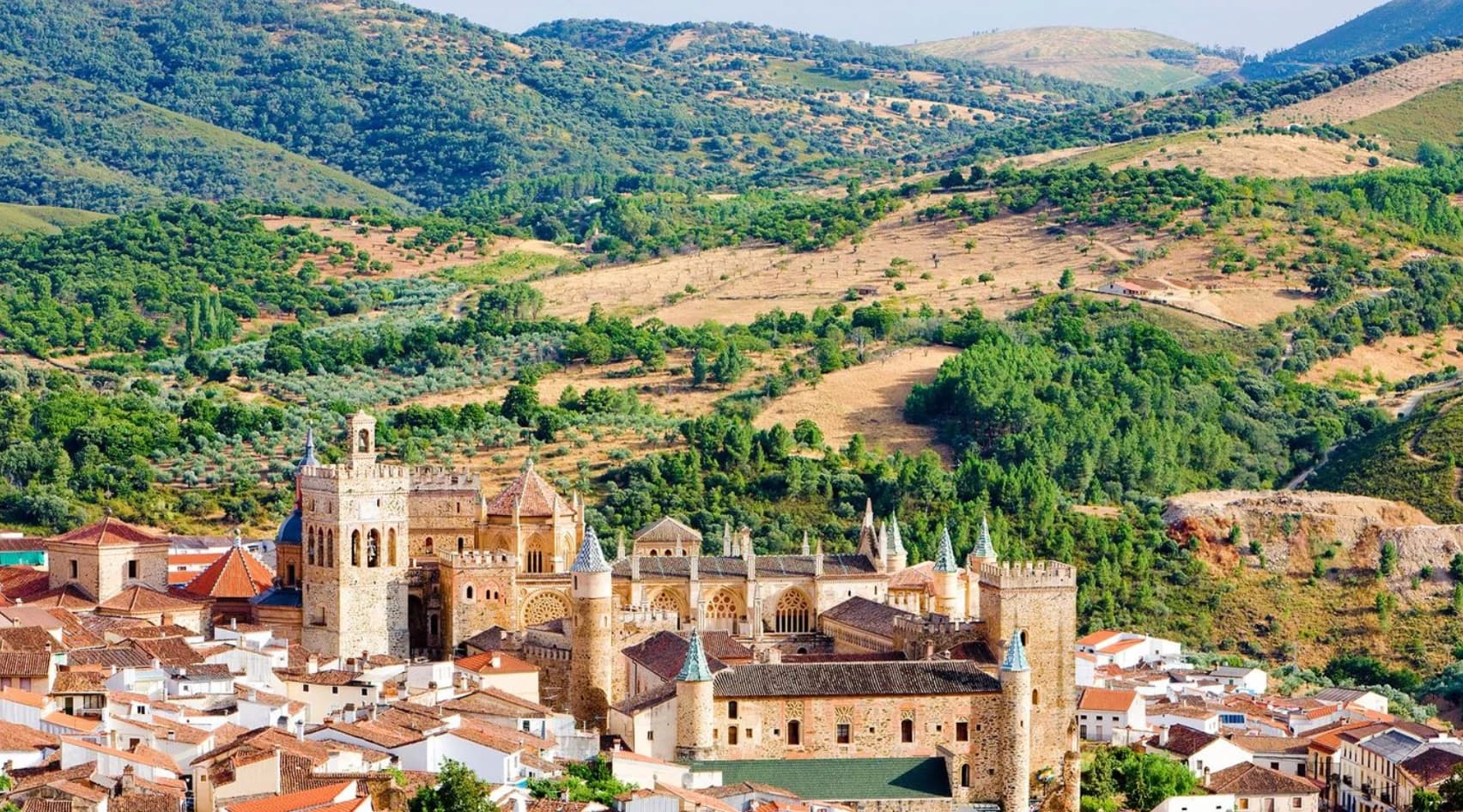
The city of Cáceres contains one of the best-preserved medieval urban complexes in Europe, a UNESCO World Heritage Site where palaces and towers crowd a walled old quarter largely untouched since the 16th century. Hotels positioned within or immediately adjacent to this monumental zone offer direct sensory access to the stonework, the silence, and the scale of a city that reached its apex when Extremaduran adventurers returned from the New World. The surrounding dehesa, a savanna-like ecosystem of holm oaks and cork trees grazed by Iberian pigs, extends north and east, and rural properties set within working estates offer a form of seclusion that is genuinely rare in continental Europe.
Mérida and the Roman south
Mérida was founded in 25 BC as a retirement colony for Roman veterans and became the capital of the province of Lusitania. Its theatre, amphitheatre, aqueduct, and temple are among the most complete Roman remains anywhere on the peninsula. Staying here places you in a city where the archaeology is not decorative but structural: it defines the street plan and the civic identity. Properties near the historic centre allow guests to visit the theatre at night, during the annual Classical Theatre Festival, in circumstances that have no equivalent in more commercialized destinations.
The Jerte Valley and the northeast
The Jerte Valley is known primarily for its concentration of cherry orchards, which produce a spectacle of blossom each spring that draws visitors from across Spain. Beyond the seasonal event, the valley offers mountain terrain, trout streams, and a quieter form of rural accommodation suited to travelers who combine cultural interest with time in a specific natural landscape. Properties here tend toward the intimate and the architecturally vernacular, working with local granite and chestnut wood rather than against them.
Trujillo and the conquistador towns
Trujillo is the birthplace of Francisco Pizarro, conqueror of Peru, and its main square is ringed by Renaissance palaces financed by American silver. The town functions as a set piece of 16th-century Spanish ambition and its scale, compact and walkable, makes it one of the most legible historical environments in the country. Rural properties in the surrounding countryside offer access to this history without the need to stay in a town center.
When to visit Extremadura
Extremadura has a continental-Mediterranean climate with extremes: summers are genuinely hot, with July and August regularly exceeding 38°C in the lowland areas, and winters are cold enough to produce frost across much of the region. The most comfortable periods for travel are spring (March to June) and autumn (September to November).
Spring brings the cherry blossom season in the Jerte Valley, typically in late March, and the landscape of the dehesa is at its most alive with wildflowers and migrating birds. The Mérida Classical Theatre Festival runs through July and August, making those months the principal cultural draw despite the heat. Autumn is the season of the montanera, the period when Iberian pigs are released into the dehesa to graze on acorns before slaughter, a cycle that defines the region's most celebrated food product. Visiting in October or November allows direct observation of this process and access to the fresh ibérico products that follow.
Suite availability is generally strong year-round given the relatively contained scale of luxury accommodation in the region, but spring weekends around the cherry blossom period and the Mérida festival weeks require advance planning.
Luxury standards in Extremadura: what to expect from top-tier suites
Extremadura does not have the concentration of international luxury hotel brands found in Barcelona or Madrid. What it offers instead is a specific typology of high-end accommodation rooted in the region's architectural heritage: the parador, the rural palace conversion, and the working estate property.
The Parador de Cáceres occupies a 14th-century palace within the walled city and represents the Spanish state's Paradores network at its most architecturally serious. Paradores, as a category, are state-operated hotels installed in historic monuments: castles, convents, monasteries, and palaces. In Extremadura, this model produces properties where the suite experience is inseparable from the physical structure of the building. Stone vaulting, interior courtyards, and medieval masonry are the context, not the decoration.
Private palace conversions and rural estate hotels (known locally as hoteles rurales de lujo) form the second category. These properties are typically smaller, often family-operated, and calibrated toward guests who value privacy and direct access to the landscape over the services of a large hotel. Suites in these properties are frequently defined by their orientation, their relationship to a courtyard or garden, and the quality of local materials used in their construction.
Expect suite amenities to be precise rather than excessive: high-quality Iberian textiles, locally sourced materials, and a considered relationship between interior and exterior. The food and beverage proposition at top properties will typically draw on the region's exceptional raw ingredients: jamón ibérico de bellota, Torta del Casar cheese, Extremaduran olive oils, and wines from the Ribera del Guadiana denomination.
How to choose the best suite in Extremadura
The first consideration is the type of experience you are optimizing for. Extremadura offers two fundamentally different suite contexts: the urban historical (Cáceres, Mérida, Trujillo) and the rural estate. These are not interchangeable. Urban suites place you inside the architectural history of the region, with immediate walking access to monuments and restaurants. Rural suites place you in the landscape, with the dehesa or the valley as your primary environment and a degree of self-sufficiency required.
The second consideration is season and what it unlocks. A suite in the Jerte Valley in late March is a very different proposition from the same suite in August. A property near Mérida's Roman theatre is most meaningful during the festival weeks. Matching the suite to the seasonal moment is as important as the property itself.
The third consideration is scale. Extremadura's luxury properties tend to be small. A suite in a converted palace may share the building with fewer than a dozen other rooms. This produces a level of quiet and personal attention that larger properties cannot replicate, but it also means that full buyouts and private arrangements are genuinely available options for those who require absolute discretion.
Why a curated selection by La Suite makes sense in Extremadura
Extremadura is a region where the volume of self-described luxury accommodation significantly exceeds the number of properties that actually deliver at the level expected by a discerning traveler. The market includes a range of rural hotels that present well photographically but fall short in construction quality, service consistency, or suite-specific design.
La Suite applies a consistent editorial standard to its selection process, evaluating properties on spatial quality, architectural integrity, service caliber, and the coherence of the suite experience as a whole. In a region like Extremadura, where marketing imagery can be compelling and independent verification is limited, this curation function has direct practical value. The properties featured in our selection have been assessed against the same criteria applied across every destination on the platform, from the Alentejo to Kyoto.
For the traveler approaching Extremadura as a serious destination rather than a detour, the La Suite selection provides a navigable shortlist of properties that warrant the investment of time and money.