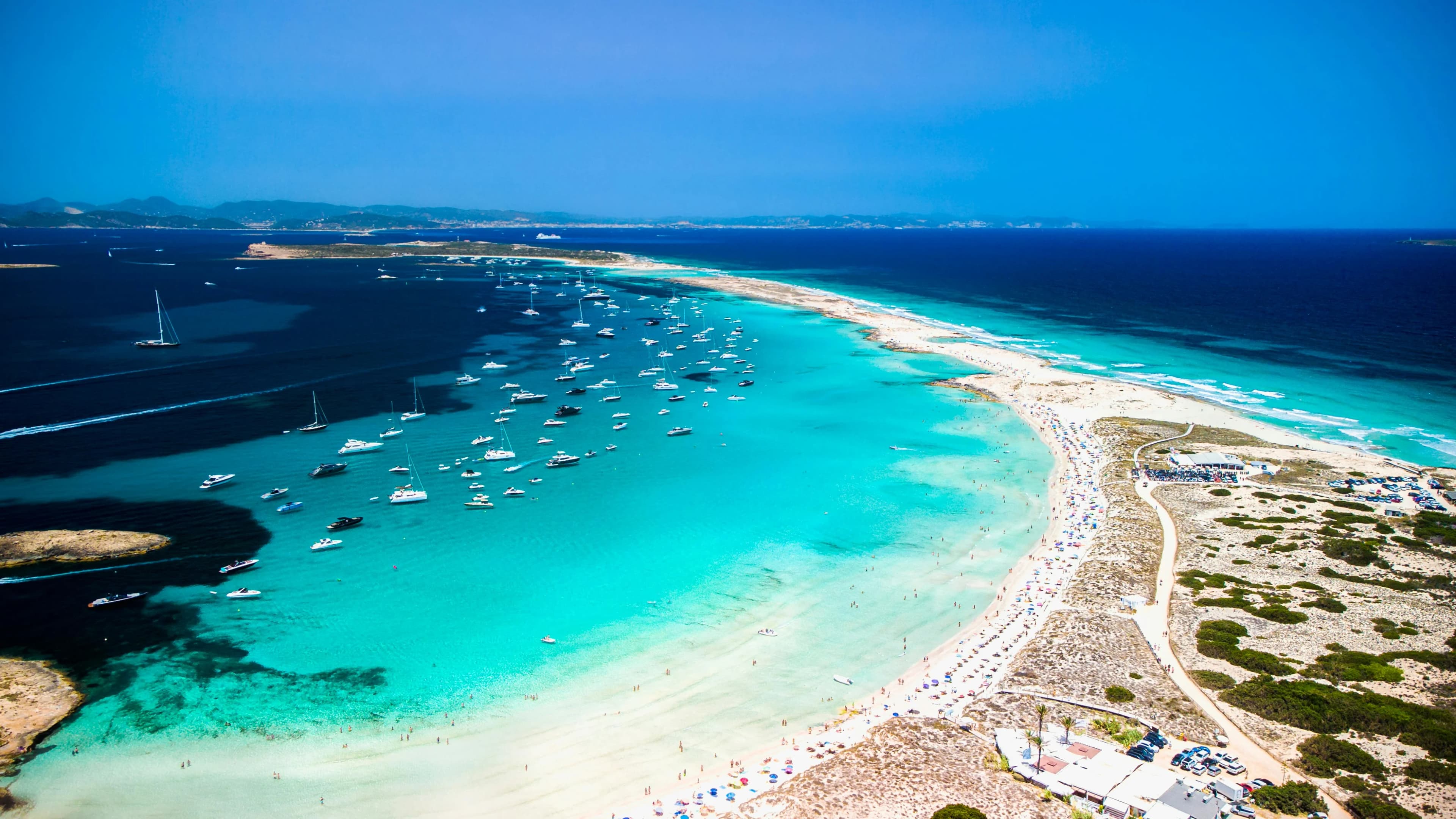
The distinct areas of Formentera for a luxury stay
The northern coast, around Es Pujols and the lagoon area of Estany Pudent, offers the most accessible shoreline with a gentle, low-key social energy. Accommodation here tends to position guests within reach of the island's most trafficked beaches without sacrificing the silence that defines Formentera after sunset.
The central plateau, La Mola, rises abruptly at the island's eastern end and operates at an entirely different register. The light here is harder, the air drier, and the landscape takes on an almost Castilian austerity. Staying in or near La Mola means orienting around panoramic views, artists' studios, and a weekly market that has attracted a culturally specific crowd since the 1970s.
Sant Francesc Xavier, the administrative capital, is where the island's modest civic life concentrates: a whitewashed church, a handful of serious restaurants, and galleries that operate with quiet confidence. Suites in this zone tend to occupy restored finca properties, offering a more grounded, architectural experience of the island.
The southern tip, Cabo de Barbaria, is the most isolated sector. A lighthouse marks the edge of the land. Staying near here means accepting a genuine remove from services, which for certain travelers is precisely the point.
When to visit Formentera for a luxury hotel stay
The island's season compresses into a narrow window. July and August represent peak demand, and availability in better properties requires planning several months in advance. The crowds during these weeks are real: the ferry from Ibiza brings day visitors in significant numbers, and the most famous beaches, particularly Ses Illetes, can feel oversubscribed by midday.
June and September represent the considered traveler's window. Water temperatures remain high, the light retains its Mediterranean intensity, and the island returns to a pace that allows genuine engagement with its landscape. Restaurants operate at full capacity but without the logistical strain of high summer.
May and early October offer a more austere version of the experience. Some smaller properties close, but those that remain open typically offer their most interesting rates and their most attentive service. The beaches are effectively private. The island's pinewood paths and salt flats become navigable without the heat of summer.
There are no major luxury calendar events in the conventional sense. Formentera's draw is elemental, not event-driven. The cultural pull is the landscape itself, the quality of the sea, and an architectural tradition that values simplicity as a form of precision.
Local luxury standards: what to expect from top-tier suites in Formentera
Formentera does not follow the conventional luxury hotel playbook. There are no Palace-designated properties here. The island's accommodation culture operates through a different vocabulary: the small boutique hotel, the restored finca, the design-led rural property with a limited number of rooms and a considered aesthetic position.
What this means in practice is that luxury in Formentera is almost always architectural and environmental rather than service-intensive in the traditional sense. The finest suites on the island tend to prioritise natural materials (local stone, untreated wood, hand-thrown ceramics), direct access to outdoor space, and an integration with the landscape that larger resort hotels cannot replicate.
Many of the most respected properties operate on adult-only or couple-oriented models, reinforcing the privacy that the island's clientele consistently ranks as a primary consideration. Air conditioning, private pools, and outdoor shower facilities have become baseline expectations in the upper tier.
The spa culture is less developed here than in Ibiza or Mallorca. What replaces it is a reliance on the island itself as the restorative agent: the sea, the pinewood air, the quality of silence after dark. Properties that understand this balance their amenities accordingly.
How to choose the right luxury suite in Formentera
The first question is architectural. Formentera's best properties divide broadly between restored traditional structures (whitewashed walls, low ceilings, thick stone construction that manages heat passively) and contemporary builds that use the island's topography as a design element. Both are valid. The choice depends on whether a traveler prioritises historical texture or spatial modernity.
The second question is proximity to water. Formentera's coastline is its primary asset, but not all coastal positions are equal. The northwestern beaches offer calmer, shallower water ideal for families or longer immersions. The eastern and southern coasts are more exposed and carry a different energy, more solitary and less serviced.
The third consideration is scale. Formentera rewards properties with a limited room count. A suite within a twelve-room hotel operates very differently from a suite within a sixty-room resort. The former typically offers a more direct relationship with the owners, more flexible meal arrangements, and a more consistent aesthetic throughout the property.
Finally, consider connectivity. Despite its positioning as a retreat destination, Formentera is easily reached from Ibiza by ferry in approximately thirty minutes. Properties near the La Savina ferry port offer convenience for those combining both islands. Properties at the far reaches of the island (La Mola, Cabo de Barbaria) require a vehicle and a genuine commitment to isolation.
Why a curated selection by La Suite matters here
Formentera's accommodation landscape is deliberately small. The total number of hotel beds on the island is subject to strict regulatory limits imposed by the Balearic government, which has consistently prioritised environmental preservation over tourism expansion. This creates a market where the difference between a genuinely exceptional suite and a merely adequate one is not always visible from standard booking platforms.
La Suite operates from direct knowledge of the properties it lists. The curation process considers not only the physical suite but the overall property ethos, the consistency of the guest experience across seasons, and the alignment between what a property presents and what it actually delivers. In a destination as small and as specific as Formentera, this granularity matters considerably.
For the traveler arriving with limited nights and precise expectations, a curated selection by La Suite removes the research burden and positions the stay from the first night as an intentional choice rather than a calculated risk.