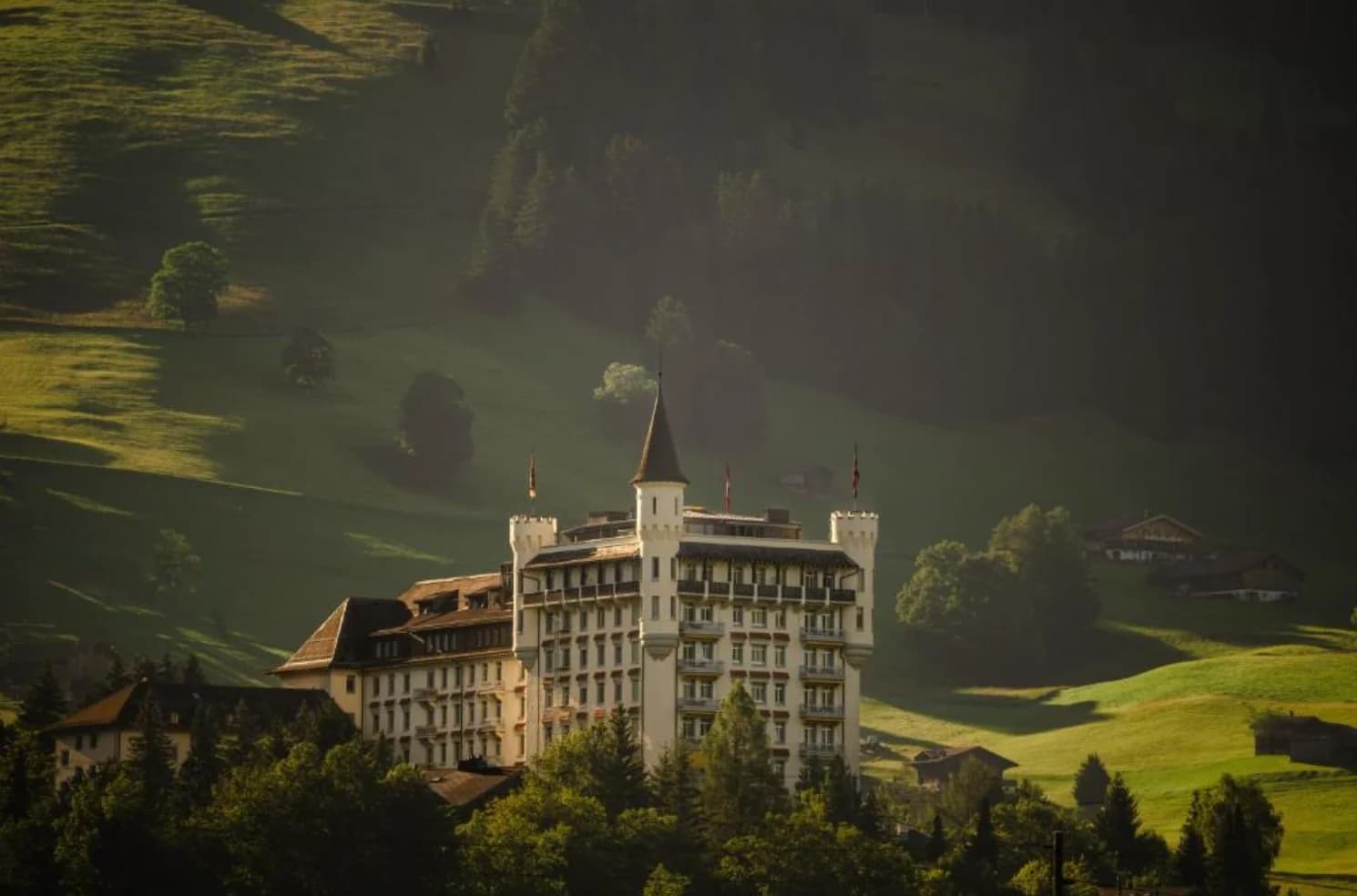
Understanding Gstaad as a luxury destination
Areas and orientations within the Gstaad region
The village core
The Promenade, Gstaad's central pedestrian axis, concentrates the highest density of couture boutiques, private banks, and restaurant addresses in the region. Staying in or immediately adjacent to the village core places guests within walking distance of this infrastructure. Suites in this zone tend to occupy historic chalet structures or modern interpretations of them, and the premium is paid for proximity and convenience as much as for the rooms themselves.
The surrounding hamlets
Saanen, Schönried, Rougemont, and Lauenen each sit within the broader Gstaad municipality or its immediate orbit. These hamlets offer a quieter residential character, with mountain views that are uninterrupted by commercial activity. Luxury properties in these locations typically command larger footprints, with suites that open onto private terraces facing the Bernese Alps. The trade-off is a short transfer to the village, which for many guests is not a compromise but a preference.
The elevated positions
Certain properties in the Gstaad area are positioned at altitude, accessible by road or gondola, and oriented toward the ski infrastructure of Eggli, Wispile, or the broader Glacier 3000 network. Suites at elevation offer direct slope access in winter and trail access in summer. The sensory experience of waking above the valley floor, with a view corridor that extends toward the Diablerets massif, is materially different from a village-level stay.
When to visit Gstaad
Winter season
The primary season runs from mid-December through late March. Suite availability at the most sought-after addresses compresses significantly around Christmas, New Year, and the last week of January, when the Gstaad Menuhin Festival's winter edition and the Palaces Cup polo-on-snow event draw an internationally recognisable crowd. Booking windows for peak weeks often extend twelve to eighteen months in advance at the top properties. Mid-January and early March offer the same snow conditions with considerably more flexibility.
Fancy going skiing in Switzerland? Check out our article on the most beautiful suites in Gstaad and Zermatt!
Summer season
July and August constitute a genuine second season. The hiking network covering the surrounding peaks is extensive and well-maintained. The Gstaad Menuhin Festival, one of Europe's oldest classical music festivals held under canvas, runs through August and serves as the cultural anchor of the summer calendar. Suite rates in summer often sit below winter peaks, and the quality of light, the green of the valley, and the relative quiet make a compelling case for those who consider Gstaad beyond its ski identity.
Shoulder periods
April, May, October, and November are off-season by most accounts. Some properties close entirely during these months. Those that remain open offer reduced rates and near-total privacy. The landscape in late autumn, before snow, has a spare quality that suits a particular kind of traveller.
Swiss luxury standards and what they mean in Gstaad
Switzerland does not operate a Palace hotel designation in the formal sense that France does, but the Swiss Hotel Association's five-star superior classification functions as an equivalent signal. Properties carrying this designation in Gstaad have been assessed against criteria that include suite dimensions, staff-to-guest ratios, and service protocol depth. What this means practically is that a luxury hotel suite at this tier will typically include a separate living area of meaningful scale, a bathroom with double fixtures and freestanding elements, and a dedicated butler or floor service structure.
Beyond classification, Gstaad's top-tier properties are distinguished by their ownership model. Several of the leading addresses are family-controlled and have been for generations. This continuity shapes everything from the art on the walls to the way front-of-house staff are trained. The result is an institutional memory that no recently converted property can replicate. For the traveller who values consistency and recognition, this matters significantly.
How to choose the right luxury suite in Gstaad
The first filter is seasonal purpose. A suite designed for ski season, with boot rooms, drying infrastructure, and direct mountain access, serves a different function than one configured for summer hiking or cultural attendance. Confirm that the property's operational model aligns with the dates in question, since some Gstaad hotels close between seasons or operate in reduced-service mode.
The second filter is scale. Gstaad's finest suites range from compact junior configurations of around 50 square metres to full floor plans exceeding 200 square metres. If the stay involves multiple adults, children, or the need for genuine separation between sleeping and working space, the floor plan matters as much as the address.
The third filter is orientation. A suite facing south will receive direct alpine light from morning through afternoon. A north-facing room may photograph better in summer but will feel cooler and darker in winter. Ask for floor plans and compass orientation before confirming.
Practical note: Gstaad is not served by a direct train from Geneva or Zurich. The journey involves a change at Zweisimmen or Montreux on the Montreux-Oberland-Bernois (MOB) railway. Transfer by private car from Geneva airport takes approximately ninety minutes. Factor this into logistics when comparing properties at different positions within the valley.
Why curation matters in a market this concentrated
The Gstaad luxury hotel market is small by design. There are only a handful of properties that genuinely operate at the level this destination's clientele expects. The challenge for the traveller is not finding a hotel in Gstaad but identifying which specific suite configuration, at which property, for which dates, represents the correct decision for a particular trip profile. La Suite's curated selection for Gstaad is built on that granular logic: not a list of hotels, but a filtered view of the suites that perform against specific criteria of space, service, and contextual fit. For a destination where the margin between the right choice and the wrong one is narrow, that level of editorial precision is the point.