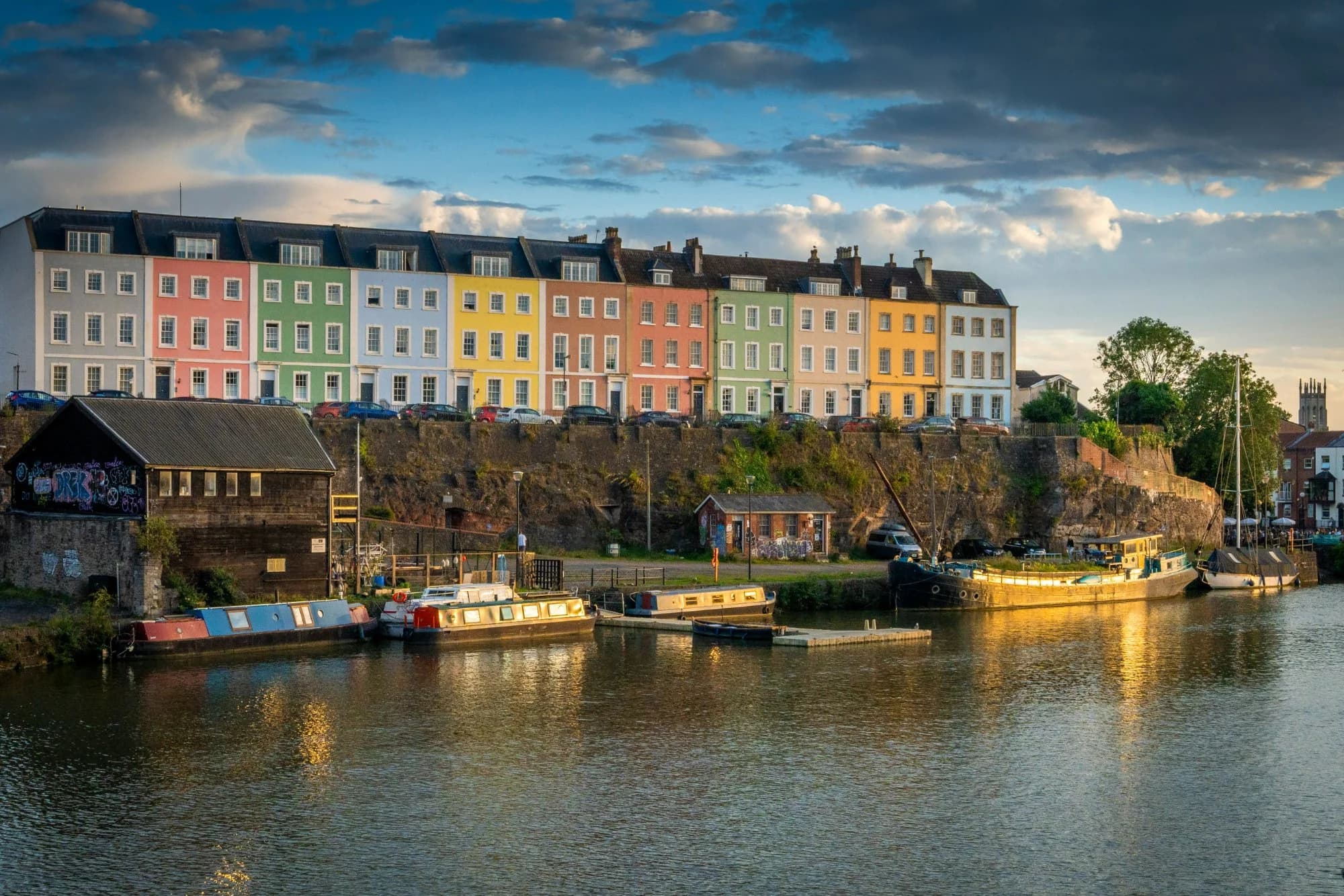
Bristol's distinct neighborhoods and where to stay
Clifton remains the city's most formally prestigious address. The Georgian and Regency terraces here were built for the merchant class that profited from Bristol's maritime trade. Today, the area retains a residential density of independent retailers, private members' institutions, and cultural venues that makes it quietly self-contained. Proximity to the Clifton Suspension Bridge, Isambard Kingdom Brunel's 1864 structure spanning the Avon Gorge, gives the neighborhood a landmark that functions as genuine urban infrastructure rather than tourist decoration.
The Harbourside district occupies the former working docks and has undergone sustained architectural transformation over the past three decades. The mix of converted warehouses, contemporary cultural institutions, and waterfront public space gives this area a texture that appeals to design-literate visitors. The M Shed, housed in a former transit shed on Princes Wharf, and the Arnolfini contemporary arts centre anchor the cultural offer at the waterfront level.
Stokes Croft and the St Pauls area to the northeast represent a different register entirely: denser, more provisional, and directly associated with Bristol's reputation for independent visual culture. This is the territory most closely associated with the city's global reputation in street art, with works that have accumulated on its walls since the early 1980s. For visitors whose priorities extend beyond conventional luxury markers, this part of the city offers a legitimate counterpoint to Clifton's formality.
When to visit Bristol for a luxury stay
Bristol's Atlantic-facing climate means that weather patterns are more moderate than those of eastern England but also less predictable. The city receives more rainfall than London on average, and travelers planning extended outdoor exploration should account for this without treating it as a deterrent. The quality of light on overcast days along the Avon Gorge is, by several measures, more architecturally interesting than its equivalent in direct sun.
The period from late May through September offers the most reliable conditions for outdoor activity and the highest concentration of cultural programming. Bristol Harbour Festival, held each July, is the city's largest free outdoor event and draws significant visitor numbers to the waterfront. The Bristol International Balloon Fiesta, staged at Ashton Court in August, has been running since 1979 and remains one of Europe's largest hot air balloon events. Both affect hotel availability materially, and advance planning is recommended for suite-level bookings during these windows.
The autumn and winter months offer a different kind of Bristol: quieter, more locally inhabited, and in some respects more revealing of the city's actual character. The independent restaurant scene, which has consistently rated Bristol among the UK's strongest outside London, operates at full capacity year-round. A winter stay in a well-positioned luxury suite, with the city less populated by day visitors, is a genuinely different proposition from a summer weekend.
Luxury standards and what to expect from Bristol's top hotel suites
Bristol does not operate within the formal prestige classification system that governs the French hotel market, where the Palace designation signals a specific standard above five stars. The UK market uses a combination of AA stars, Visit England quality assessments, and the informal but functionally significant Small Luxury Hotels of the World affiliation for independent properties.
What distinguishes the best luxury hotel suites in Bristol from those in London or Edinburgh is a particular relationship between the building's history and its current interior language. The city's most considered hotels tend to occupy buildings with genuine historical specificity: former banking halls, converted Victorian civic structures, or Georgian townhouses in Clifton. The architectural fabric of these spaces shapes the suite experience in ways that purpose-built luxury hotel blocks rarely achieve.
Guests should expect suites at the top end of the Bristol market to offer substantial floor areas by UK city hotel standards, with the kind of material quality, natural light, and service discretion that justifies their positioning. The city's independent hotel culture means that the best properties here often function with a degree of personality and editorial point of view that distinguishes them from the chain-operated luxury tier.
How to choose the best luxury suite in Bristol
The primary choice for suite-level travelers in Bristol is between position and atmosphere. Clifton-based properties offer proximity to the gorge, the suspension bridge, and the city's most formally residential environment. Harbourside properties offer direct waterfront access, stronger architectural drama in the converted-warehouse idiom, and a shorter walk to the city's most active cultural institutions.
For stays of more than two nights, the question of walkability is meaningful. Bristol's topography is unusually steep for a British city of its size, and the relationship between neighborhoods is not always intuitive on foot. A suite positioned in Clifton places guests within walking distance of the village but requires transport to reach the Harbourside. The inverse applies to waterfront properties. Understanding this geography before committing to a specific hotel is a practical consideration at the planning stage.
Travelers with a specific interest in design and architecture should pay close attention to the building type and period of any property under consideration. Bristol's most interesting suite accommodation tends to be found in buildings that have absorbed the city's commercial and civic history, and the quality of that conversion is not uniform across the market.
Why a curated selection matters in Bristol
Bristol's hotel market is smaller in absolute terms than London or Edinburgh, but it is also more variable in quality within the luxury tier. The city's independent culture has produced a number of properties that position themselves at the high end without consistently delivering the spatial standards, material quality, and service calibration that suite-level travelers expect. The gap between marketing language and actual product is, in some cases, significant.
A curated selection by La Suite applies a consistent editorial standard across the Bristol market, filtering for the properties that genuinely deliver on the core requirements: suite-level space, privacy, material finish, and a considered relationship with the city's identity. For travelers who have limited time and specific expectations, this curation removes the research burden and provides a reliable shortlist. Bristol rewards the right choice of accommodation. The curated selection by La Suite ensures that choice is made with precision.