Understanding Bahrain's luxury geography
Manama and the financial district
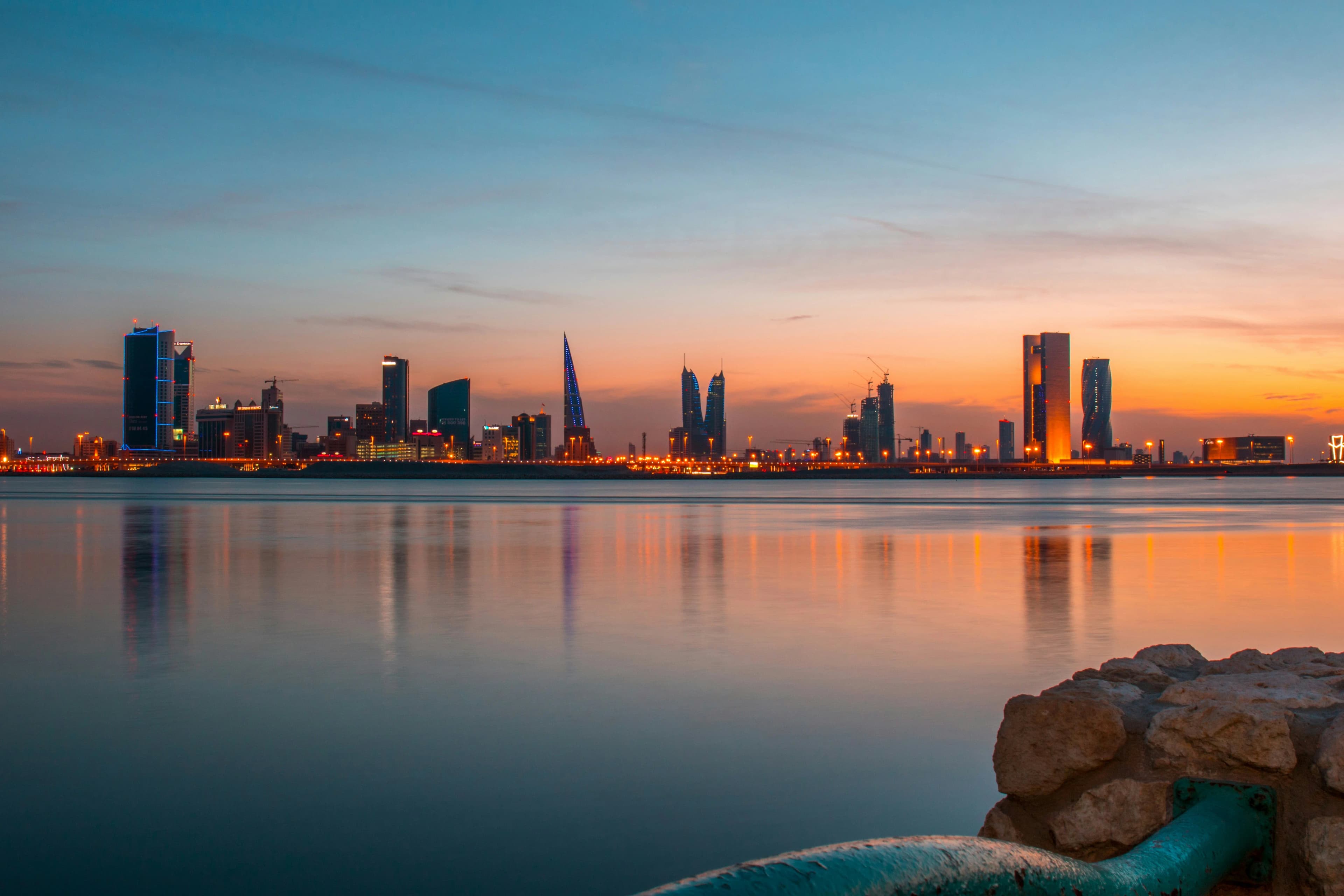
The capital concentrates the majority of Bahrain's internationally branded luxury hotels. The financial district and the Bahrain Bay development deliver high-floor suites with unobstructed views across the Gulf. This is the corridor for corporate travel at the highest tier, where suites are designed around discretion, connectivity, and the kind of spatial quiet that active schedules demand. The proximity to the Bahrain World Trade Center and the diplomatic quarter makes this zone the default choice for government and executive visits.
Amwaj Islands and the northern coast
The Amwaj Islands, a reclaimed archipelago in the northeast of the country, represent a different register of Gulf luxury. Properties here are oriented around private beach access, marina frontage, and the relative seclusion that artificial island development can provide. The northern coastline, from Muharraq toward the causeway, holds a mix of resort-format hotels and smaller boutique properties, with suites that prioritize outdoor terraces and direct water proximity over urban convenience.
Muharraq and the cultural corridor
Muharraq, Bahrain's second city and the original seat of the Al Khalifa ruling family, carries the country's most intact historic urban fabric. The Muharraq pearling trail is a UNESCO World Heritage Site. Staying in this corridor, or choosing a suite in Manama with direct access to it, changes the texture of a Bahrain visit substantially. The architectural vocabulary here is wind-tower vernacular, courtyard houses, and narrow limestone streets, a counterpoint to the tower-glass aesthetic of the financial district.
When to visit Bahrain for a luxury suite stay
Bahrain's climate follows a Gulf pattern: winters are mild and entirely manageable, summers are severe. The practical luxury travel window runs from October through April, when daytime temperatures remain between 17 and 28 degrees Celsius and outdoor terraces, pool access, and coastal proximity become genuine amenities rather than theoretical ones.
The Bahrain Grand Prix, held annually at the Bahrain International Circuit in Sakhir, typically takes place in late February or early March. During race weekend, suite inventory across the capital and the northern coast compresses sharply and rates adjust accordingly. Travelers prioritizing the Grand Prix experience should treat suite booking as a logistical priority, not an afterthought. The same applies to the Bahrain International Airshow, which operates on a biennial schedule.
Ramadan, which shifts annually through the Islamic calendar, alters the rhythm of the country in ways that luxury travelers should account for. Restaurants, bars, and hotel facilities observe modified hours. For travelers with a specific interest in Bahraini cultural life and the particular atmosphere of the holy month, it can represent a rewarding period. For those whose suite stay is anchored in spa access, evening dining, or consistent service hours, the shoulder periods immediately before or after Ramadan tend to offer better conditions.
Local luxury standards: what defines a top-tier suite in Bahrain
Bahrain does not operate a formal national classification system equivalent to France's Palace designation, but the international luxury brands present in the market apply their own tier standards rigorously. The country's top-performing suites sit within the flagship properties of global groups and tend to be rated against the group's global portfolio rather than local benchmarks alone.
Several distinguishing features characterize the best suites in Bahrain. Spatial scale is significant: Gulf luxury hospitality has historically competed on floor area, and Bahraini properties reflect this. Corner suites and presidential-level inventory regularly exceed 150 square meters. Views are a primary currency: suites oriented toward the Arabian Gulf, the Bahrain Bay basin, or the King Fahd Causeway carry a premium that is architecturally justified.
Butler service is near-universal at the top tier. The quality of in-suite dining, the responsiveness of private check-in, and the degree to which a suite can be operated as a self-contained residence are reliable differentiators between properties that perform at the international luxury standard and those that approximate it.
Bahrain also sits within a short flight of major Gulf hubs, which means the country's luxury hotels serve a significant transit and layover market from Riyadh, Kuwait City, and Dubai. The best suites are accordingly calibrated for short, intensive stays as much as for extended leisure travel.
How to choose the right luxury suite in Bahrain
The first distinction to make is between urban-format and resort-format properties. Urban suites in Manama's financial district offer walking access to galleries, souqs, and the National Museum, but sacrifice outdoor space and beach access. Resort-format suites on the northern coast or the Amwaj Islands invert that trade-off. Neither is objectively superior; the choice depends on how the traveler intends to use the suite as a base.
The second consideration is elevation and orientation. In Bahrain's high-rise properties, the difference between a mid-floor suite and a top-floor suite is not merely symbolic. Gulf haze and coastal light behave differently at altitude, and the quality of the water view from the upper floors of a Manama tower is a materially different experience from street level.
Third, travelers interested in Bahraini cultural programming should specifically ask about access to Muharraq, the Qal'at al-Bahrain archaeological site, and the Bahrain National Museum. Some properties have dedicated cultural concierge arrangements; others do not. For design-literate travelers, the Tree of Life, an ancient prosopis tree surviving alone in the southern desert, and the Al Fateh Grand Mosque are worth factoring into any itinerary built around sensory and architectural discovery.
Finally, the question of alcohol service is relevant in Bahrain in a way that differs from neighboring Saudi Arabia. Bahrain permits alcohol at licensed hotels and restaurants, and the best suites include minibar and in-suite dining service that reflects this. Travelers who have visited dry Gulf states and carried assumptions from that experience should note the distinction.
Why curated selection matters in Bahrain
Bahrain's luxury hotel market is smaller in absolute terms than Dubai or Abu Dhabi, but it is not simple to navigate. The gap between a property that markets itself as luxury and one that performs at that standard in practice is significant, and the absence of a local classification framework means the signal value of a brand name or a star rating is limited without contextual knowledge.
La Suite curates suites in Bahrain against a consistent set of spatial, experiential, and service criteria. The goal is to remove the interpretive work from the traveler's decision process and surface only the inventory that genuinely meets the standard. In a market where suite quality varies more than headline rates suggest, that curatorial function is not decorative. It is structural.