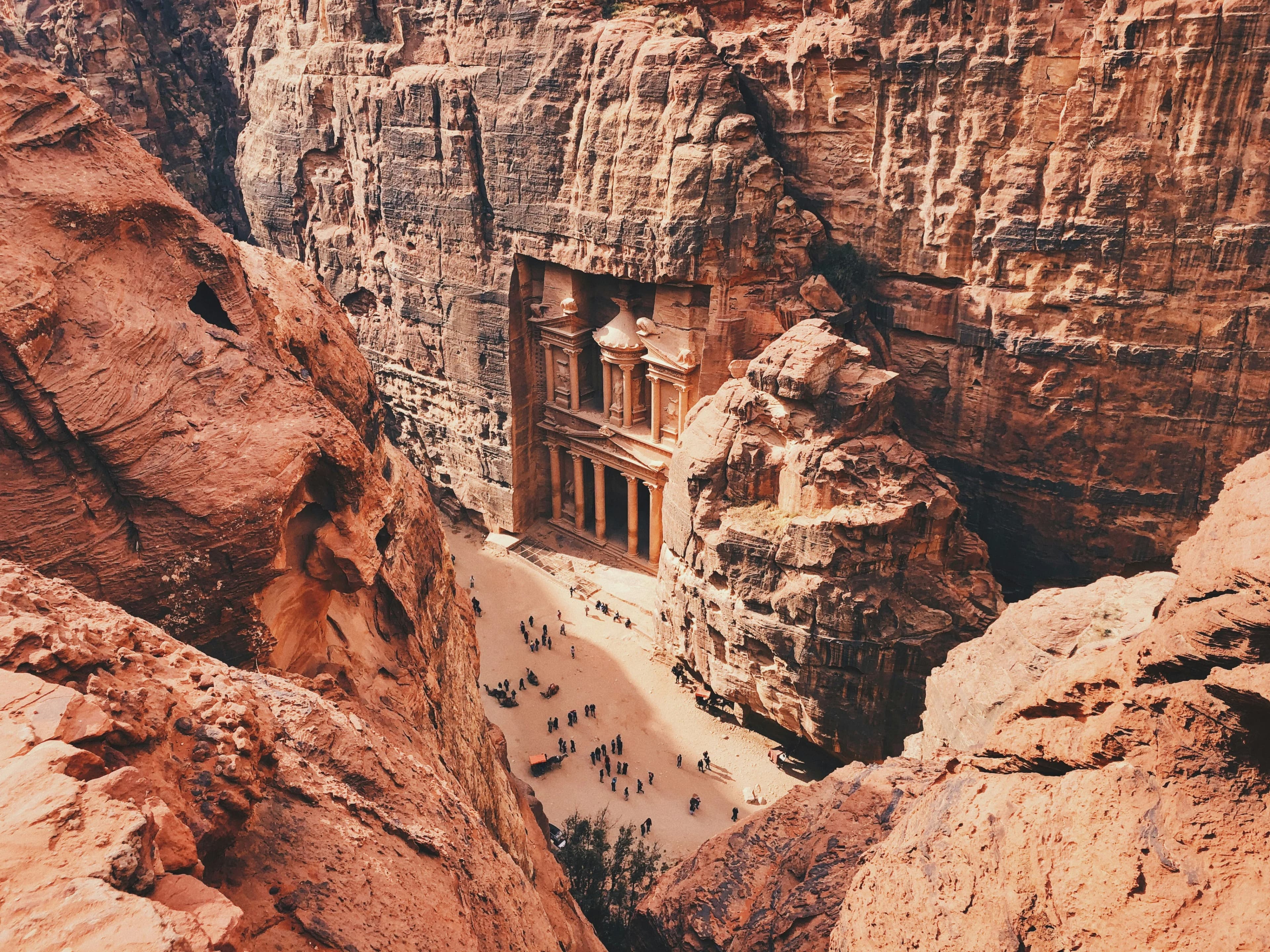
Where to stay in Jordan: distinct territories for luxury travel
The Dead Sea shore
The Dead Sea coastline sits at the lowest point on Earth, approximately 430 metres below sea level. The atmosphere here is dense with minerals, the light is particular, and the landscape has a quality of compressed silence that is unlike anywhere else in the region. Properties along the Jordanian shore of the Dead Sea are typically resort-format, with suites designed to face the water and maximise the sensory experience of the environment. This is the axis of the country's most established luxury hotel infrastructure, with a concentration of large-scale properties that have invested significantly in spa programming, given the therapeutic reputation of the water and mud.
Wadi Rum and the desert south
Wadi Rum is a protected desert wilderness of red and orange sandstone formations, vast silence, and a scale that recalibrates the senses. Luxury accommodation here takes a very different form from the resort model: tented camps with architecturally refined interiors, private terraces facing open desert, and a near-total absence of urban interference. The experience of a luxury suite in Wadi Rum is one of controlled immersion. The best properties maintain the elemental quality of the landscape while providing the precise conditions, temperature, lighting, linen, and service, that distinguish a curated stay from basic desert camping.
Aqaba and the Red Sea coast
Aqaba is Jordan's only coastal city and its single access point to the Red Sea. The coral reefs here are among the most accessible in the region, and the city has attracted a growing portfolio of upscale properties catering to divers, leisure travelers, and those transiting between Jordan and the Sinai Peninsula. Suite offerings in Aqaba tend toward the contemporary, with an emphasis on sea-facing terraces and proximity to the marine reserve.
Amman and the urban interior
Amman functions as the country's cultural and commercial capital. Its luxury hotel scene is concentrated in the western districts, particularly Abdoun and Sweifieh, and has matured significantly over the past decade. The city offers a different register of luxury: urban, architectural, and calibrated to the demands of business travelers and cultural visitors exploring the capital's gallery scene, restaurant culture, and proximity to archaeological sites such as Jerash and Madaba.
When to visit Jordan for a luxury suite stay
Jordan's climate makes timing a meaningful consideration. The country experiences four distinct seasons, and the quality of the experience shifts significantly between them.
Spring, running from March through May, is widely considered the most rewarding period. Temperatures are moderate across all regions, the desert landscape carries traces of vegetation after winter rains, and Petra is walkable without the heat stress of summer. Availability at leading properties is highest in spring, but so is demand, particularly around the Easter and Eid holiday periods.
Autumn, from September through November, mirrors spring in its climatic quality and is increasingly favored by experienced travelers who wish to avoid the peak crowds of spring. The Dead Sea resorts are particularly well-suited to autumn visits, when the water temperature remains warm and the surrounding landscape takes on a golden quality in the late afternoon light.
Summer, from June through August, brings extreme heat to the desert and Jordan Valley regions, with temperatures in Wadi Rum and the Dead Sea regularly exceeding 40 degrees Celsius. This period is less suitable for outdoor exploration but can work well for travelers whose primary interest is the Dead Sea itself or Aqaba's marine environment, provided the suite offers reliable climate control and private outdoor space.
Winter is mild in Amman and occasionally cold in the highlands, with the possibility of snow at Petra. The low season from December through February offers competitive rates at many properties and significantly reduced visitor numbers at archaeological sites.
Luxury standards in Jordan: what to expect from top-tier suites
Jordan's luxury hotel sector is anchored by a handful of internationally affiliated five-star properties alongside a growing number of independent boutique hotels that have invested in genuinely distinctive design approaches. There is no formal national designation equivalent to France's Palace classification, but the market is stratified in practice, and the gap between a five-star resort and a genuinely exceptional suite experience is meaningful.
At the upper end, suites in Jordan's leading properties typically feature private terraces or plunge pools, butler service, locally sourced stone and textile detailing, and access to hammam or Dead Sea treatment facilities. The better properties source regional craft elements, Jordanian ceramics, handwoven textiles from the south, and architectural references to Nabataean or Mamluk heritage, to ground the interior experience in place rather than generic international luxury.
Service culture in Jordan's top-tier hotels is notably warm without being intrusive. Jordanian hospitality (known locally as karam) places a genuine cultural weight on the quality of welcome, and this translates into a style of suite service that is attentive and personal without the formality of, for example, a European Palace hotel.
How to choose the right luxury suite in Jordan
The choice of suite in Jordan depends primarily on the purpose and rhythm of the trip. Several practical considerations apply specifically to this destination.
For travelers combining Petra, Wadi Rum, and the Dead Sea in a single itinerary, the question of suite continuity matters. Moving between very different property types (desert camp, Dead Sea resort, city hotel) requires advance planning and, ideally, a curated selection that ensures consistent quality across formats. The contrast between a tented luxury suite in Wadi Rum and a cliff-facing suite above the Dead Sea is part of the journey's architecture, but the quality baseline must hold across both.
Views and orientation are particularly consequential in Jordan. A suite facing the Dead Sea at sunrise and another facing open desert at dusk are fundamentally different sensory experiences. Checking the precise orientation and floor level of a suite before confirming is not pedantry; it is the difference between an exceptional stay and a merely comfortable one.
Privacy is also a structural consideration. Jordan is a popular group-travel destination, and larger resort properties on the Dead Sea can feel crowded during peak periods. Suites with private pool access or dedicated outdoor terraces offer meaningful insulation from the communal areas.
Why a curated selection matters in Jordan
Jordan's luxury accommodation market is smaller than those of comparable destinations in the region, but it is uneven in quality. The category of five-star hotel here covers a wide range of actual experiences, from internationally managed resorts with genuine design investment to properties that carry the rating without the corresponding attention to suite experience.
La Suite applies the same editorial standard to Jordan that it applies globally: only properties where the suite itself, its architecture, its service logic, its sensory environment, meets a defined threshold are included in the curated selection. For a destination where the number of genuinely exceptional options is limited, this specificity is particularly valuable. A traveler arriving in Jordan for the first time, or returning with higher expectations, does not need a long list. They need the right one. That is what the curated selection by La Suite is built to provide.