Where to stay in Qatar: distinct territories for luxury suite travelers
Doha's West Bay and the corniche corridor
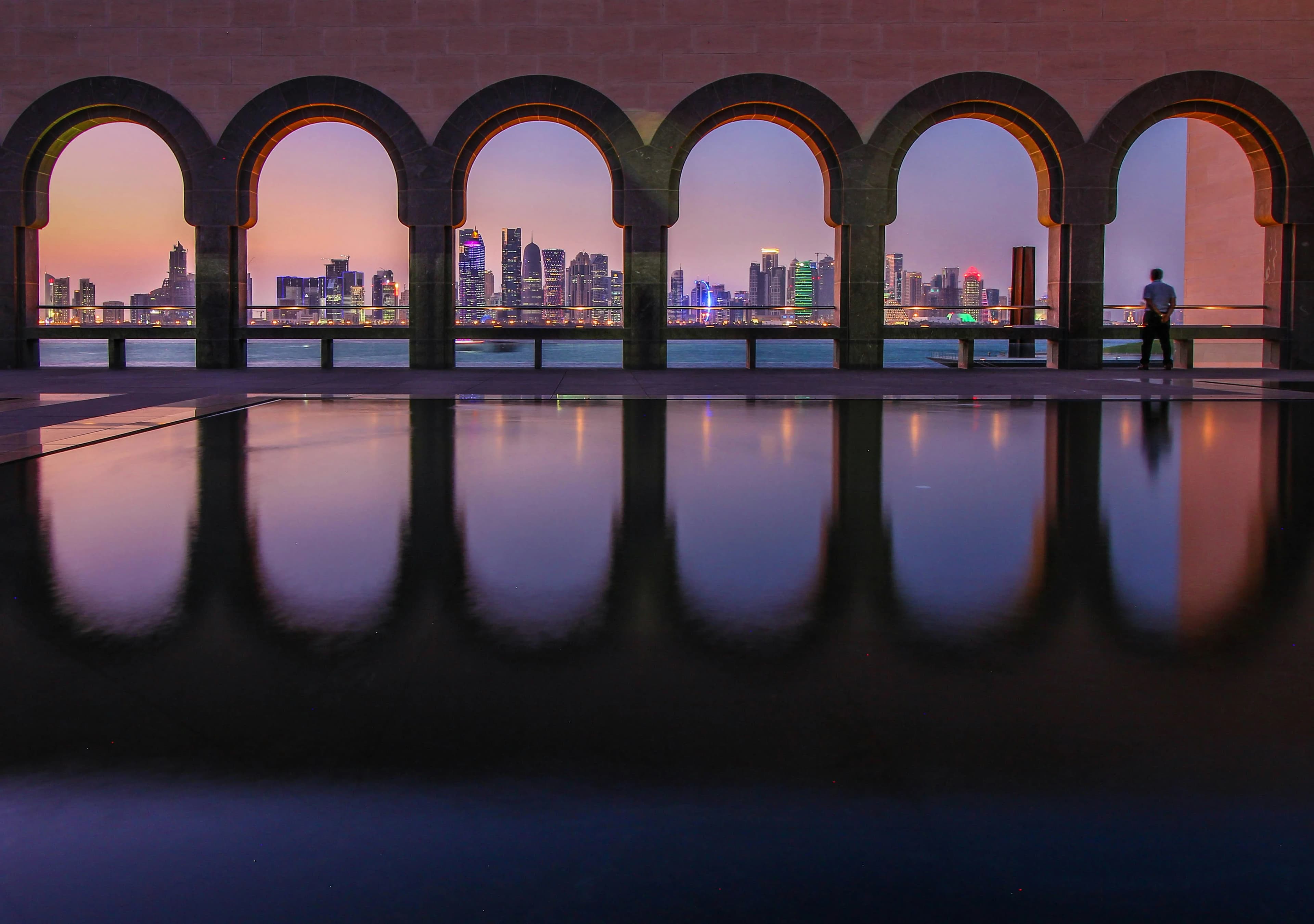
West Bay is Qatar's primary financial and diplomatic district, and it is here that the most architecturally assertive hotel towers are concentrated. Suites in this zone command views across the Arabian Gulf and the city's evolving skyline. The corniche promenade below structures daily life between morning and evening, and suites positioned along this axis benefit from a natural rhythm that the rest of the city does not offer. This is the appropriate base for business travelers and for those who want immediate proximity to the Museum of Islamic Art and the cultural quarter.
The Pearl-Qatar and Lusail
The Pearl is an artificial island developed since the mid-2000s, modeled loosely on Mediterranean marina typologies but executed at Gulf scale. Suites here operate within a different register: quieter, more residential, with direct access to waterfront dining and retail. Lusail, immediately to the north, is Qatar's newest planned city and represents the country's most forward-looking urban experiment. Hotels positioned in Lusail offer a perspective on how Qatar is constructing its next chapter, with generous suite formats designed for extended stays.
The desert interior
South of Doha, the landscape opens into the Qatari desert: flat, mineral, and austere. The Inland Sea, known locally as Khor Al Adaid, sits at the southeastern corner of the country where dunes meet tidal water. Specialist properties and desert camps in this zone offer a form of suite accommodation that prioritises solitude and landscape over urban amenity. The experiential contrast with Doha is absolute, and many travelers choose to anchor their stay in the city while allocating one or two nights to the desert.
When to visit Qatar for a luxury suite stay
Qatar's climate dictates a clear travel calendar. The primary season runs from October through April, when temperatures are moderate and outdoor engagement is possible. This window also aligns with Qatar's most significant cultural and sporting events, including the Qatar Prix de l'Arc de Triomphe equivalent in equestrian sport, international art fairs, and the Formula 1 Qatar Grand Prix, which returned to the permanent calendar and generates significant demand for premium suite inventory.
The summer months from May through September are characterised by extreme heat and high humidity. Occupancy at top properties drops sharply during this period, and rates often reflect the reduced demand. For travelers whose schedules allow flexibility, this window can offer access to flagship suites at more accessible price points, with the understanding that outdoor activity is largely confined to early morning or evening hours.
Ramadan, whose dates shift annually, brings a different quality to Qatar. The country's hospitality sector adapts formally: hotel restaurants restructure their service hours, and the atmosphere shifts toward a more contemplative register. Some travelers find this period offers an authentic encounter with Qatari culture that the high season cannot replicate.
Local luxury standards: understanding Qatar's hospitality framework
Qatar does not operate a labeling system analogous to France's Palace designation, but the country's hospitality sector is governed by the Qatar Tourism Authority's star classification framework, which applies rigorous standards at the five-star level. In practice, the properties that attract international luxury travelers are predominantly international branded hotels operating their flagship or ultra-luxury tiers: the names associated with the highest suite categories globally are well represented in Doha.
Beyond the international flags, Qatar has invested significantly in what might be called sovereign hospitality: properties conceived and positioned as national statements rather than purely commercial assets. These hotels carry a particular ambition in terms of scale, material quality, and service staffing ratios. Suites in these properties frequently exceed 150 square meters and are finished with materials sourced specifically for the project rather than drawn from a standard procurement catalogue.
Local culture shapes the suite experience in specific ways. Privacy is a structural consideration, not an amenity add-on. Many properties offer dedicated suite entrances, private elevator banks, and in-suite dining infrastructure that operates at the level of a full kitchen rather than a pantry. For travelers who prioritize discretion (whether for professional or personal reasons) Qatar's top-tier suite inventory is technically well-suited.
How to choose the best luxury suite in Qatar
The primary decision axis in Qatar is urban versus desert. Both experiences are legitimate and serve different travel intentions, but they require different booking logic. Urban suites in Doha involve considerations of floor height, orientation relative to the Gulf or the skyline, and proximity to cultural institutions. Desert and coastal properties involve considerations of access, exclusivity ratios, and the extent to which the natural landscape is integrated into the suite's spatial design.
Architecture type is a relevant filter. Qatar's hotel landscape is dominated by contemporary construction: glass towers, geometric volumes, and interiors that draw on both Gulf tradition and international contemporary design. There is limited inventory of historic properties in the European sense. Travelers seeking patinated, centuries-old architecture will not find it here. What Qatar offers instead is a precision of finish and a scale of ambition that functions as its own architectural register.
Suite categories in Qatar's leading properties range from junior suite formats at approximately 60 to 80 square meters through to full-floor presidential configurations. The intermediate categories (grand suites, diplomatic suites, and duplex formats) often represent the strongest value-to-experience ratio, particularly outside the October-to-February peak window.
Connectivity and service infrastructure matter distinctly in Qatar. The country's top hotel suites are calibrated for guests who require seamless professional function: high-capacity private networks, dedicated concierge personnel with government liaison capability, and access to private transport including helicopter transfers to desert locations.
Why a curated selection by La Suite matters in Qatar
Qatar's hotel market has expanded rapidly over the past two decades, and the volume of properties marketing themselves at the luxury tier has grown accordingly. Not all five-star inventory in Doha performs at the same level. Suite quality, service consistency, and the actual physical experience of occupying a room vary considerably between properties that carry nominally equivalent ratings.
La Suite's curation applies a filter that standard booking platforms cannot replicate. The selection process evaluates suite design, spatial quality, service architecture, and the overall coherence of the property experience. In a market where marketing language is uniformly ambitious, independent assessment becomes the operative tool for identifying where the experience actually matches the positioning. For Qatar specifically, where the density of premium-marketed properties is high and the differences between them are not always legible from standard listings, a curated selection by La Suite provides the clarity that the decision requires.